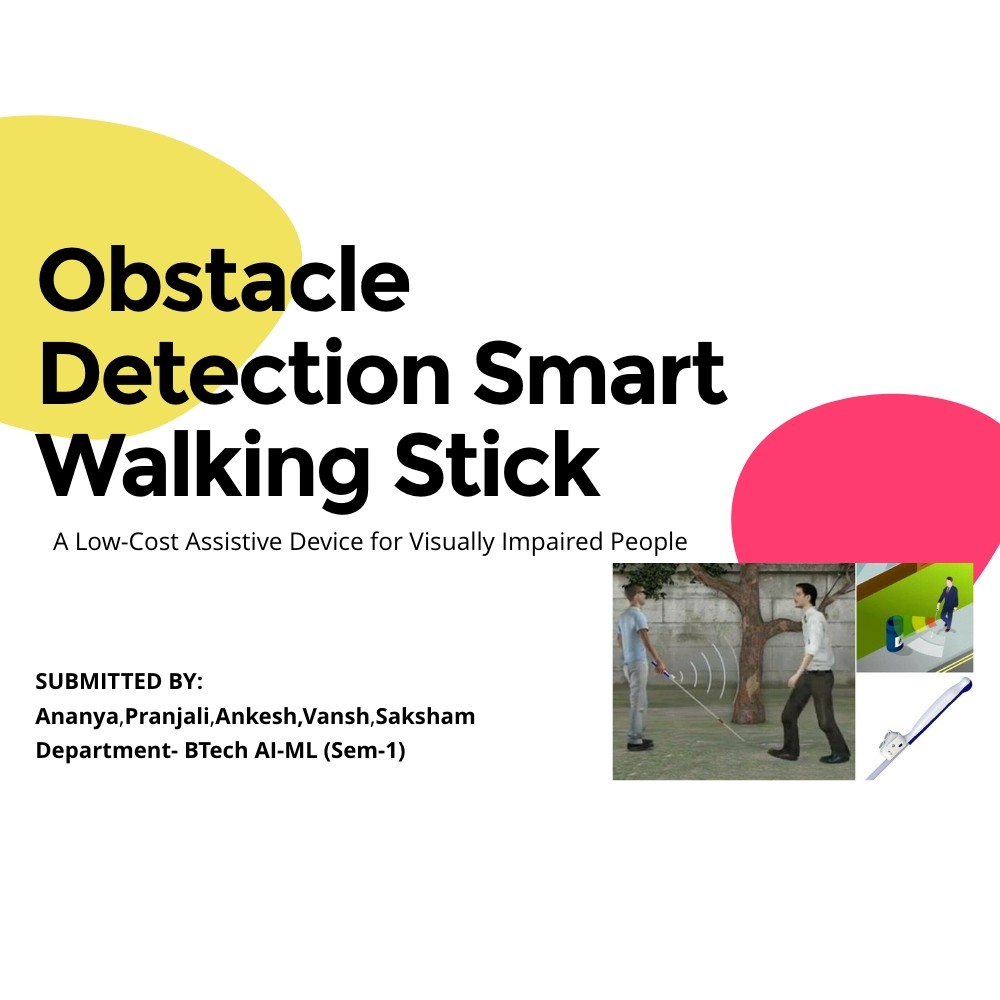
Obstacle Detection Smart Walking Stick
A Low-Cost Assistive Device for Visually Impaired People
SUBMITTED BY:
Ananya,Pranjali,Ankesh,Vansh,Saksham
Department- BTech AI-ML (Sem-1)
INTRODUCTION-
Visually impaired people often face difficulties while moving independently, especially when obstacles are present in their way.
Traditional walking sticks can help detect obstacles through physical contact, but they may not provide sufficient warning for obstacles located at a distance.
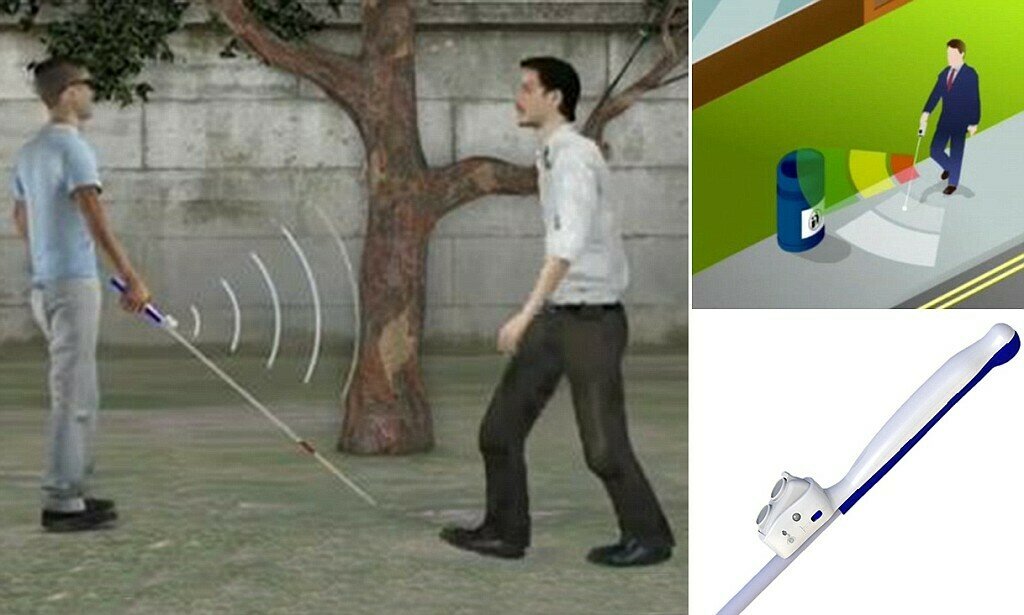
To overcome this limitation, we developed an Obstacle Detection Smart Walking Stick using an Arduino microcontroller and ultrasonic sensor.
The system detects nearby obstacles and provides audio and vibration alerts, helping the user identify potential obstacles without direct physical contact.
Problem Statement
Visually impaired people may encounter various obstacles such as:
1
2
- WALLS
- POLES
- FURNITURE
- OBJECTS
- STEPS
- BARRIERS
- OBJECTS PLACED IN WALKING PATHS
PROBLEM-
There is need for simple, affordable and portable assistive device that can detect obstacles before the user physically reaches them and provides an immediate warning.
- To design a low-cost smart walking stick for visually impaired people.
- To detect obstacles without requiring physical contact.
- To measure the approximate distance between the user and an obstacle.
- To provide an audible warning through a buzzer.
- To provide a vibration alert through a coin vibration motor.
- To develop a portable and easy-to-use prototype.
- To improve safety and independence during movement.
OBJECTIVES
PROPOSED SOLUTION
Our proposed system uses an ultrasonic sensor mounted on a walking stick to detect obstacles in front of the user.
The sensor sends ultrasonic waves and receives the reflected waves from an obstacle.
The Arduino processes the sensor signal and determines whether an obstacle is within the predefined detection range.
When an obstacle is detected:
🔊 Buzzer → Produces an audible warning
📳 Coin Vibration Motor → Produces a tactile warning
This allows the user to receive warnings through both sound and vibration.
COMPONENT
FUNCTION
Main microcontroller that processes sensor data and controls the alerts
Detects obstacles and measures their approximate distance
Provides an audible warning when an obstacle is detected
Provides vibration feedback to the user
Acts as an electronic switch for the vibration motor
Limits current and provide circuit protection
Used for electrical connections between components
Used for assembling and testing circuit
ARDUINO
ULTRASONIC SENSOR
BUZZER
COIN VIBRATION MOTOR
TRANSISTOR
RESISTOR
JUMPER WIRES
BREADBOARD
WORKING PRINCIPLE
The working of the smart walking stick can be explained in the following steps:
- The battery supplies power to the circuit.
- The switch turns the system ON or OFF.
- The ultrasonic sensor continuously sends ultrasonic waves toward the front.
- When the waves hit an obstacle, they are reflected back toward the sensor.
- The sensor calculates the distance based on the time taken for the echo to return.
- The Arduino receives and processes this distance information.
- If an obstacle is detected within the predefined range, the Arduino activates the buzzer and vibration motor.
- The user receives an immediate warning through sound and vibration.
Distance= (speed of sound* time of flight/2)
CIRCUIT CONNECTIONS
The major electrical connections in the prototype are:
- The ultrasonic sensor is connected to the Arduino for obstacle detection.
- The Arduino receives the sensor's trigger and echo signals.
- The buzzer is connected to an Arduino output to generate an audio alert.
- The coin vibration motor is controlled through a transistor, which allows the Arduino to drive the motor safely.
- A resistor is used where required for current limiting and circuit protection.
- The battery supplies power to the system through an ON/OFF switch.
- Jumper wires and a breadboard are used for temporary circuit assembly and testing.
ADVANTAGES
- Low Cost: Uses easily available electronic components.
- Contactless Detection: Obstacles can be detected before physical contact.
- Dual Alert System: Provides both sound and vibration feedback.
- Portable: Can be integrated into a lightweight walking stick.
- Easy to Operate: Requires minimal user interaction.
- Low Power Requirement: Suitable for battery-powered operation.
- Simple Design: Arduino-based control makes the prototype easy to modify and test.
- Expandable: Additional sensors and features can be added in future versions.
APPLICATIONS AND FUTURE SCOPE
APPLICATIONS
-
Assistive mobility for visually impaired people
-
Indoor navigation assistance
-
Outdoor walking assistance
-
Detection of nearby obstacles in walking paths
-
Educational demonstration of embedded systems and assistive technology
FUTURE SCOPE
The prototype can be further improved by adding:
-
Multiple ultrasonic sensors for wider obstacle detection
-
Water detection sensors
-
GPS for location tracking
-
Emergency SOS functionality
-
Voice-based alerts
-
Rechargeable battery and improved power management
-
Bluetooth or mobile connectivity
-
AI/ML-based environmental recognition using a camera
CONCLUSION
The Obstacle Detection Smart Walking Stick is a low-cost assistive technology prototype designed to improve the safety and mobility of visually impaired people.
By combining an ultrasonic sensor, Arduino, buzzer and vibration motor, the system can detect nearby obstacles and provide immediate audio and tactile feedback.
The project demonstrates how basic electronics and embedded systems can be used to develop practical solutions for real-world problems.
With further development, the system can be enhanced using additional sensors, GPS, voice assistance and AI-based object recognition.

Copy of Palette
By Ananya