How to NOT write CSS
The story of
Functional CSS benefits
Andrii Bohdanov
GitHub: https://github.com/AndrewBogdanovTSSLinkedIn: https://www.linkedin.com/in/andrii-bohdanov-0828a02b/


Principal Frontend Engineer at VF Corp
Location: Lugano, Switzerland
20 years of experience in Web Development
The history behind Functional CSS
How did we even get here?
Fundamental Articles
you need to read
Getting Started
1. Create Nuxt project
3. Add UnoCSS module to nuxt.config.ts:
pnpm create nuxt fun-cssexport default defineNuxtConfig({
modules: ['@unocss/nuxt']
})4. (Optional) Create a uno.config.ts file:
import { defineConfig } from 'unocss'

export default defineConfig({
  // ...UnoCSS options
})
2. Install Required Packages
pnpm i -D unocss @unocss/nuxtCloning the repo
1. Clone the project
3. Enjoy :)
https://github.com/AndrewBogdanovTSS/fun-css2. Install dependencies
pnpm iPerformance benefits of Functional CSS
-
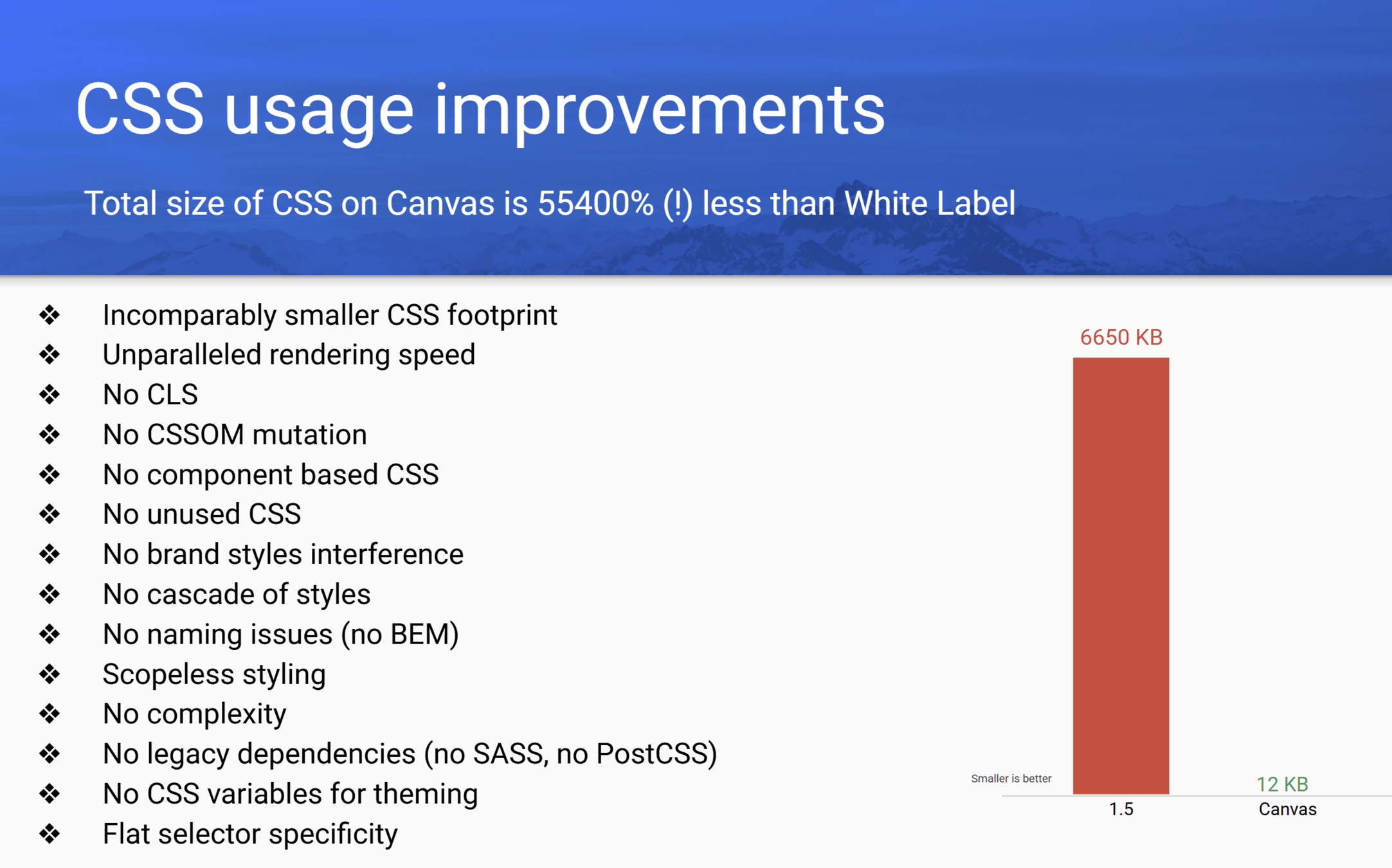
No XHR calls for CSS component chunks
-
Single CSS file (that can also be inlined directly in HTML)
-
Highly optimized CSS bundle
-
No FOUC
Optimized bundle delivery
Performance benefits of Functional CSS
Optimized bundle delivery
Rendering benefits of Functional CSS
-
CSS to SS: elimination of cascade complexities
-
Avoids CSSOM mutation when components mount/unmount into the DOM.
-
Changes only affect the relevant DOM subtree.
-
Faster rendering in component-heavy SPAs
Faster Rendering
Build-time benefits of UnoCSS
-
On-Demand Generation
-
Minimal Core Design
-
No runtime analysis or DOM dependency
-
Single-Pass Scanning
-
Smart Caching
-
Parallel Processing
Lightning-Fast Builds
Scalability benefits
-
Token-Driven Styling
-
Consistent Naming
-
Reusable Patterns
-
Design Constraints
-
Reduced Custom CSS
-
Centralized Configuration
-
Design-to-Code Parity
CSS that describes Design System
OOCSS vs FCSS
| Comparison Aspect | Traditional CSS | Functional CSS |
|---|---|---|
| Context switching | High - Separate CSS files/sections | Low - Inline utility classes in markup |
| Support Cost | High - global scope, specificity issues | Low - isolated scope, no specificity |
| Runtime Performance | Low - Manual optimization required, some optimizations not possible | High: Auto-treeshaking, isolated utilities, no side effects, no CSS chunks |
| Buildtime Performance | Slow - usually limited by a compiler (SASS/SCSS/PostCSS) | Fast: No parsing, no AST, no scanning |
| Refactoring | Risky - cascade and HTML structure dependencies | Safe - no cascade, no structural dependencies |
| Learning Curve | High: CSS methodologies + Preprocessors (BEM/OOCSS/SMACSS/SASS/LESS/etc.) | Medium: Utility API memorization |
| Design Consistency | Manual enforcement needed | Enforced via constrained utilities |
| Initial Loading | Larger CSS payload (unused rules common) | Smaller - JIT eliminates unused styles |
| Abstraction Level | High - abstracted class names | Low - 1:1 CSS property mapping |
In Summary
Conclusion
Embrace functional CSS for better performance and control.
Ask your questions
Thanks you!
Copy of How to not write CSS
By Andrey