Corentin Cadiou
CNRS @ IAP, Paris
Early Milky-Way galax(ies) in the Megatron simulations
Co-Is: Harley Katz, Martin Rey
Collaborators: Oscar Agertz, Jeremy Blaizot, Alex J. Cameron, Nicholas Choustikov, Julien Devriendt, Uliana Hauk, Gareth Jones, Taysun Kimm, Isaac Laseter, Aayush Saxena, Sergio Martin-Alvarez, Kosei Matsumoto, Camilla T. Nyhagen, Autumn Pearce, Francisco Rodriguez-Montero, Victor Rufo-Pastor, Joki Rosdahl, Adrianne Slyz, Richard Stiskalek, Anatole Storck, Wonjae Yee
Typical path from sims to observations

Lots of assumptions
(equilibrium, geometry, element abundances, …)
\(\rho, T, Z,v\)
sometimes \(n_\mathrm{H}, n_{\mathrm{H^+}}, n_\mathrm{He}, n_\mathrm{He^+},n_\mathrm{He^{2+}},n_\mathrm{e^{-}}\)
Physical space
Observable
Megatron suite of simulations
- On-the fly radiative transfer,
- 81-ions non-equilibrium thermochemistry,
- Chemical enrichment from SN and stellar winds,
- Milky-Way progenitor,
- 4 “high-resolution” sims at \(10\,\mathrm{pc}\) comoving,
- 3+1 “low-\(z\)” sims at \(23\,\mathrm{pc}\) proper.
\(\Sigma\)HI
\(\Sigma\)HII
\(\Sigma\)MgII
\(\Sigma\)OII
Mocks in absorption:
Main object, \(z=4\), raw file outputs, no postprocessing
Mocks in emission:
Main object, \(z=9\), w/ nebular cont. Pyneb (Luridiana+15) & coll. Chianti (Del Zanna+21)
The Megatron suite of simulations

The Megatron suite of simulations
4 High-z ISM
The Megatron suite of simulations
4 High-z ISM
3+1 "low"-z CGM
State of the CGM of a MW progenitor at \(z \approx 3-4\)

CGM at \(z \approx 3-4\)

CGM at \(z \approx 3-4\)

CGM at \(z \approx 3-4\)
CGM at \(z \approx 3-4\)
Is the CGM in equilibrium?
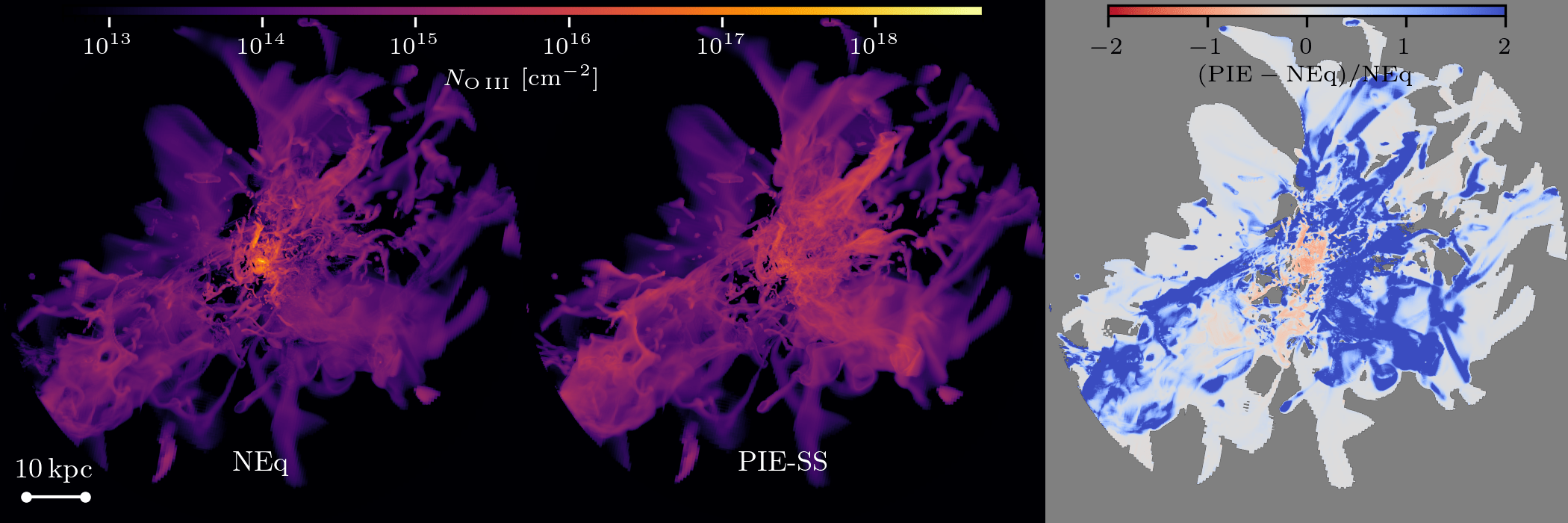
Relax to photo-ionisation equilibrium (PIE)
No local radiation field, no time-dependence, assume \(n_\mathrm{e}\) dominated by primordial species, self-shielding
\[\frac{\mathrm{d}n_i}{\mathrm{d}t} = 0 = \text{Recomb} + \text{Collisional} + \text{UVB}\]
CGM at \(z \approx 3-4\)
Is the CGM in equilibrium?

CGM at \(z \approx 3-4\)
Is the CGM in equilibrium?

CGM at \(z \approx 3-4\)
Is the CGM in equilibrium?
NEq.
PIE
Assuming PIE ⇒ biased towards colder/denser gas
\(T\)
\(n_\mathrm{H}\)
CGM at \(z \approx 3-4\)
Is the CGM in equilibrium?

\(\pm0.5\,\mathrm{dex}\)
CGM at \(z \approx 3-4\)
Is the CGM in equilibrium?
Non-equilibrium effects:
\(\Delta(T, n_\mathrm{H}) \sim 0.2-0.5\,\mathrm{dex}\)
⇒ \(\Delta L \sim 1\,\mathrm{dex}\)
for some lines
CGM at \(z \approx 3-4\)
CGM out of equilibrium: why?

40 kpc
- Local radiation dominate locally over UVB
Anisotropic effects
- Recombination lag
\(t_\mathrm{cool} \ll t_\mathrm{rec}\), worse with time
CGM at \(z \approx 3-4\)
CGM out of equilibrium: why?
- Local radiation dominate locally over UVB
Anisotropic effects
- Recombination lag
\(t_\mathrm{cool} \ll t_\mathrm{rec}\), worse at low \(z\)

High-\(z\) kinematics
ALMA-like observations (at 0.1")

\(L=\textcolor{green}{\epsilon(n_\mathrm{X},T)} \textcolor{red}{n_\mathrm{X}n_\mathrm{e}}\bigotimes\mathrm{PSF}\)
Tabulated
From simulation

PRELIMINARY RESULTS

PRELIMINARY RESULTS
High-\(z\) cold disks?

\(M_\star \approx 10^{10}\,M_\odot, \quad z=4,\quad r>R_\mathrm{vir}/4\)
Overall trend:
lower-ionization lines damped with neq
\(\mathrm{CII\, 158µm}\)
\(\mathrm{OIII\, 88µm}\)
Take-home messages
- Megatron simulation suite
200,000+ spectra in 4 “ISM” runs (\(z\gtrapprox 8\)) ⇒ Katz, CC+ Wednesday
3+1 “CGM” runs (\(z\gtrapprox 3.5\)) ⇒ CC+ Wednesday
Link to low-\(z\) UFDs ⇒ Rey, ..., CC+ Wednesday
Properties of Pop. III stars ⇒ Storck, ..., CC+ Thursday
Sensitivity of line diagnostics to subgrids ⇒ Choustikov, ..., CC+ Thursday
Origin of steep \(\beta\) slopes ⇒ Katz, CC+ Thursday
- CGM (incl. inner CGM!) is out-of-equilibrium
Assuming PIE leads to 0.5 dex (median), and factors of
2-3× on individual line of sight
- High-\(z\) kinematics
Very easy to make ALMA-like maps (or JWST IFU)
from \(z=3-15\) and \(M_\star\lessapprox 10^{10}\,M_\odot\)

Model [i]
- Based on RAMSES-RT (Rosdahl+13)
- Out-of-equilibrium chemistry (Katz 23)
Primordial species: \(\text{H~{\small I}-{\small II}}\), \(\text{He~{\small I}-{\small III}}\), \(e^{-}\)
Metal ions: \(\text{C~{\small I}-{\small VI}}\), \(\text{N~{\small I}-{\small VII}}\), \(\text{O~{\small I}-{\small VIII}}\), \(\text{Ne~{\small I}-{\small X}}\), \(\text{Mg~{\small I}-{\small X}}\), \(\text{Si~{\small I}-{\small XI}}\), \(\text{S~{\small I}-{\small XI}}\) & \(\text{Fe~{\small I}-{\small XI}} \)
Molecules: \(\text{H}_2\) & \(\text{CO}\) - Dust model (Rémy-Ruyer+14)
Assuming dust-to-gas ratio - Heating & Cooling
photoheating, photoelectric heating, excitation/dissociation heating, primordial, dust recombination, dust-gas collisions, metal lines- \(\text{C~{\small I}}\), \(\text{C~{\small II}}\), \(\text{N~{\small II}}\), \(\text{O~{\small I}}\), \(\text{O~{\small III}}\), \(\text{Ne~{\small II}}\), \(\text{Si~{\small I}}\), \(\text{Si~{\small II}}\), \(\text{S~{\small I}}\), \(\text{Fe~{\small I}}\), \(\text{Fe~{\small II}}\)


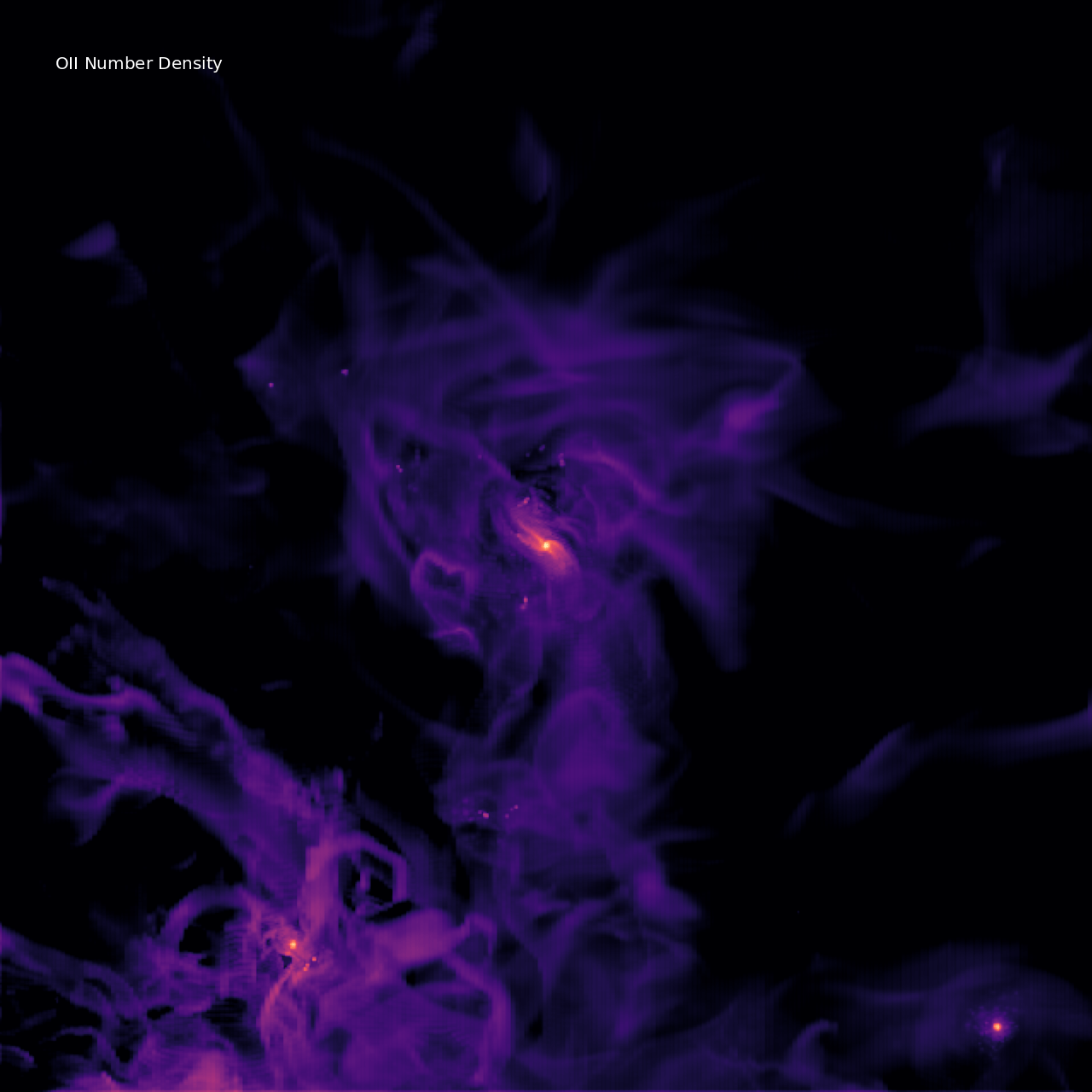


\(\text{O\small{II}}\)
\(\text{O\small{I}}\)
\(\text{N\small{I}}\)
\(\text{Mg\small{II}}\)
\(\text{Ne\small{II}}\)
\(\text{CO}\)
\(\rho\)
\(v_r\)
\(\text{O\small{III}}\)
Model [ii]
-
Turbulence-based star formation (Padoan & Nordlund 11, Agertz+21)
\(\dot{\rho_\star} = \varepsilon_\star\rho/t_\mathrm{ff}\)- if \(Z<10^{-6}Z_\odot\) ⇒ Pop. III
- if \(Z\geq10^{-6}Z_\odot\) ⇒ Pop. I & II, Kroupa
- \(M_\star = 500\,\mathrm{M}_\odot\)
\(M_{\star,\rm III} \sim 100\,\mathrm{M}_\odot\) - Feedback (Agertz+21; Rey+23)
core-collapse SN, type Ia, winds + HN (Nomoto+06). - Yields (Limongi & Chieffi 18)
AGB winds (Ritter+18)
Model [iii]
- MW analogue @ \(z=0\)
- Genetically engineered to form earlier
ICs generated withgenetIC - 2 main runs
- constant physical \(\Delta x_\mathrm{min} \approx 20-40\,\mathrm{pc}\)
3 runs with ≠ ICs -
constant comoving \(\Delta x_\mathrm{min}(z=2) = 20\,\mathrm{pc}\)
\(\Delta x_\mathrm{min}(z=5)=10\,\mathrm{pc}\)
\(\Delta x_\mathrm{min}(z=14)=4\,\mathrm{pc}\)
3 runs: efficient feedback, variable IMF, hypernova
- constant physical \(\Delta x_\mathrm{min} \approx 20-40\,\mathrm{pc}\)

- Early forming MW mass galaxy
- \(1.6\times 10^{4}\mathrm{M}_\odot\) DM, \(500\, \mathrm{M}_\odot\) Pop. II stars, individual Pop III stars, \(1\, \mathrm{pc}\) resolution at first star formation
- IMF sampled chemical enrichment from individual stars for all relevant elements
- SN (CC, Ia, HN, PISN), Winds → follows Vintergatan (validated for MW galaxies at z = 0)
- 81 species chemistry coupled to 8 bin RT
- PRISM ISM model
- Enhanced resolution in the CGM
- Calibration sims with IMF variations and physical model variations

Introducing MEGATRON
Processes that control ion and molecular properties:
- Collisional, photo, cosmic-ray ionization
- Radiative, dielectronic, dust recombination
- Charge exchange
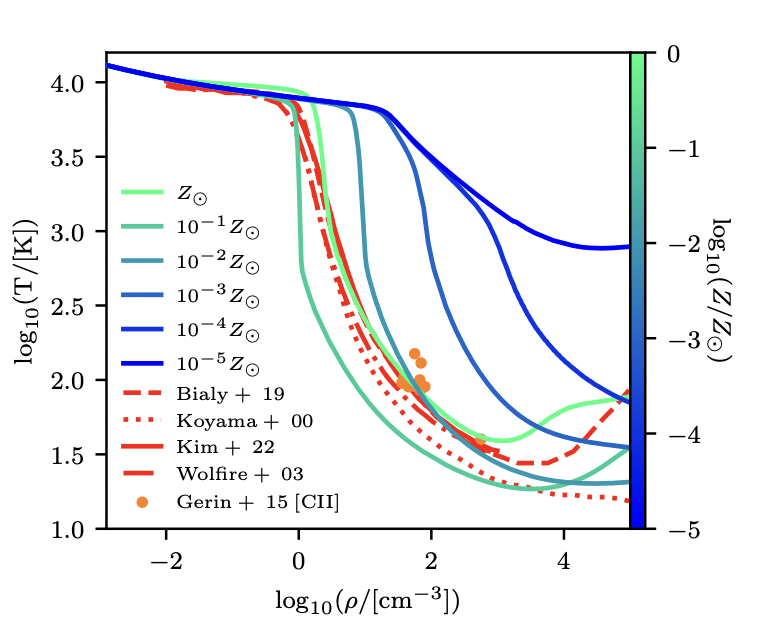
RAMSES-RTZ + PRISM: Non-equilibrium chemistry coupled to on-the-fly radiative transfer
Processes that control gas temperature:
- Cosmic-ray, photo, photo-electric, H2, dust heating
- Primordial, \(\mathrm{H}_2\), CO, metal, dust* recombination, dust-gas collisional cooling
- Adiabatic (expansion), shocks (e.g. SN, turbulence), gravitational, etc.
Katz, CC 2024
\(\Sigma\)OI
\(\Sigma\)OII
\(\Sigma\)OIII
Create “twin” simulation relaxed to photo-ionization equilibrium (PIE):
- Haardt-Madau UV bg,
- Local Habing field (\(6-13.6\,\mathrm{eV}\)),
- Dust-to-gas ratio (Rémy-Ruyer+14),
- Iterate until
\(\dfrac{\mathrm{d} n_{X_i}}{\mathrm{d} t} = 0\quad\) at fixed \(T\).
Code: Katz & CC, in prep.
Electron abundances


\(M_\star \approx 10^{10}\,M_\odot, \quad z=4\)
Effect on \(\mathrm{He\,III}\)
Data within \(r>R_\mathrm{vir}/4\)


\(M_\star \approx 10^{10}\,M_\odot, \quad z=4\)


Effect on \(\mathrm{He\,II}\)
\(M_\star \approx 10^{10}\,M_\odot, \quad z=4\)


Overall trend:
high-ionization lines boosted with neq
\(M_\star \approx 10^{10}\,M_\odot, \quad z=4,\quad r>R_\mathrm{vir}/4\)

\(M_\star \approx 10^{10}\,M_\odot, \quad z=4,\quad r>R_\mathrm{vir}/4\)
Overall trend:
intermediate-ionization lines unchanged
HeII @ (PIE)
\(M=1.2\,10^9\,\mathrm{M_\odot}\)
HeII @ (neq)
\(M=8.8\,10^8\,\mathrm{M_\odot}\)
+\(30\%\)
[CIII]\(\lambda\lambda 1907\rm Å\) @ (PIE)
[CIII]\(\lambda\lambda 1907\rm Å\) @ (neq)
[CIII]\(\lambda\lambda 1907\rm Å\) @ (PIE)
[CIII]\(\lambda\lambda 1907\rm Å\) @ (neq)
[OIII]\(\lambda\lambda 1664\rm Å\) @ (PIE)
[OIII]\(\lambda\lambda 1664\rm Å\) @ (neq)
[OIII]\(\lambda\lambda 1664\rm Å\) @ (PIE)
[OIII]\(\lambda\lambda 1664\rm Å\) @ (neq)
Cooling length refinment
Refining where
\( \Delta x > 2 \sqrt{\dfrac{P_\mathrm{th}}{\rho}}\times {t_\mathrm{cool}},\)
(Rey+23)
- up to \(80\,\mathrm{pc}\)
- turned on at key moments


Cooling length refinment
\(+120\,\mathrm{Myr}\)


Quasi-Lagrangian + Jeans
Quasi-Lagrangian + Jeans + CGM ref


Most massive galaxy, edge-on


Most massive galaxy, face-on
results
Stacked profiles
36 galaxies @ \(z=10\)
\(8.3\leq\log(M_\star/\mathrm{M}_\odot)\leq 10.0\)
⚠️ PRELIMINARY ⚠️
⚠️ PRELIMINARY ⚠️
⚠️ PRELIMINARY ⚠️
⚠️ PRELIMINARY ⚠️
⚠️ PRELIMINARY ⚠️
⚠️ PRELIMINARY ⚠️
⚠️ PRELIMINARY ⚠️
⚠️ PRELIMINARY ⚠️
⚠️ PRELIMINARY ⚠️
⚠️ PRELIMINARY ⚠️
⚠️ PRELIMINARY ⚠️
⚠️ PRELIMINARY ⚠️
⚠️ PRELIMINARY ⚠️
⚠️ PRELIMINARY ⚠️
⚠️ PRELIMINARY ⚠️


Only gas within \(\pm0.5\,\mathrm{kpc}\) height
All gas

Does non-equilibrium cooling matter?
Switching to equilibrium cooling
- same stellar mass, but
- ISM has much less cold gas


Katz 22
Results from Eddie

Stellar mass vs. Halo mass
CP not too bad compared to Vintergatan (Rey+23)
CC underregulates
Constant comoving
Constant physical


Varying IMF to the rescue?
Same model, but high-\(z\) dwarf \(M_\mathrm{dm}=10^{9}\,\mathrm{M}_\odot\) at \(z=6\)
Cooling length refinment
Refining where
\( \Delta x > 2 \sqrt{\dfrac{P_\mathrm{th}}{\rho}}\times \dfrac{1}{\Lambda_\mathrm{net}},\)
(Rey+23)
- up to \(80\,\mathrm{pc}\)
- turned on at key moments
\(z=5.8\)
\(z=5.8(+2\,\mathrm{Myr})\)
\(20\,\mathrm{kpc}\)

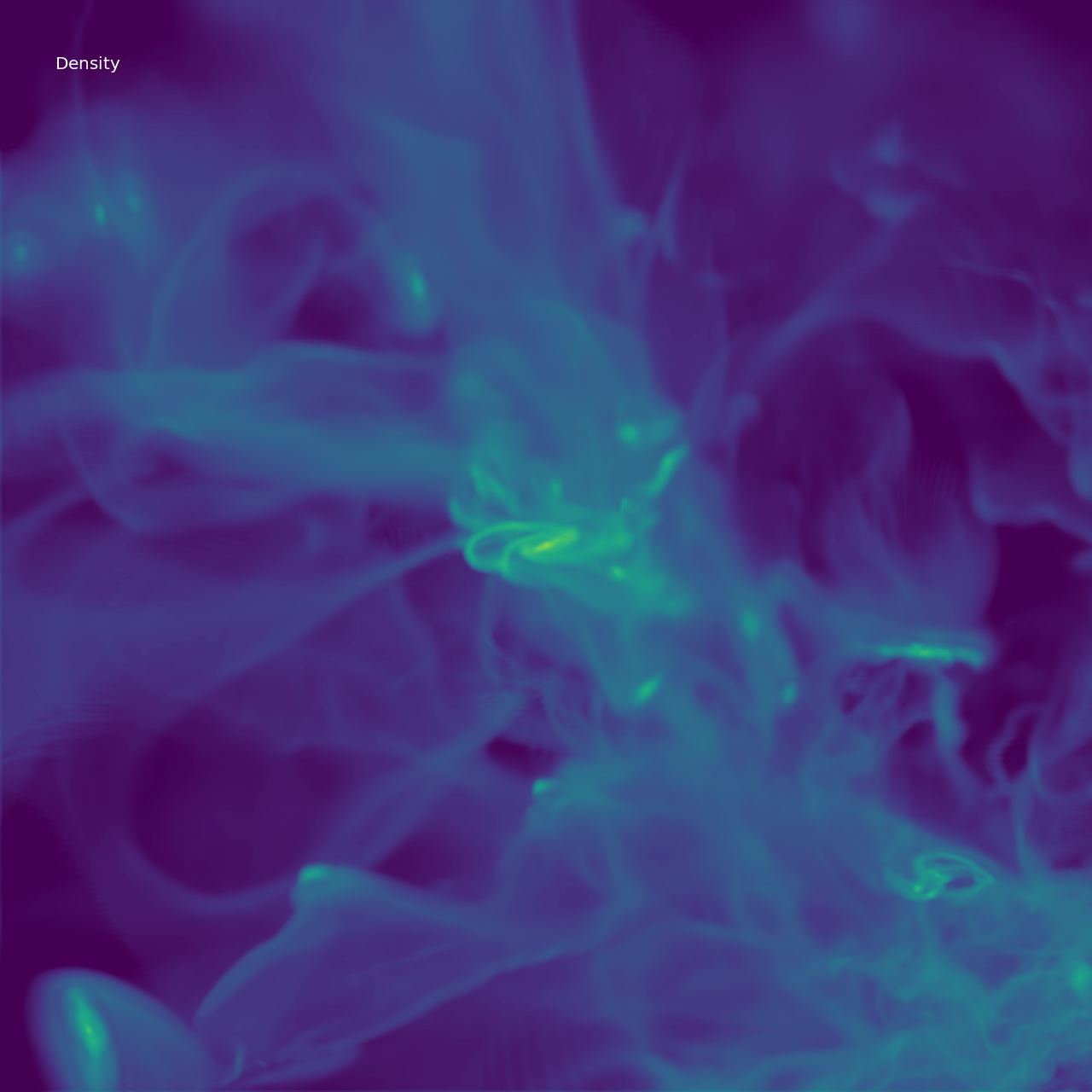
Cooling length refinment


How much does it cost?
\(\times 3\)
\(\times 70\)!
Conclusions
It works and stay tuned for results?


Early Milky-Way in the Megatron sims
By Corentin Cadiou