Corentin Cadiou
Framing the Big Picture of Galaxy Star Formation Quenching with JWST & Euclid 2024
Postdoc @ Lund University
Soon “Chargé de recherche” CNRS @ IAP, Paris


Mini-quenching of high-\(z\) \(\gtrsim 10^7\,\mathrm{M}_\odot\) halos & ISM
Side-B: peeking into emission lines
Insights from the MEGATRON* simulation — with H. Katz & M. Rey


*MEGATRON: TransforMing Galaxy Formation by REsolvinG the Non-Equilibrium Chemistry And TheRmOdyNamics of the ISM and CGM
Detailed modelling of the ISM and emission lines to constrain (the interplay between) feedback and star formation

Spectra contain a huge amount of information
SFR
SFH
Katz+23
Spectrum of a \(z=8.5\) galaxy
U
Z
Katz+23
*geometry, equilibrium, ISM properties near stars, element abundances

3. Mock spectra &
images

2. Post-processing*

1. Simulation

From intrinsic…
… to observed


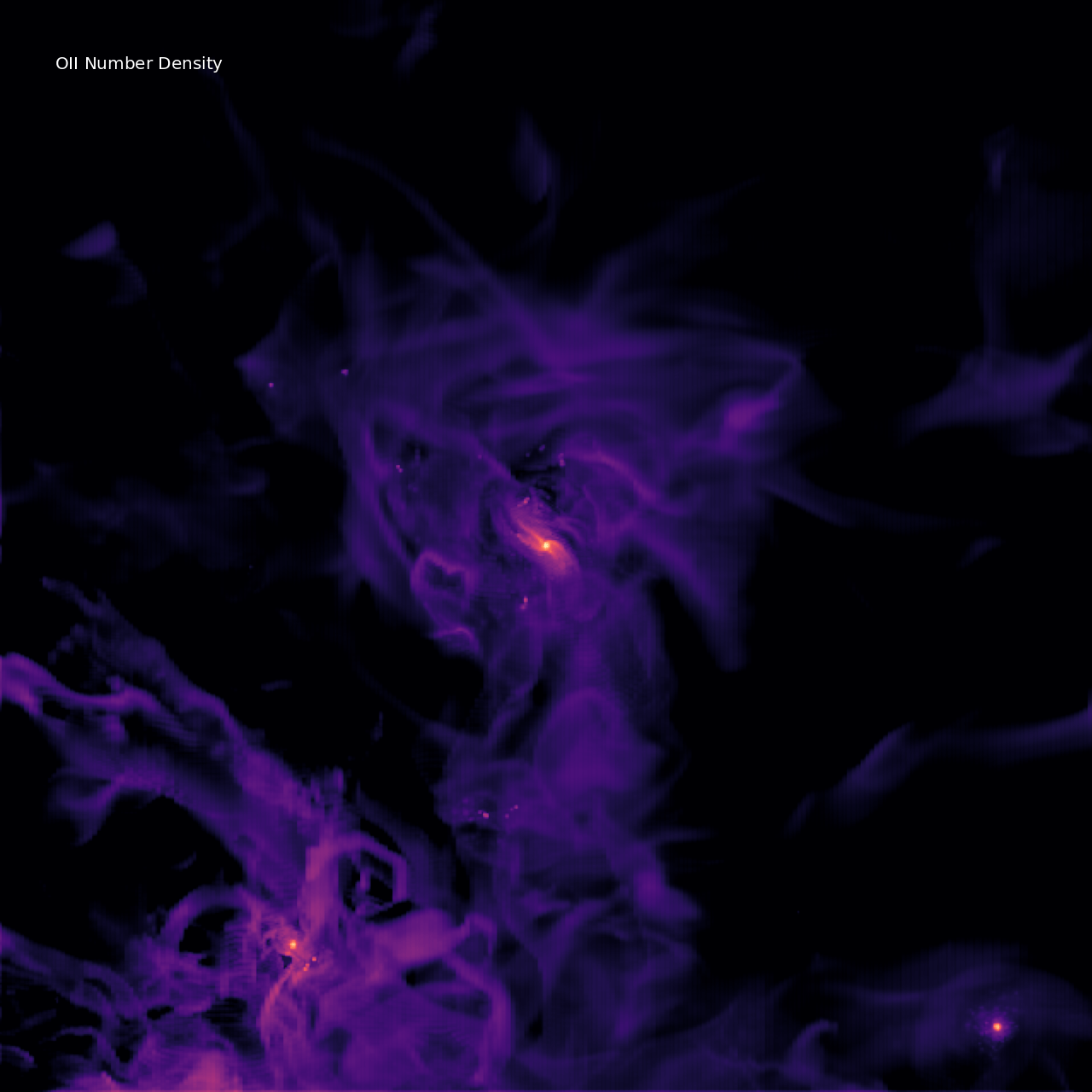


\(\text{O\small{II}}\)
\(\text{O\small{I}}\)
\(\text{N\small{I}}\)
\(\text{Mg\small{II}}\)
\(\text{Ne\small{II}}\)
\(\text{CO}\)
\(\rho\)
\(v_r\)
\(\text{O\small{III}}\)
Megatron model [i]
- Based on RAMSES-RT (Rosdahl+13)
- Out-of-equilibrium chemistry (Katz 23)
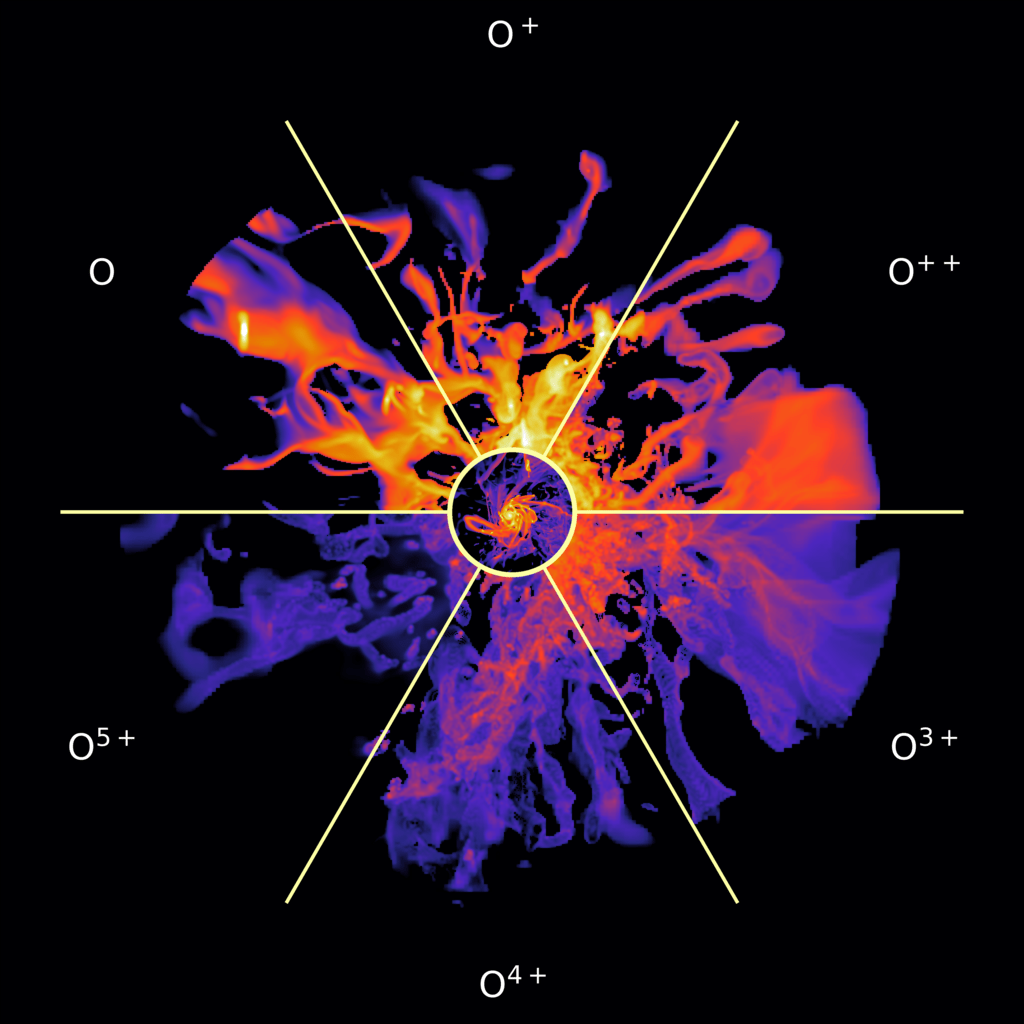
Primordial species: \(\text{H~{\small I}-{\small II}}\), \(\text{He~{\small I}-{\small III}}\), \(e^{-}\)
Metal ions: \(\text{C~{\small I}-{\small VI}}\), \(\text{N~{\small I}-{\small VII}}\), \(\text{O~{\small I}-{\small VIII}}\), \(\text{Ne~{\small I}-{\small X}}\), \(\text{Mg~{\small I}-{\small X}}\), \(\text{Si~{\small I}-{\small XI}}\), \(\text{S~{\small I}-{\small XI}}\) & \(\text{Fe~{\small I}-{\small XI}} \)
Molecules: \(\text{H}_2\) & \(\text{CO}\)
- Dust model (Rémy-Ruyer+14)
Assuming dust-to-gass ratio
- Heating & Cooling out of equilibrium
photoheating, photoelectric heating, excitation/dissociation heating, primordial, dust recombination, dust-gas collisions, metal lines- \(\text{C~{\small I}}\), \(\text{C~{\small II}}\), \(\text{N~{\small II}}\), \(\text{O~{\small I}}\), \(\text{O~{\small III}}\), \(\text{Ne~{\small II}}\), \(\text{Si~{\small I}}\), \(\text{Si~{\small II}}\), \(\text{S~{\small I}}\), \(\text{Fe~{\small I}}\), \(\text{Fe~{\small II}}\) @ \(T<10^4\,\mathrm{K}\)
- CLOUDY tables @ \(T>10^4\,\mathrm{K}\)
Megatron model [ii]
- Turbulence-based star formation (Padoan & Nordlund 11, Agertz+21)
\(\dot{\rho_\star} = \varepsilon_\star\rho/t_\mathrm{ff}\)- if \(Z<10^{-6}Z_\odot\) ⇒ Pop. III
- if \(Z\geq10^{-6}Z_\odot\) ⇒ Pop. I & II, Kroupa
- \(M_\star = 500\,\mathrm{M}_\odot\)
\(M_{\star,\rm III} \sim 100\,\mathrm{M}_\odot\)
- Feedback (Agertz+21; Rey+23)
core-collapse SN, type Ia, winds + HN (Nomoto+06).
- Yields (Limongi & Chieffi 18)
AGB winds (Ritter+18)
Simulated objects
- MW analogue @ \(z=0\)
- Genetically engineered to form earlier
ICs generated withgenetIC
- 2 main runs
- constant physical \(\Delta x_\mathrm{min} \approx 20-40\,\mathrm{pc}\)
-
constant comoving \(\Delta x_\mathrm{min}(z=2) = 20\,\mathrm{pc}\)
\(\Delta x_\mathrm{min}(z=5)=10\,\mathrm{pc}\)
\(\Delta x_\mathrm{min}(z=14)=4\,\mathrm{pc}\)

fiducial:
few JWST targets


early-forming:
many targets
\(z>8\)
Side quest:
if you have an unusual formation history to test, we can simulate it!

(side quest): causal origin of (morphological) quenching
\(M_\star = 10^{11}\,\mathrm{M_\odot}\) @ \(z=2\) galaxy
different ang. mom history (ask me for details!)
Low tides
High tides
\(\mathcal{B}\searrow\)
\(R_\mathrm{eff} \nearrow \)
\(v/\sigma\nearrow\)
See Cadiou+21a, and Cadiou+21b; Storck, CC+24


1. Single-halo setup: massive dwarf
\(M_\mathrm{DM} \approx 10^{8}\,\mathrm{M_\odot}\)
to \(z=6\)


Merger
1. Single-halo setup: massive dwarf
\(M_\mathrm{DM} \approx 10^{9}\,\mathrm{M_\odot}\) at \(z=6\)


Strong feedback
⇒ removes cold gas
⇒ \(\sim100\,\mathrm{Myr}\) mini-quenching
Increasing feedback strength

\(T<500\,\mathrm{K}\)
\(2\times 10^{51}\,\mathrm{erg/SN}\)
\(4\times 10^{51}\,\mathrm{erg/SN}\)
\(5\times 10^{51}\,\mathrm{erg/SN}\)
1. Single-halo setup: varying \(E_\mathrm{SN}\)


With hypernovae
With Ly\(\alpha\) rad. pressure
1. Single-halo setup: varying feedback channels
⇒ Stronger feedback heats up/expells cold gas \(T<500\,\mathrm{K}\)

1. Single-halo setup: signature of FB?
High \(T_\mathrm{e^-}\)
Lower \(T_\mathrm{e^-}\)
⇒ Exciting opportunities to relate
ISM to feedback with NIRSPEC!
1. Single-halo setup: signature of FB?
⇒ Exciting opportunities to relate
ISM to feedback with NIRSPEC!

Varying feedback
Varying star formation recipe
See Nicolas' talk yesterday
2. Quenching of more massive halos?
Focus : halos \(M_\mathrm{DM} = 10^8-10^{10}\,\mathrm{M_\odot}\)
at \(z=10\)


⇒ Mini-quenching
\(M_\star \lesssim 10^8\,\mathrm{M_\odot}\) for \(\sim 50-100\,\mathrm{Myr}\)
iff feedback is strong enough
Increasing mass
Mini-quenching? Napping?
3. Even more massive?
Focus : halos \(M_\mathrm{DM} = 10^{10}-10^{11}\,\mathrm{M_\odot}\) at \(z=6\)


⇒ No SNe quenching in this mass range?


SNe quenching - SPICE simulation (Bhagwat+24)
\(M_\mathrm{DM}=3\times 10^{11}\,\mathrm{M}_\odot\) at \(z=5\)
\(M_\star= 10^{8.5}\,\mathrm{M}_\odot\) at \(z=5\)
Plenty others in bursty/HN channels
3. Massive end : peeking into other sims


AGN quenching - FLARES simulation (Lovell+20)
AGN quenching - THESAN simulation (Kannan+22) (no ISM)
Conclusions
- Low-mass quenching within our uncertainties
Strong SNe (Hypernovæ, top-heavy IMF, Ly\(\alpha\)) ⇒ mini-quenching
- Maybe high-mass quenching w/out AGN is possible
- Different feedback (quenching?) channels ⇒ different line ratios
ISM thermodynamics matter, direct obs.
Open questions
- Observational constraints on FB processes to understand quenching?
- “Easy” to generate mocks → how to make the simulations most useful? How to pin down quenching?
- Can we learn anything from combined IFU data?
Conclusions
- Low-mass quenching within our uncertainties
Strong SNe (Hypernovæ, top-heavy IMF, Ly\(\alpha\)) ⇒ mini-quenching
- Maybe high-mass quenching w/out AGN is possible
- Different feedback (quenching?) channels ⇒ different line ratios
ISM thermodynamics matter, direct obs.
Open questions
- Observational constraints on FB processes to understand quenching?
- “Easy” to generate mocks → how to make the simulations most useful? How to pin down quenching?
- Can we learn anything from combined IFU data?


Katz 22