Corentin Cadiou
cadiou@iap.fr
Researcher @ CNRS (France)
https://github.com/cphyc/
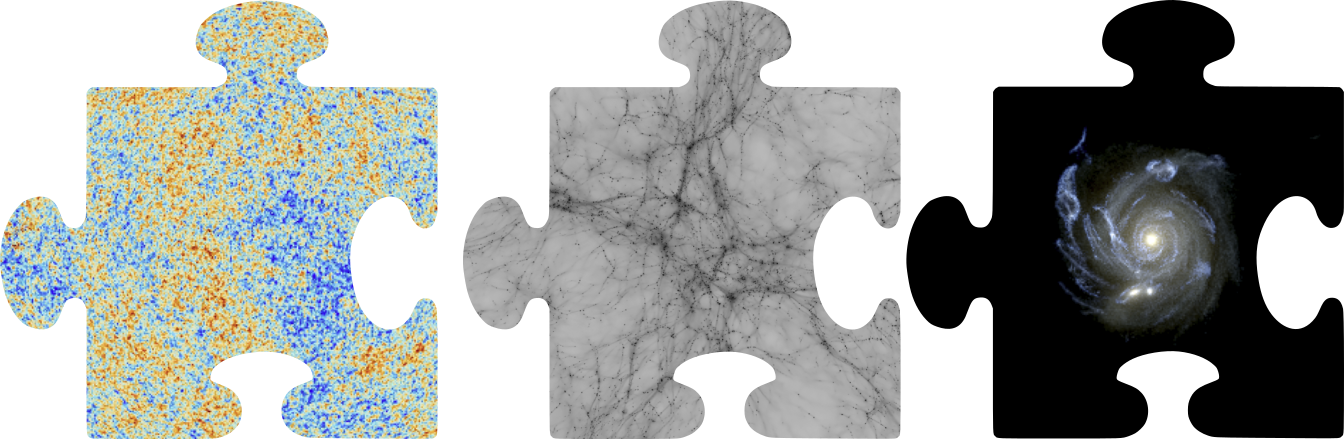
Tracing Cosmic Evolution:
From the CMB to the Web, the CGM, and Galactic Disks






kpc
100 kpc
Mpc
Gravitational
collapse
Baryonic physics, star form, AGNs
Feedback processes
Perturbations
Simulations
Perturbation
theory
Galaxy formation in a 🥜 shell
- Dark matter (DM) halo formation
- Gas condenses in DM halo
- Stars form out of gas
- Supernova + AGNs reinject energy


T [K]
Cooling rate \(\Lambda\)
\(\dfrac{\mathrm{d}T}{\mathrm{d}t} = \Lambda(T) \rho^2\)
\(\dfrac{\mathrm{d}M_\star}{\mathrm{d}t}\propto \rho^{3/2}\)
increasingly non-linear
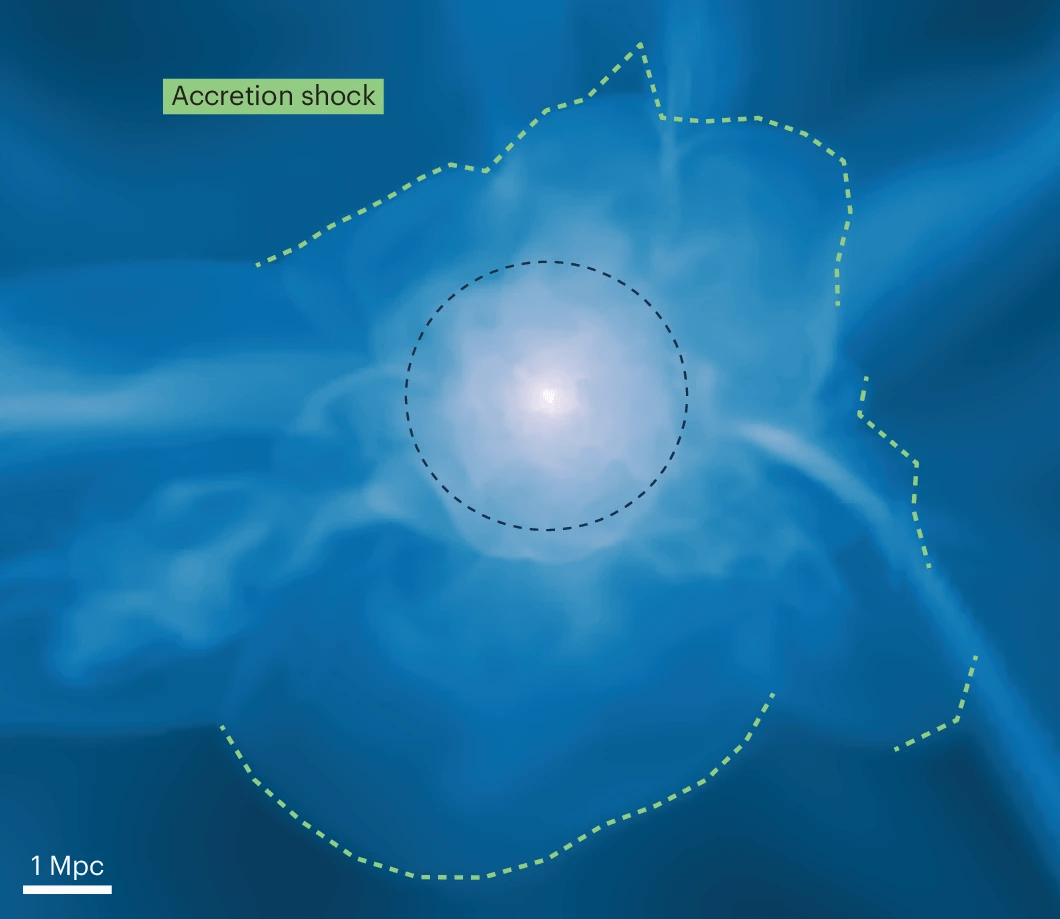
Accretion shocks, adiabatic heating, KH instabilities etc.
Vallés-Pérez+24
Galaxy formation in a 🥜 shell
- Dark matter (DM)
- Gas condenses in DM potential
- Stars form out of gas
- Supernova + AGNs reinject energy
increasingly non-linear
increasingly chaotic?
⇒
Intrinsic alignment measurement: Ganeshaiah Veena+ 19 · Alignment: M. Sachs
Neighbouring galaxies' shapes are aligned
(on the plane of the sky)
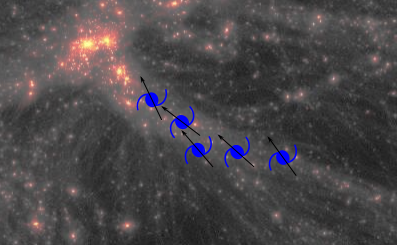
Intrinsic alignment
Baryon dominated?
No cosmo information?
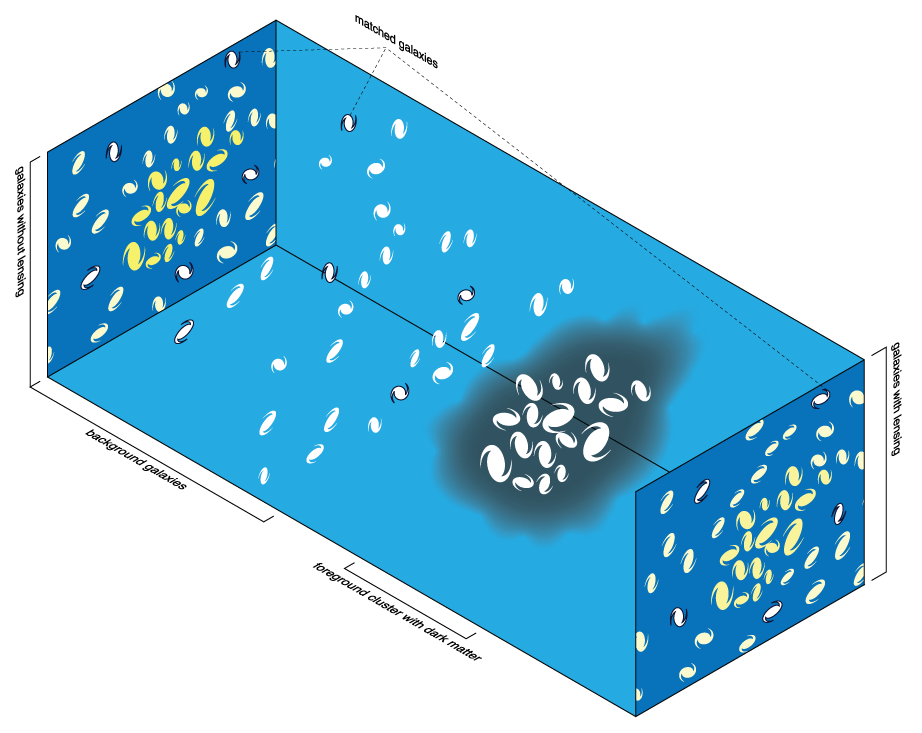
Weak lensing
L.o.s. measurement of
dark matter density
+
⇒

Galaxy formation: the biased point of view of the spin
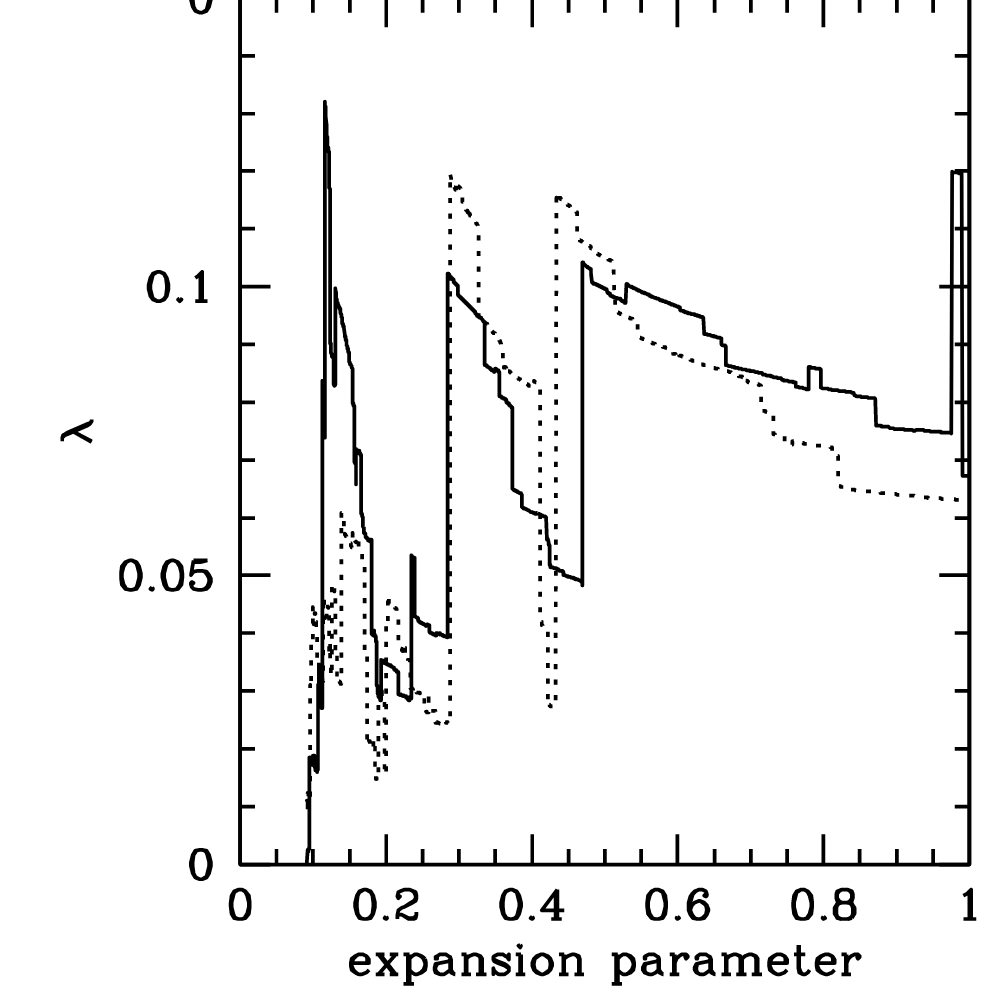
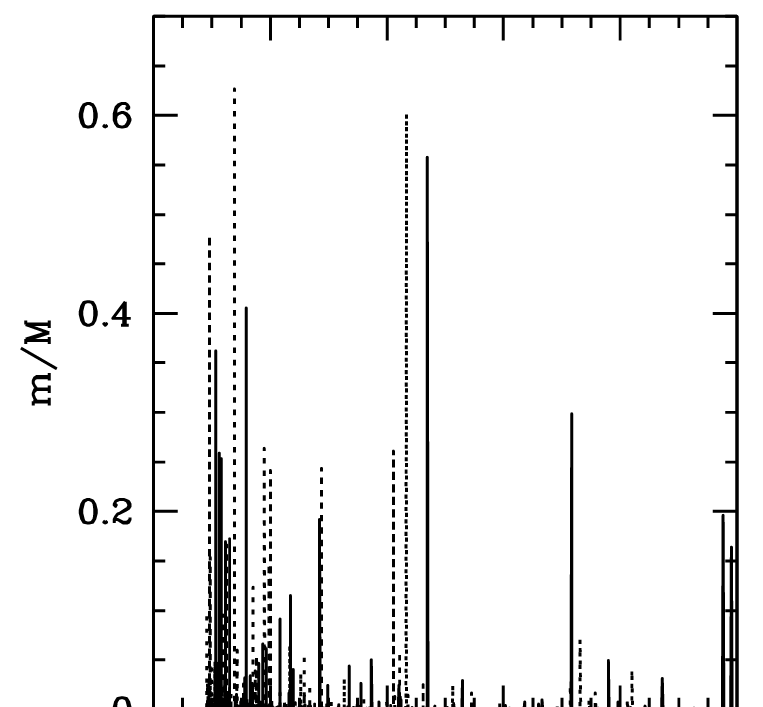
Stochastic spin: Vitviska+ 02, Beson+ 20
Spin prediction, Porciani+ 02
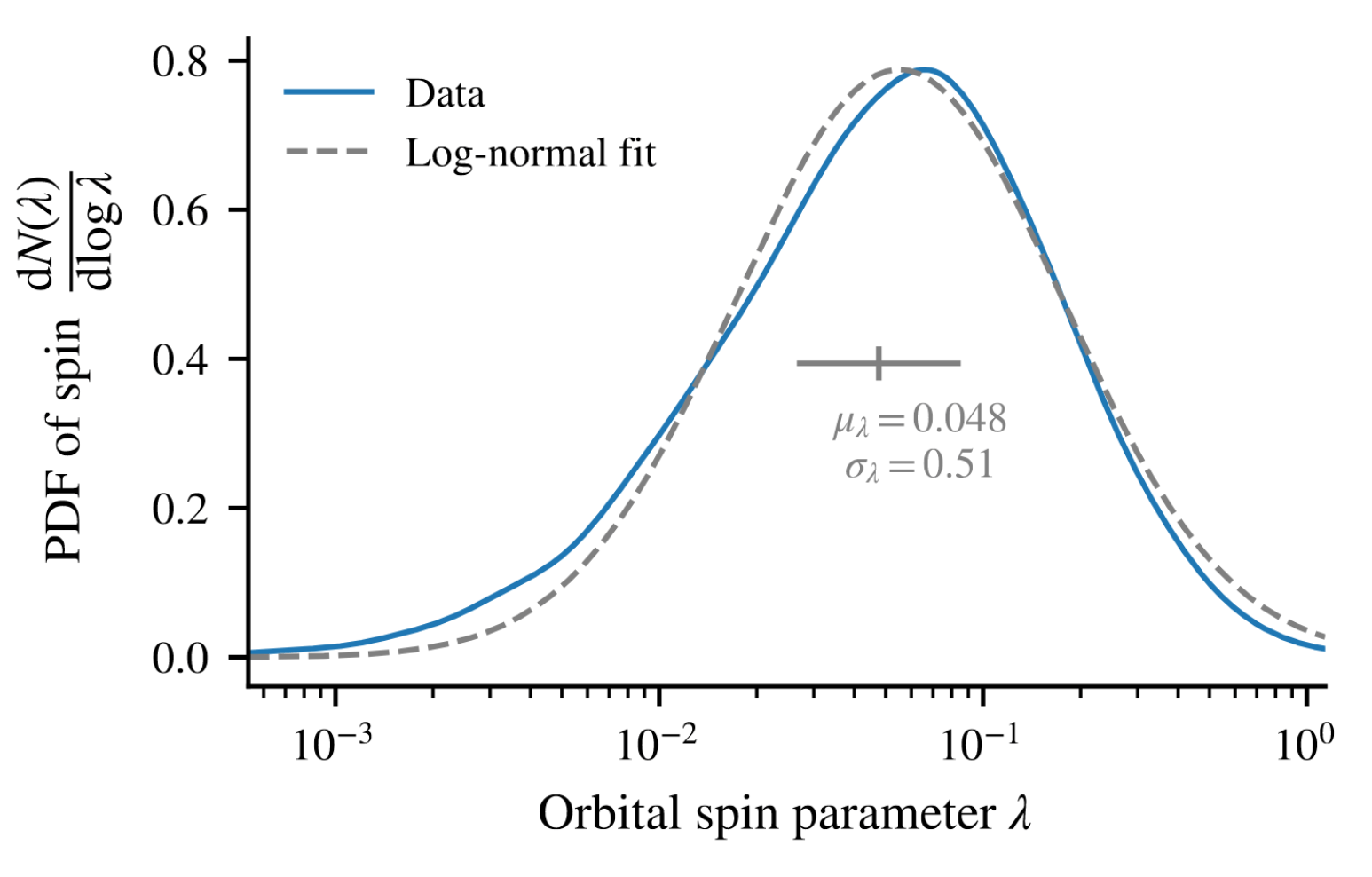
Spin: \[\lambda = \dfrac{j}{\sqrt{2}R_\mathrm{vir}V_{vir}}\]
- Spin jumps at mergers
- Distribution well reproduced by drawing mergers' parameters randomly
- Theoretical predictions are, at best, inaccurate
First complication
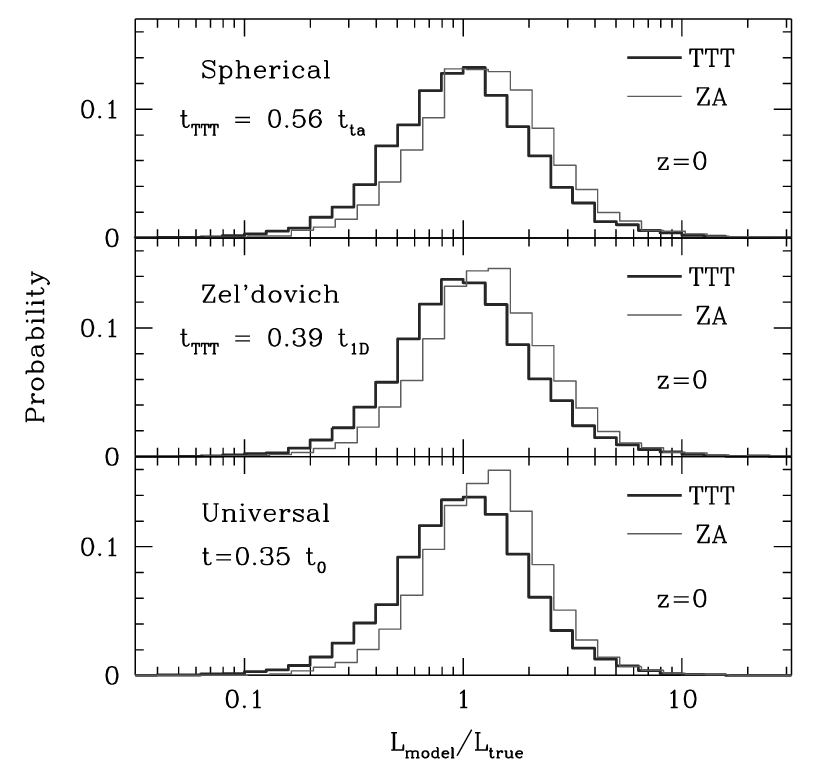
\(\pm 100\%\)!
“Mergers bring chaos”
Second complication
Let's be optimistic and assume we can predict DM spin
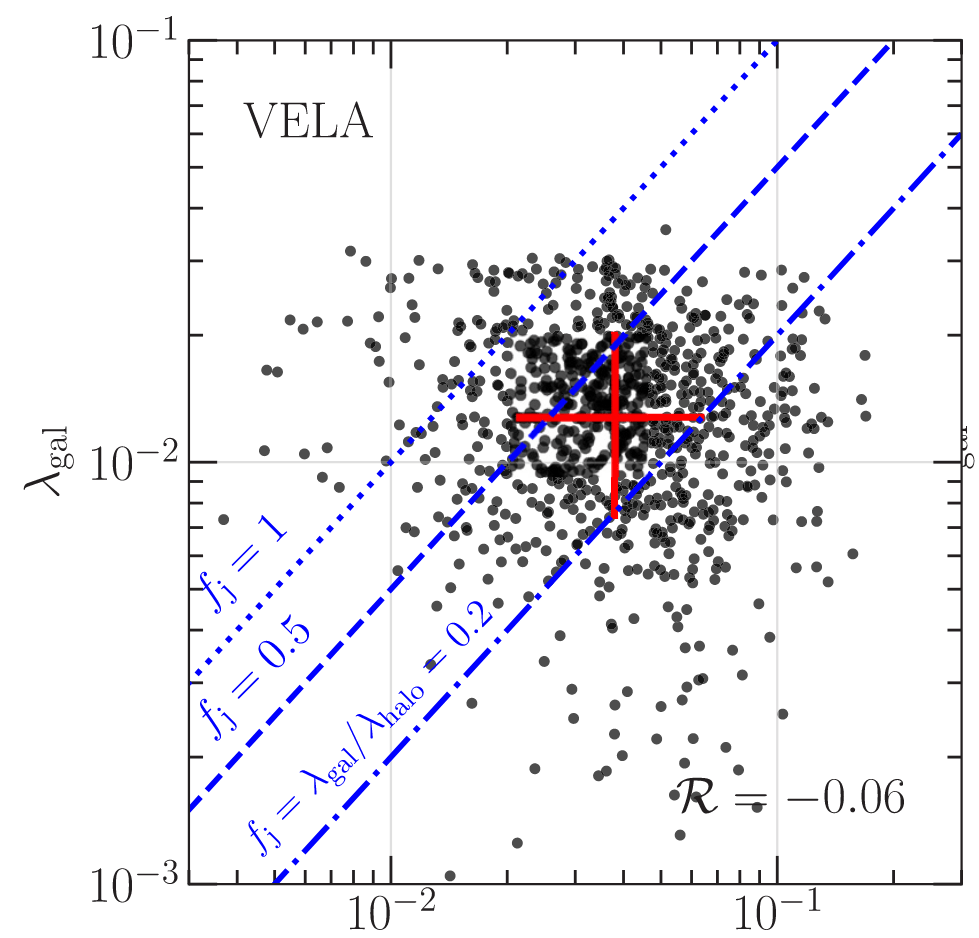
DM spin is not even a good predictor for the galaxy's!
Jiang+ 19
\(\lambda_\mathrm{DM}\)
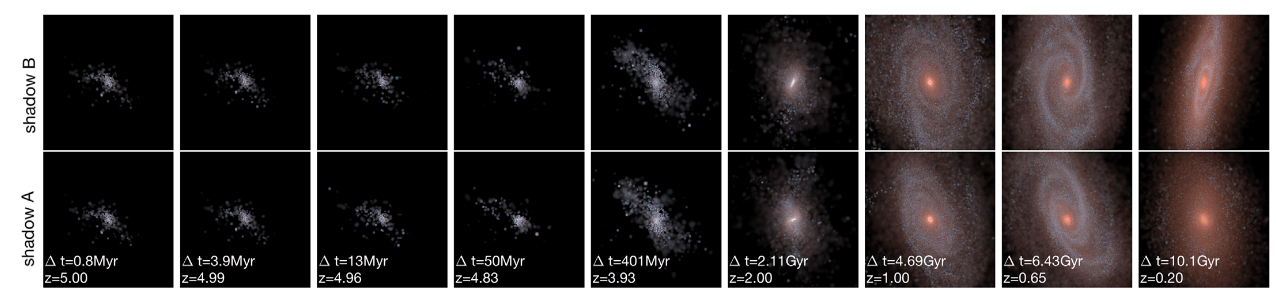
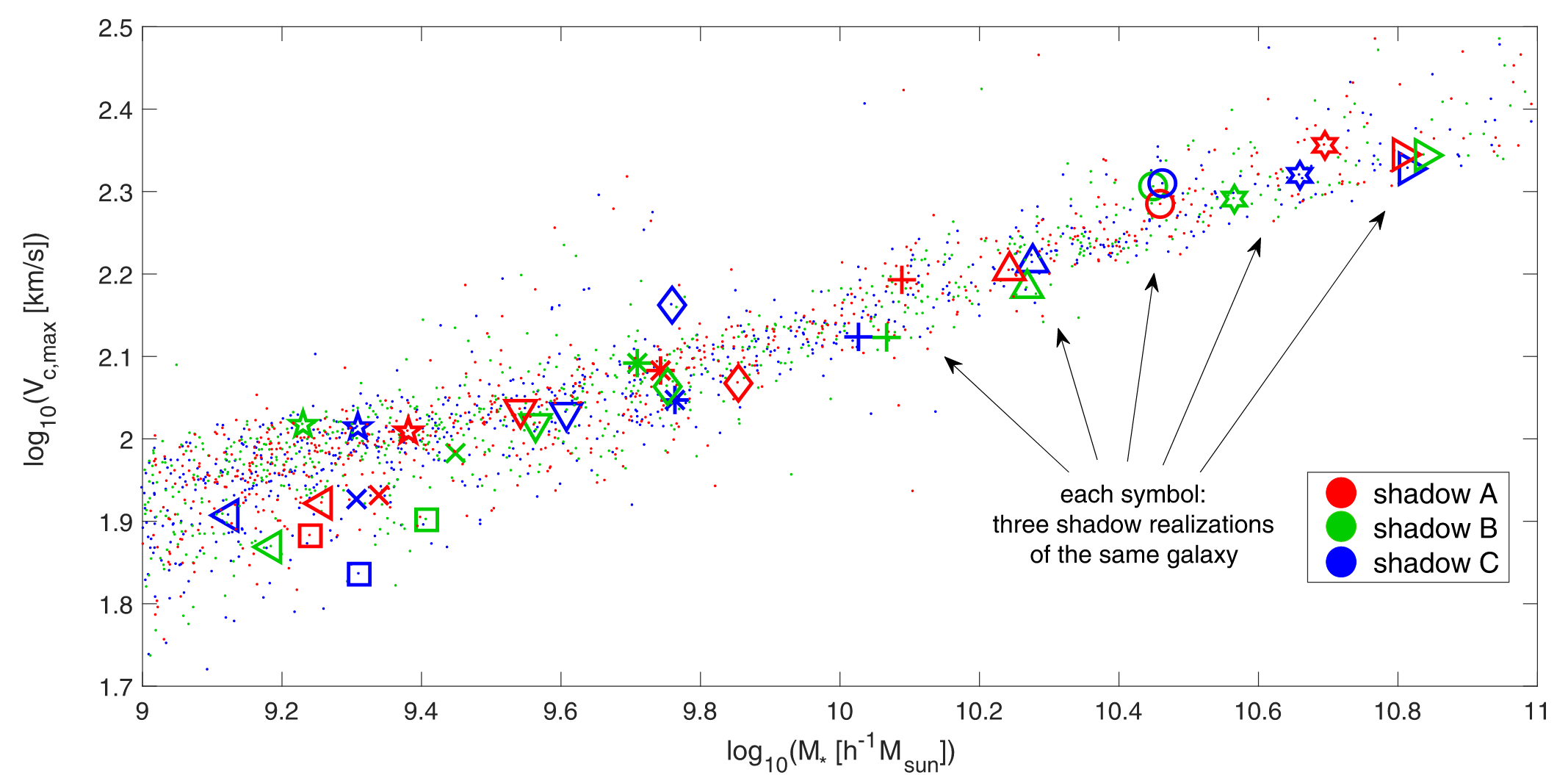
Butterfly effect: Genel+ 19, see also Thiébaut+ 08
Third complication
Resimulating the same galaxy twice yields different results ⇒ galaxies are chaotic
Is DM angular momentum chaotic?
Results from Cadiou+21, 22
1
Is DM angular momentum chaotic?
Results from Cadiou+21, 22
1
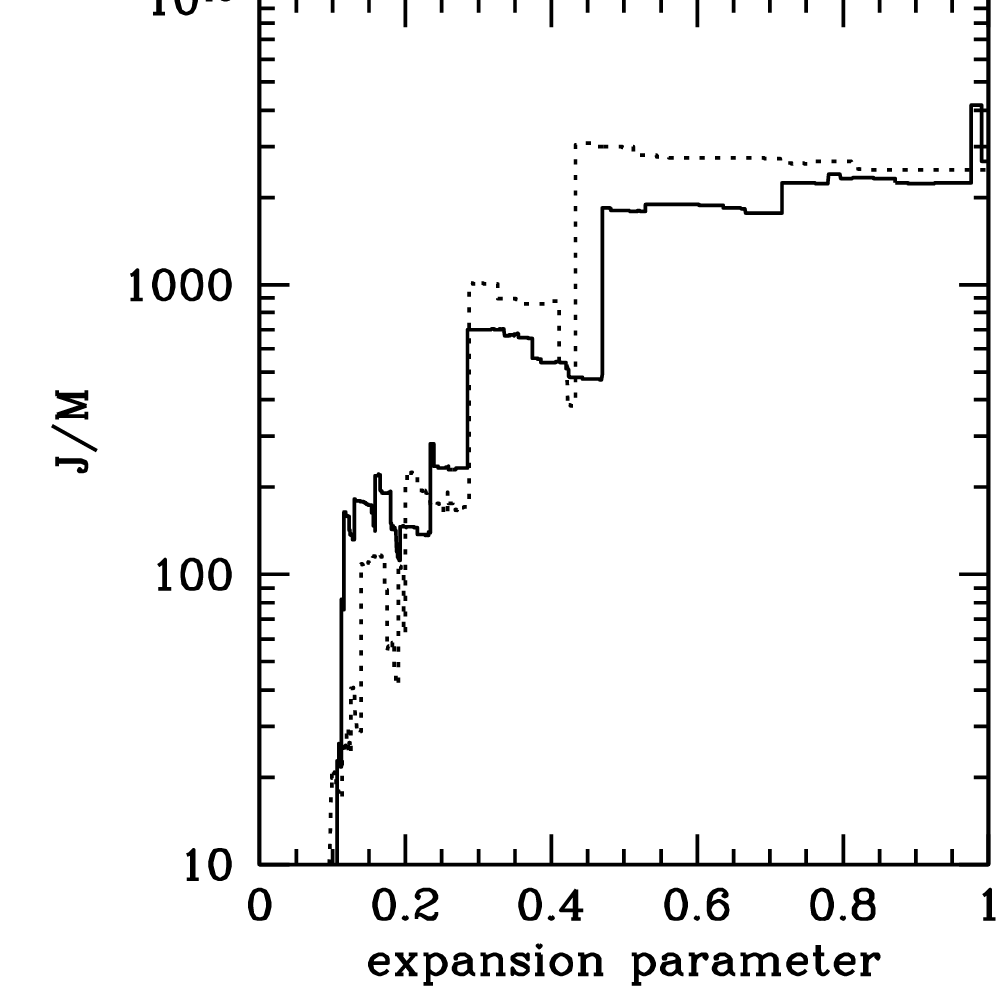
DM angular momentum

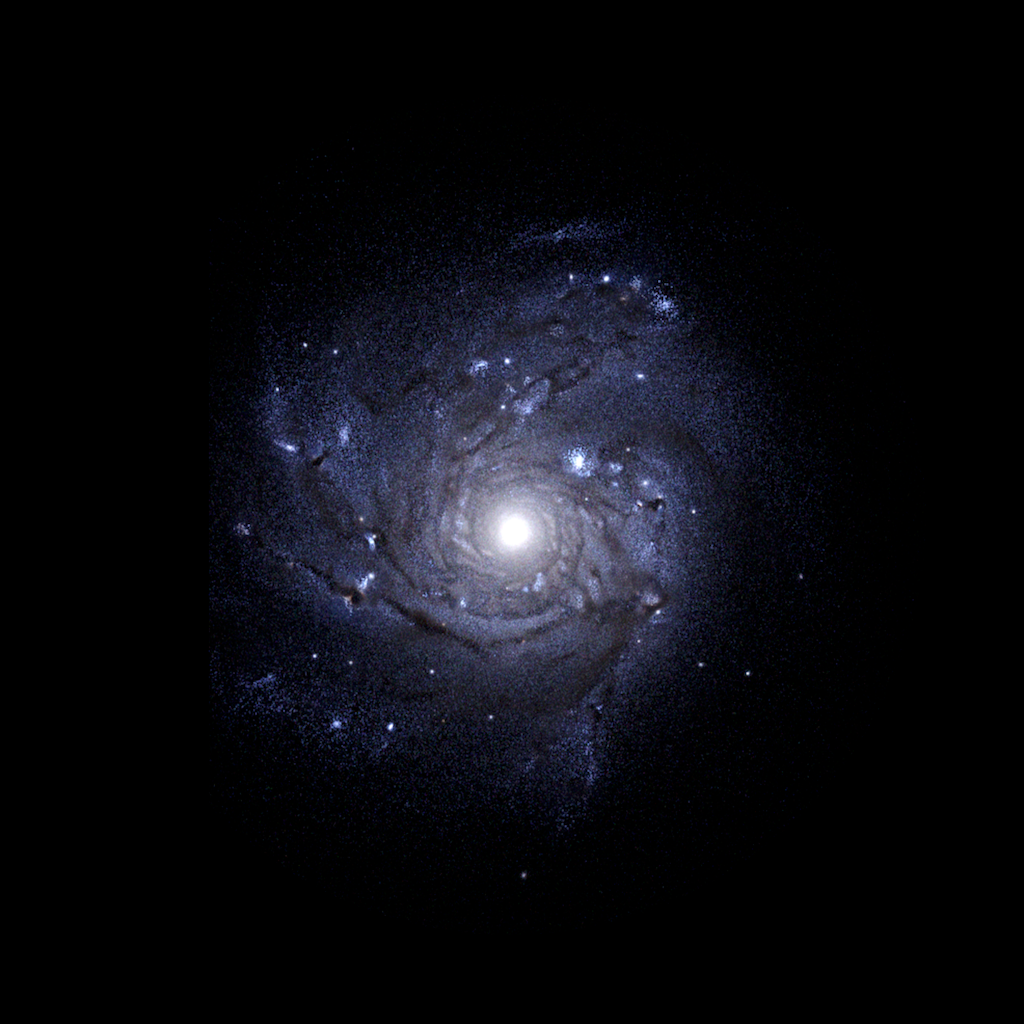

\(z=0\)
\( z = 100\)
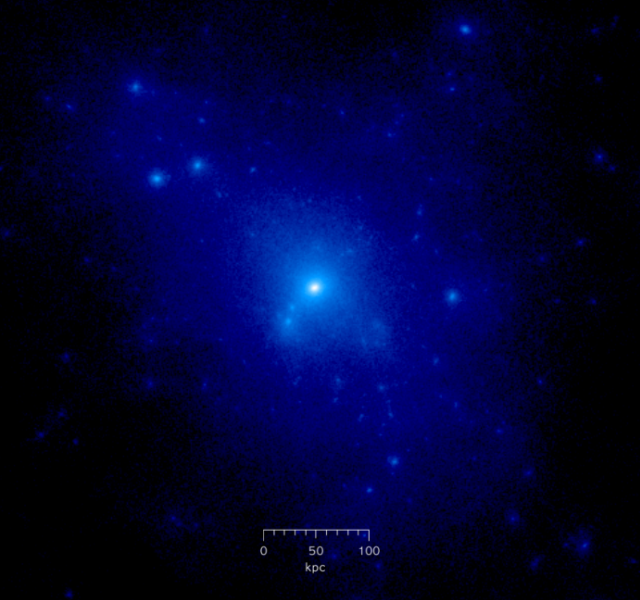
\(z=0\)
\( z = 100\)
[White 84]
DM angular momentum
\(z=0\)
\( z = 100\)
[Genetic modifications: Roth+16, see also Rey&Pontzen 18, Stopyra+20]
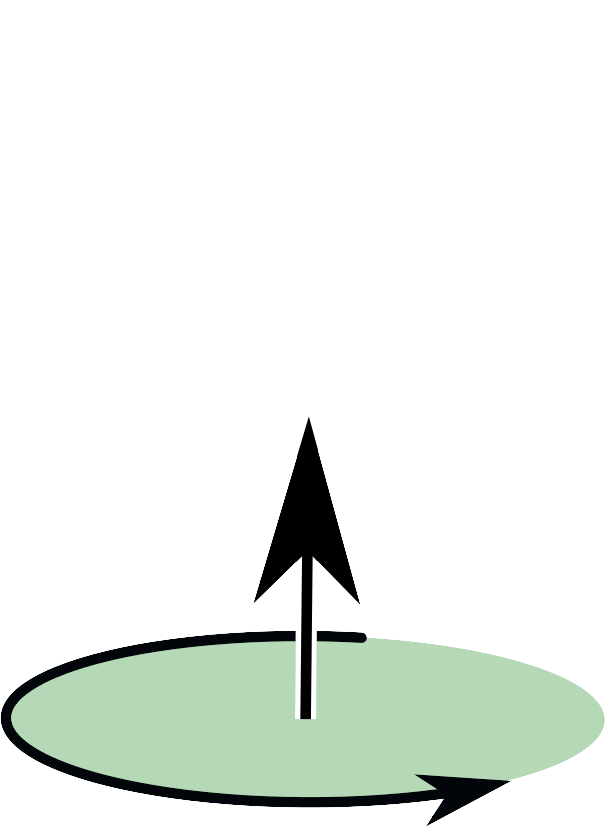
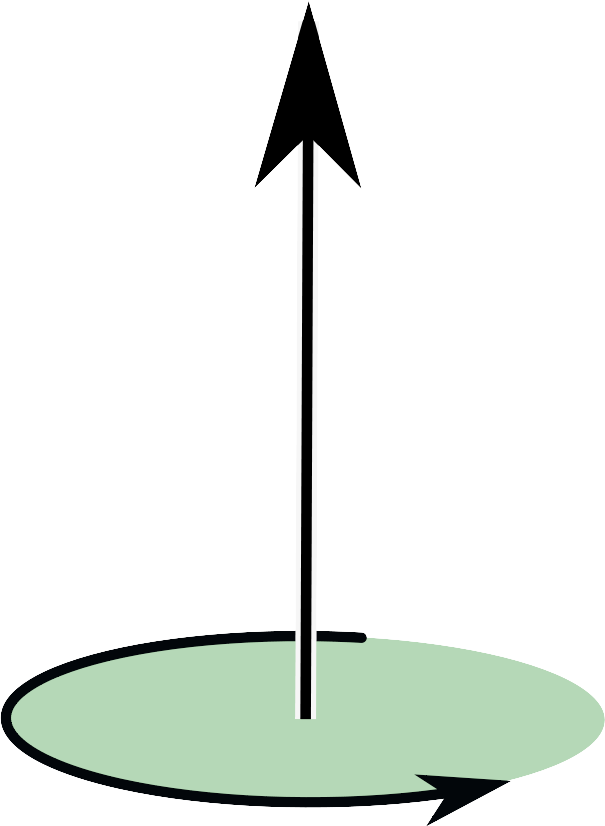
DM angular momentum


Time
Angular
momentum
DM angular momentum
✅ AM of fixed DM regions responds ~linearly (so is not chaotic!)
However, particle membership hence DM halo does not
Angular
momentum
Time
DM angular momentum
Dark matter spin is hard to predict
the usual culprit are mergers
Are mergers really
stochastic?
Results from Cadiou +24b
2
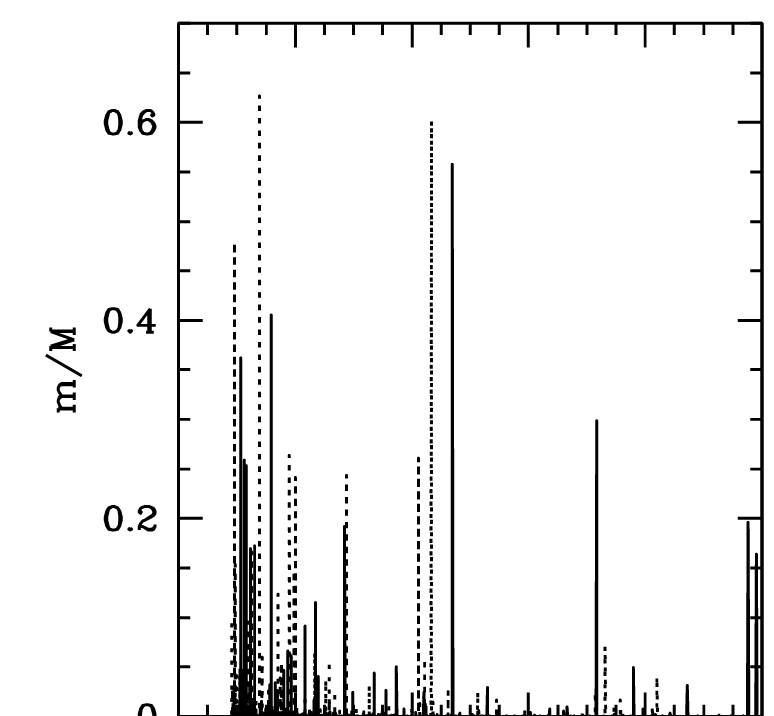
Cadiou+24
Based on the critical event theory (Cadiou +20)
itself based on Hanami 2001
We can make some reasonable predictions
of orbital spin of mergers
Given: tides + density peaks


\(z\gg 100\)
\(z = 0\)
Changes to tides at \(z=100\), effect at \(z<1\)
How chaotic is baryonic
angular momentum?
Results from Cadiou +21a
3
How chaotic is baryonic
angular momentum?
Results from Cadiou +21a
3
\(\lambda_\mathrm{DM}\)
Full hydro simulations
(RAMSES, New-Horizon model):
- Resolved disk height
\(\Delta x_\mathrm{min} = 35\ \mathrm{pc}\) - \(M_\mathrm{200c} = 10^{12}\ \mathrm{M}_\odot\)
at \(z=2\) - SF, AGN, SN feedback
- 3 galaxies, 5× scenario each
\( j_0 \times 0.66\)
\( j_0 \times 0.8\)
\( j_0 \times 1.2\)
\( j_0 \times 1.5\)
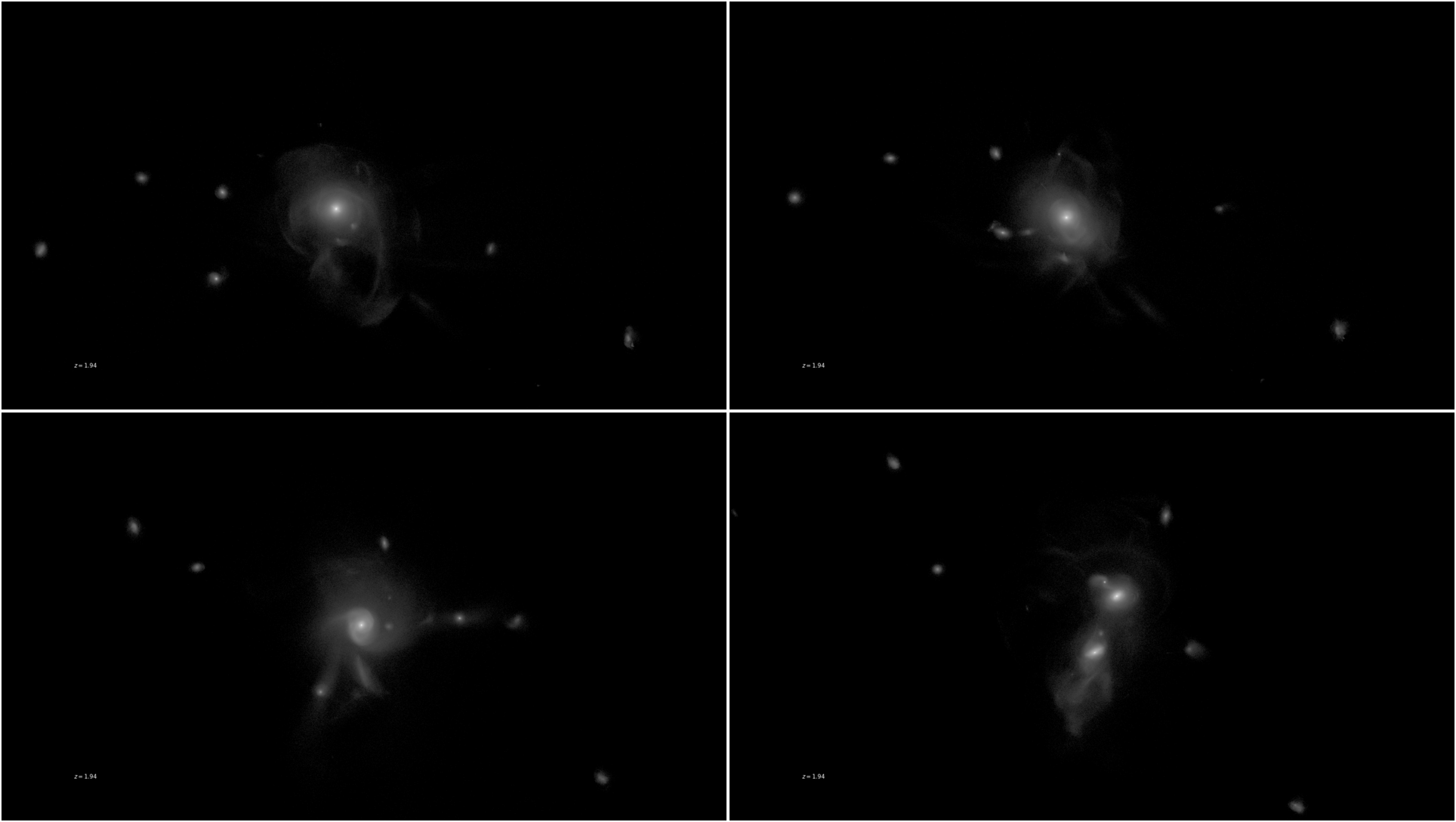
\( j_0 \times 0.66\)
\( j_0 \times 0.8\)
\( j_0 \times 1.2\)
\( j_0 \times 1.5\)
See Cadiou+21a
INPUT: Changes to tides \(z=\infty\)
OUTPUT: Ang. mom
\(z=2\)

Halo and disk evolve separately,
this allows stellar AM to be ~linear despite halo AM not being

Gas + stars spAM
Stars spAM
Halo spAM
Halo spAM
See Cadiou+21a

Special case: no massive satellite
Low tides
High tides
\(\mathcal{B}\searrow\)
\(R_\mathrm{eff} \nearrow \)
\(v/\sigma\nearrow\)
See Cadiou+21a
Impact of the cosmological-scale tides on halo properties
Results from Storck, Cadiou+25
4
Impact of the cosmological-scale tides on halo properties
Results from Storck, Cadiou+25
4
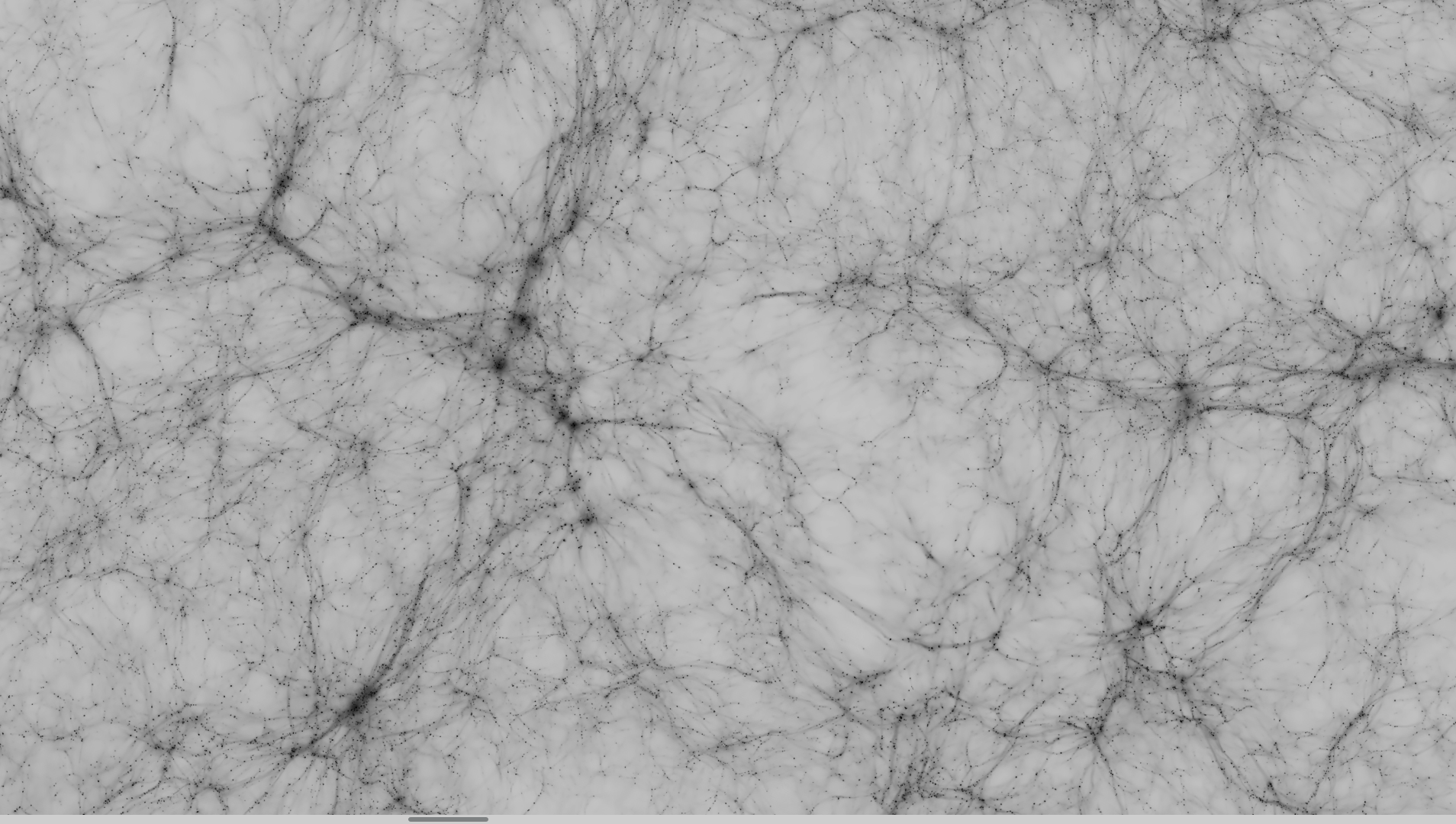
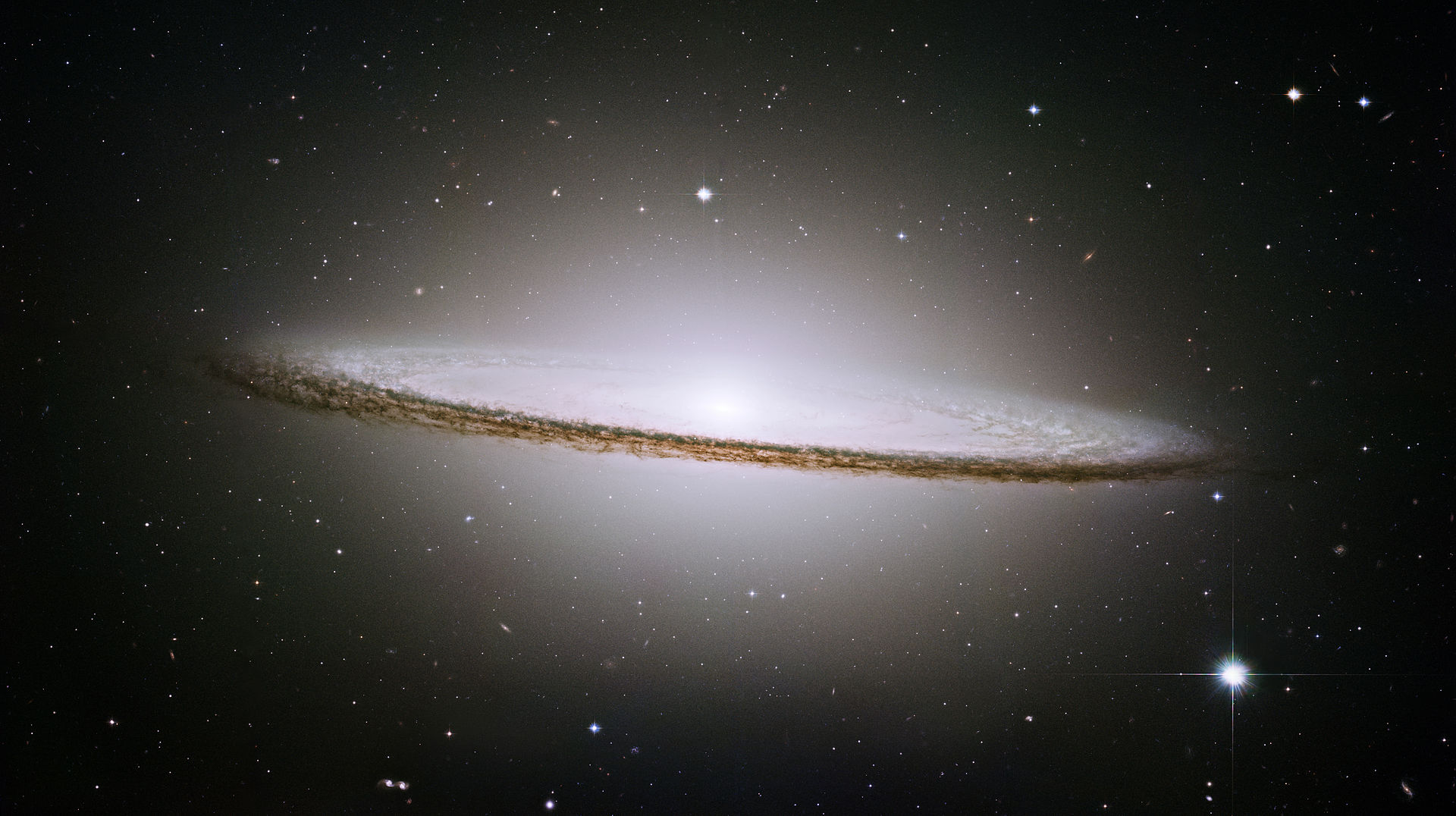
\(\rho_\mathrm{i}, v_\mathrm{i}\)
\(\Lambda\)CDM+baryon non-linear evolution
halo & galaxy properties
What if the galaxy had formed here instead?
What if the galaxy had formed here instead?
or here?
The “splicing” technique
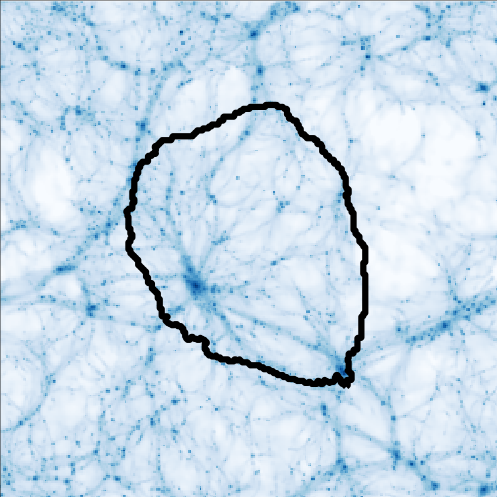
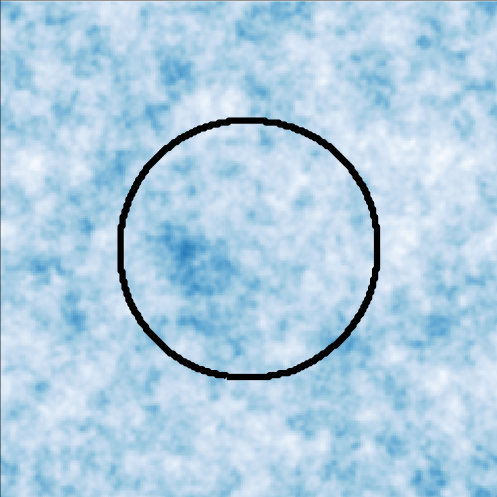
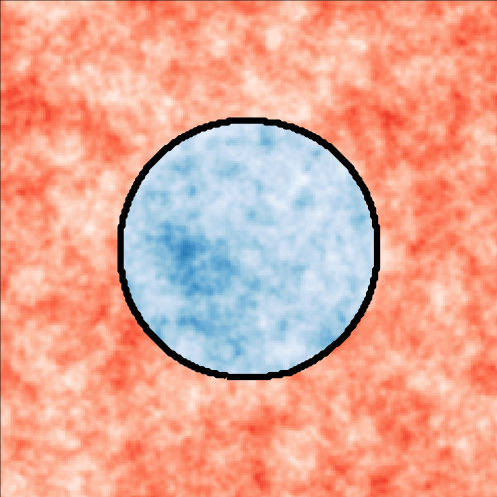
- Generate ICs
- Integrate (\(N\)-body)
- Select region of interest
- Trace back to ICs
- “Splice” the region
- Integrate again
\(t\)
Splicing: equivalent of constraining density field at all points in region
\(\longleftarrow 50\,\mathrm{Mpc} \longrightarrow\)
Same halo (same initial tides + density)
forming closer and closer to filament

Repeat for 5 halos, 9 positions

\(\sigma\)
\(\langle q\rangle\)
Deviation from the mean
For different quantities
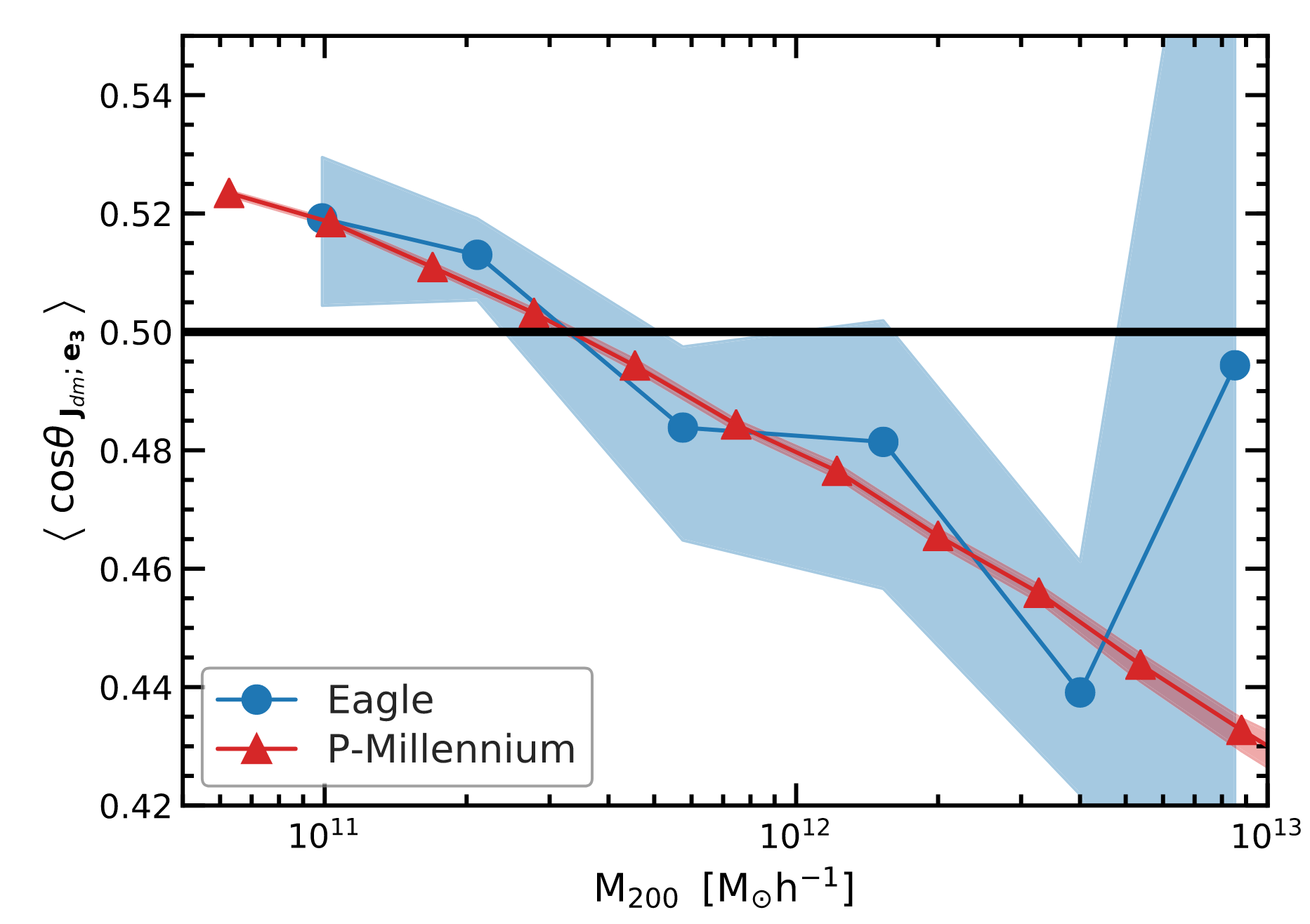
spin alignment
shape alignment

\(\sigma\)
\(\langle q\rangle\)
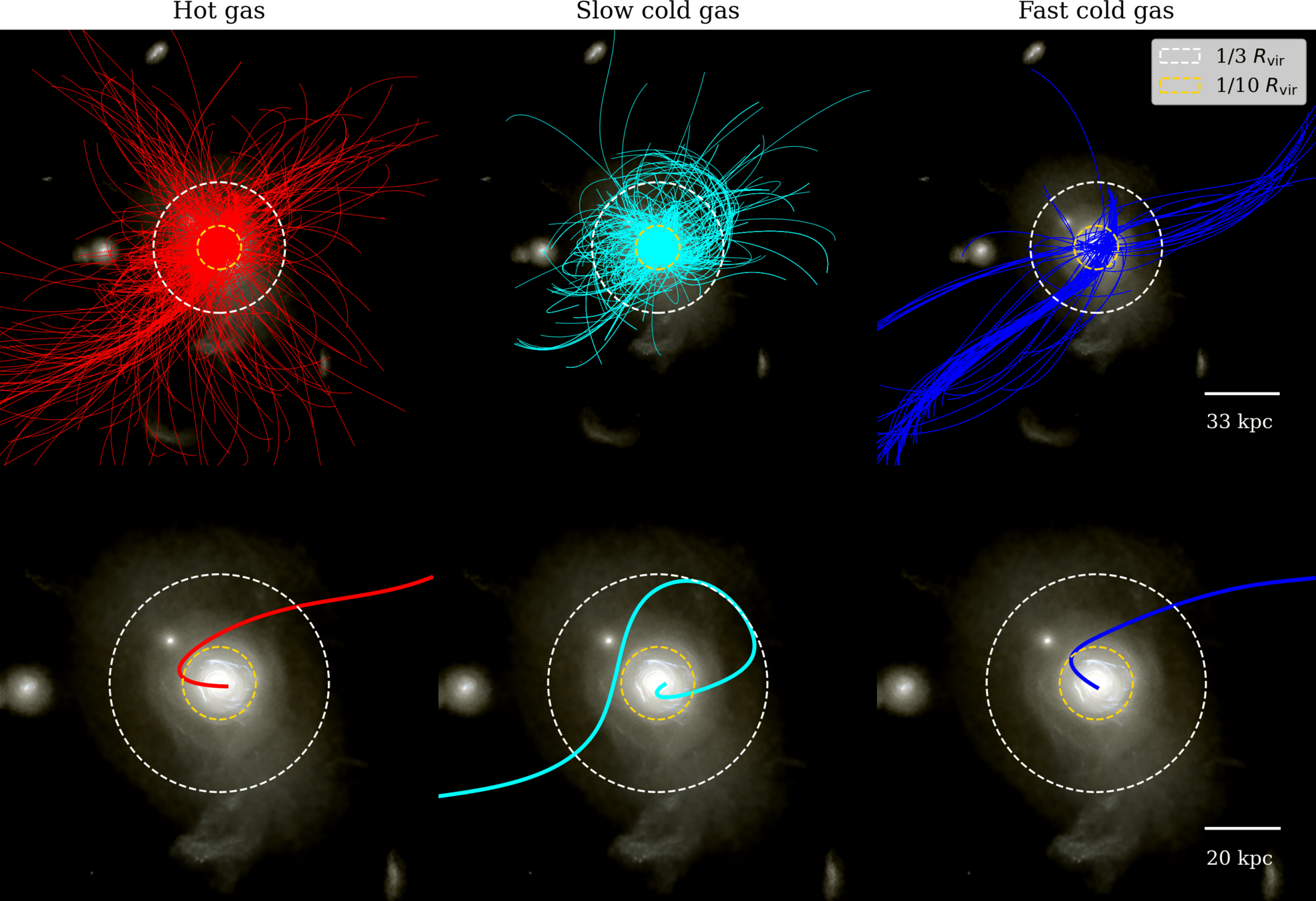
Angular momentum transport: CGM structure
Results from Cadiou+25
(& Rey+CC+25 — Katz+CC+25 — Storck+CC+25 — Choustikov+CC+25)
See also CC+22 — Kocjan+CC+24,
5
kpc
100 kpc
Mpc
Gravitational
collapse
Baryonic physics, star form, AGNs
Feedback processes
Perturbations
Simulations
Perturbation
theory
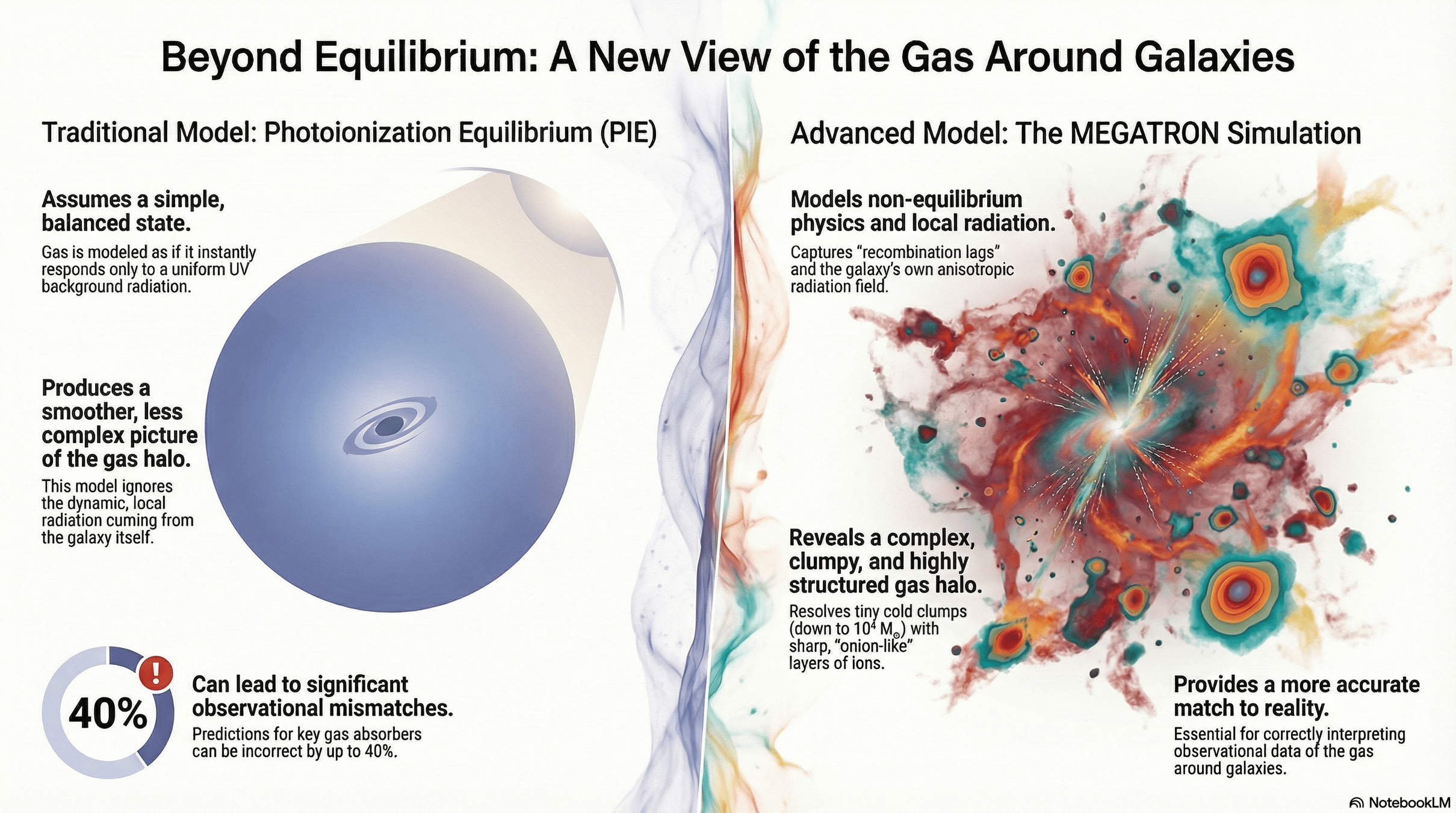
Simple isothermal CGM vs. Complex multiphase CGM
- Well-mixed (isothermal)
- "Bathtub" modelling
- Not well-mixed (turbulence)
- How much gas reaches the galaxy?

Megatron simulations:
high-\(z\) galaxy
+ non-equilibrium chemistry
+ radiative transport
+ \(\sim 50-100\,\mathrm{pc}\) resolution
- Complex, multiphase structure,
- Smallest structures at resolution limit,
-
Non-equilibrium ionized structures
- impact on thermochemical structure,
- impact on observations.
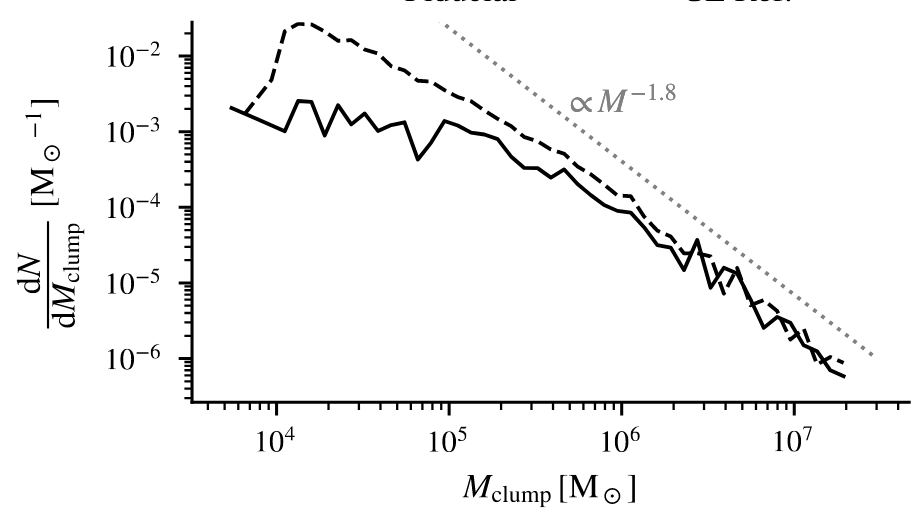
Increase of resolution:
⇒ more small scale structures
Megatron simulations:
high-\(z\) galaxy
+ non-equilibrium chemistry
+ radiative transport
+ \(\sim 50-100\,\mathrm{pc}\) resolution
- Complex, multiphase structure,
- Smallest structures at resolution limit,
- Non-equilibrium ionized structures
- impact on thermochemical structure,
- impact on observations.
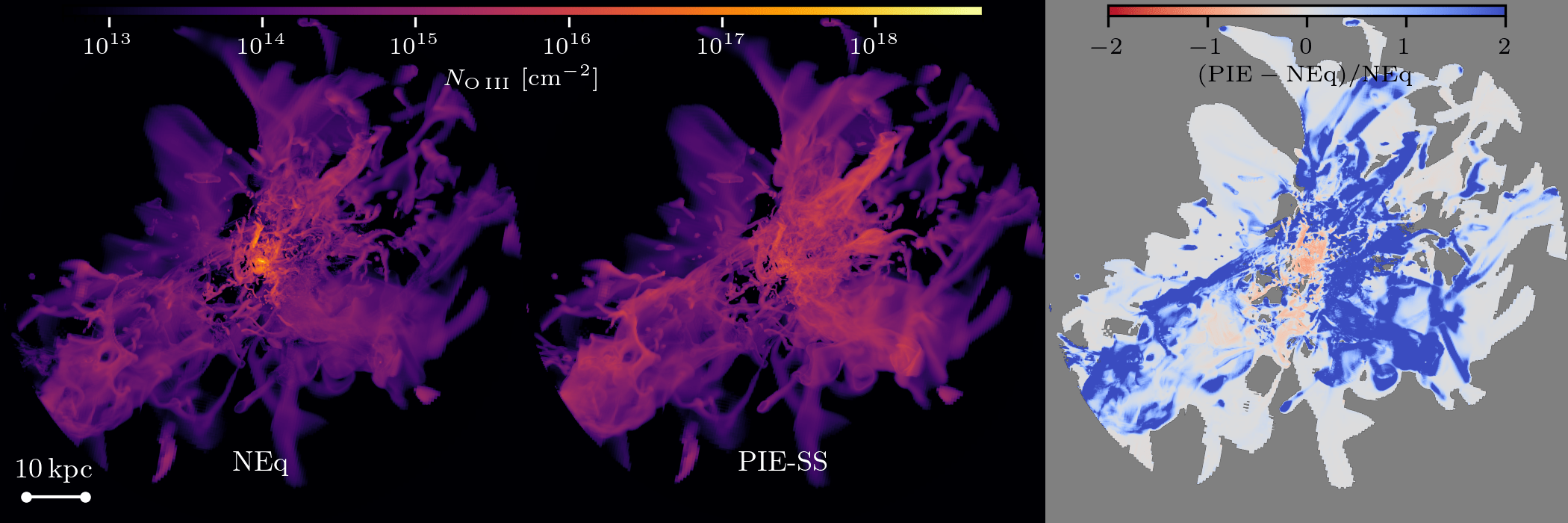
OIII column density
in simulation
assuming ionization equilibrium
\(40\,\%\)-change in HI covering fraction
Conclusions
-
Tides set merger orbital parameters & angular momentum accretion
Mergers are not stochastic/not rerolling the dice
-
Trickling down to galactic scale, which drives scaling relations
Galaxies are less stochastic than expected
Galaxy & DM spin are partially independent at the level of individual galaxies
-
Non-linear effects on halo shape and alignment are comparable to population-level
Crucial to investigate further for the success of Euclid or LSST
-
Knowledge/modelling frontier: Circum Galactic Medium transport
Non-equilibrium, multiphase state in obs. (low-\(z\)) and sims (high-\(z\))
Cosmic web → CGM → ISM: how does AM evolve in this picture?
Tracing cosmic evolution
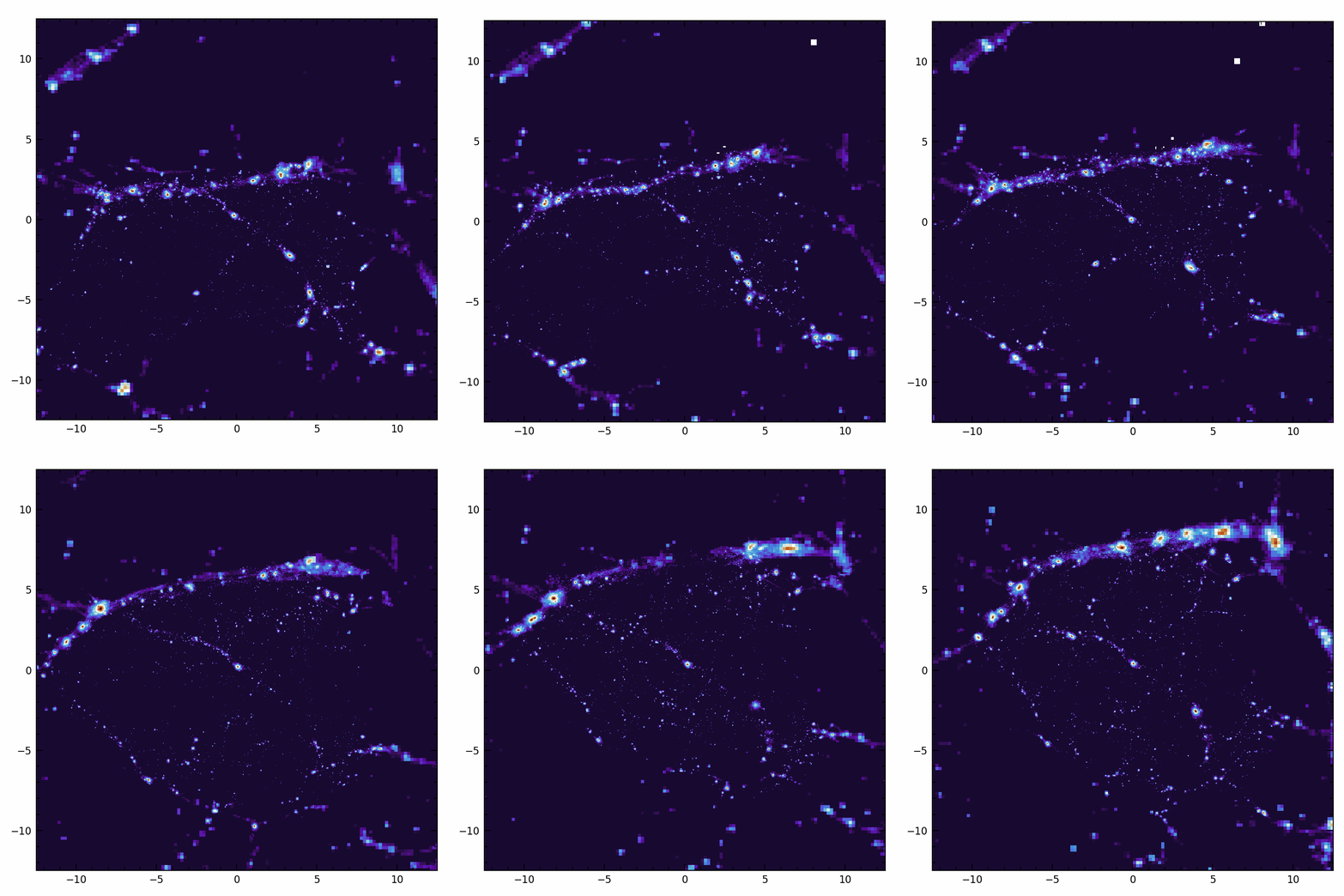
Conclusions
The (not so) new frontier:
physics in the circumgalactic medium
Tracing cosmic evolution: what's next?
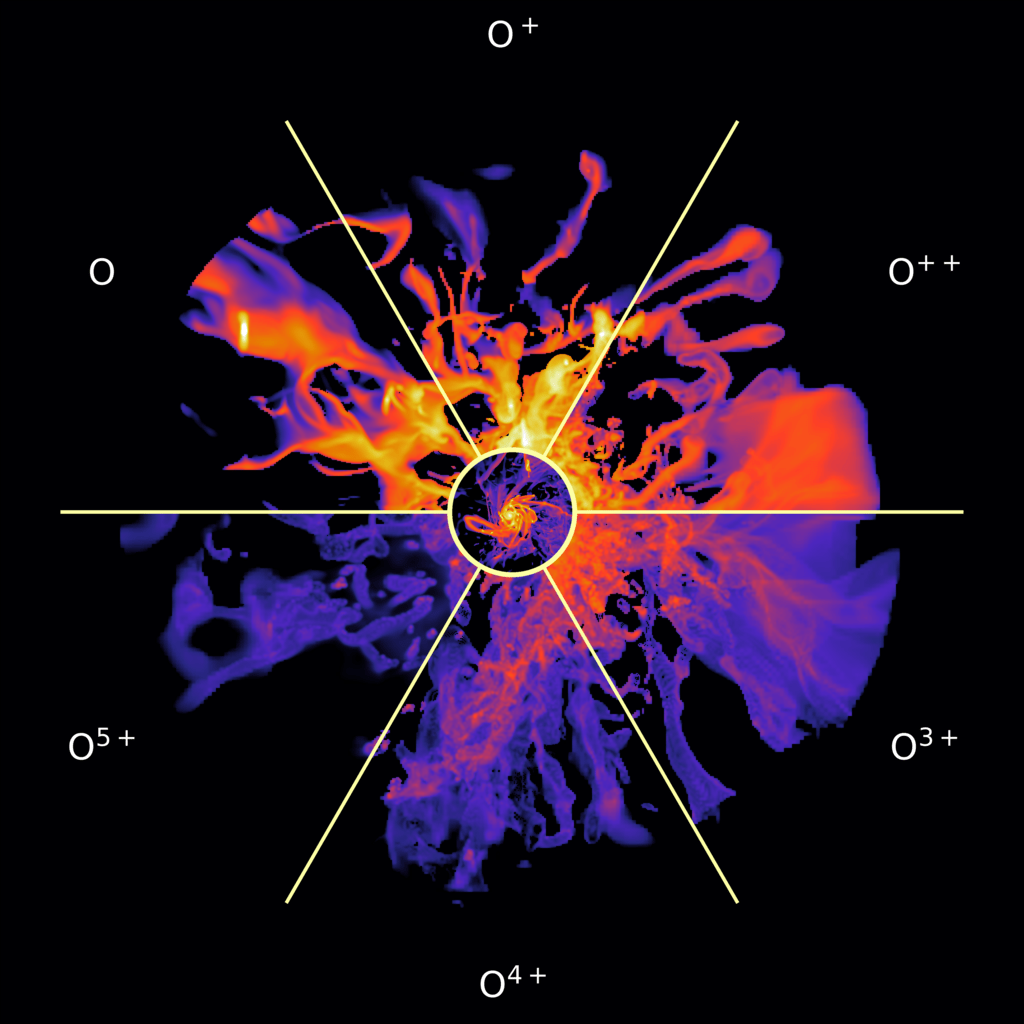
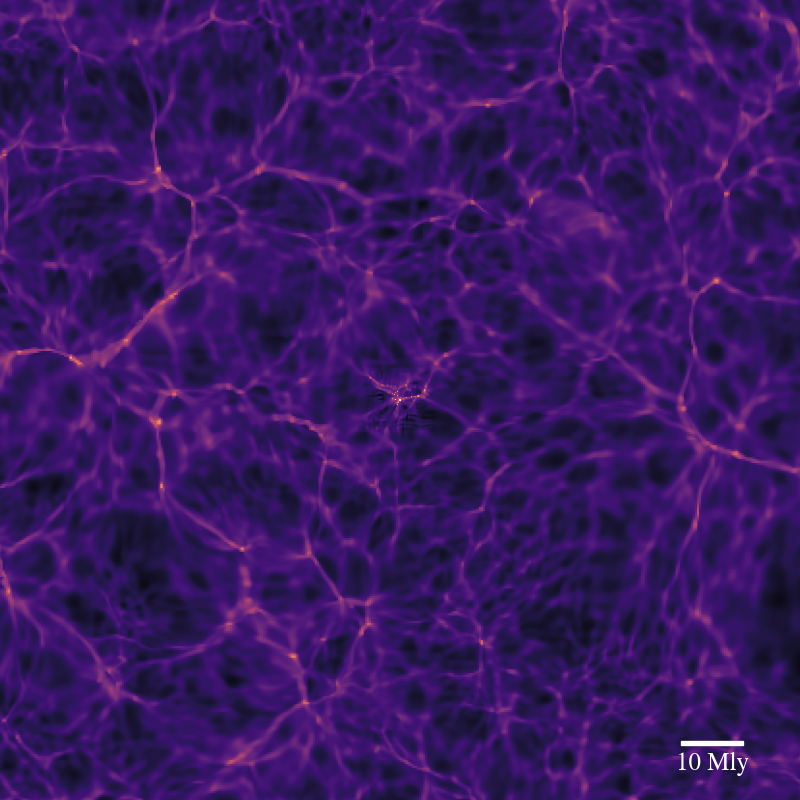
Conclusions
Come talk to me if you're interested in…
- galaxy formation,
- the cosmic web,
- numerical simulations (on GPUs, load-balancing, on-the-fly, …),
- data visualization (interactive, volume rendering, …).
🖥️ 118c — cadiou@iap.fr — https://cphyc.github.io —@cphyc.bsky.social
Processes that control ion and molecular properties:
-
Collisional, photo, cosmic-ray ionization
-
Radiative, dielectronic, dust recombination
-
Charge exchange
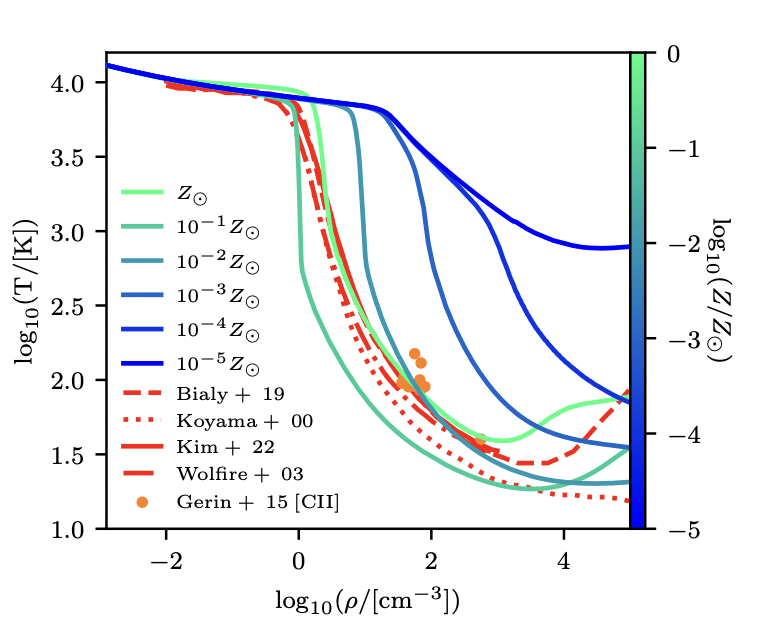
RAMSES-RTZ + PRISM: Non-equilibrium chemistry coupled to on-the-fly radiative transfer
Processes that control gas temperature:
- Cosmic-ray, photo, photo-electric, H2, dust heating
- Primordial, \(\mathrm{H}_2\), CO, metal, dust* recombination, dust-gas collisional cooling
- Adiabatic (expansion), shocks (e.g. SN, turbulence), gravitational, etc.
Image: Cadiou/Katz/Rey+in prep


Tracing Cosmic Evolution: From the CMB to the Web, the CGM, and Galactic Disks @ Korea
By Corentin Cadiou
Tracing Cosmic Evolution: From the CMB to the Web, the CGM, and Galactic Disks @ Korea
IAP Seminar