Corentin Cadiou
CNRS Researcher
Filaments @ Kavli IPMU | 2026
What flows from the cosmic web into galaxies?


Cosmic web: a multiscale structure
Mpc to galactic scales


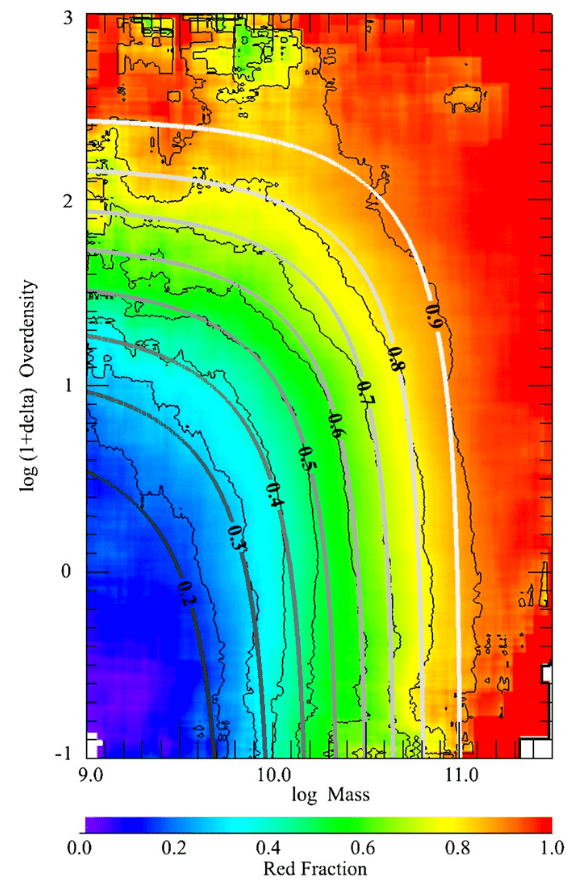
“Environmental” quenching
Higher density | high mass \(\rightarrow\) redder galaxies
⚠️ cannot explain morphology/orientations!
Cluster-like
Void-like
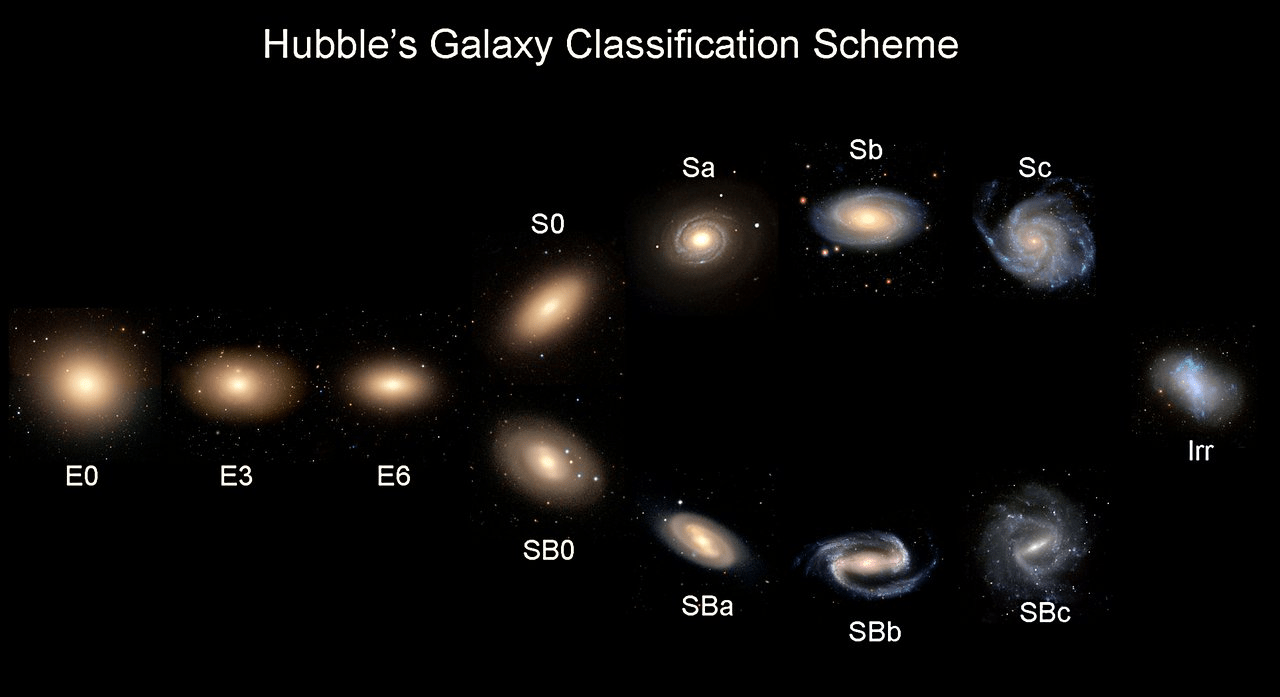
“Environmental” quenching
Higher density | high mass \(\rightarrow\) redder galaxies
⚠️ cannot explain angular momentum!
Cluster-like
Void-like

Cosmic web: effects on scalar galaxy properties
Distance to filament changes
- color & sSFR
- rotational support (\(v/\sigma\))
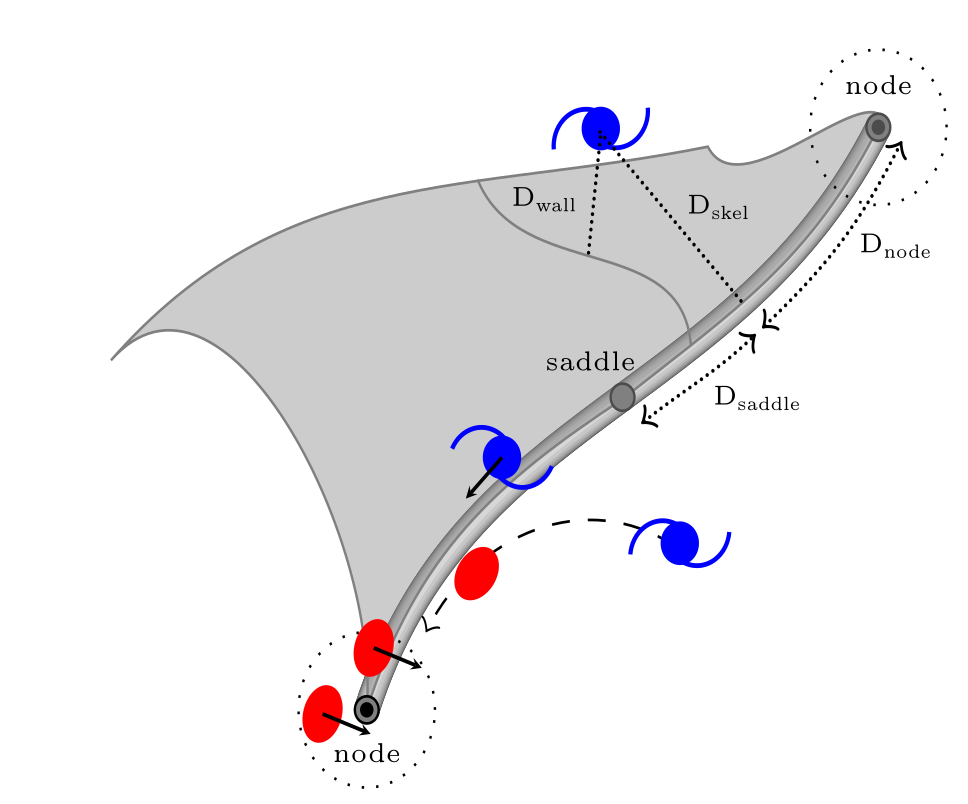

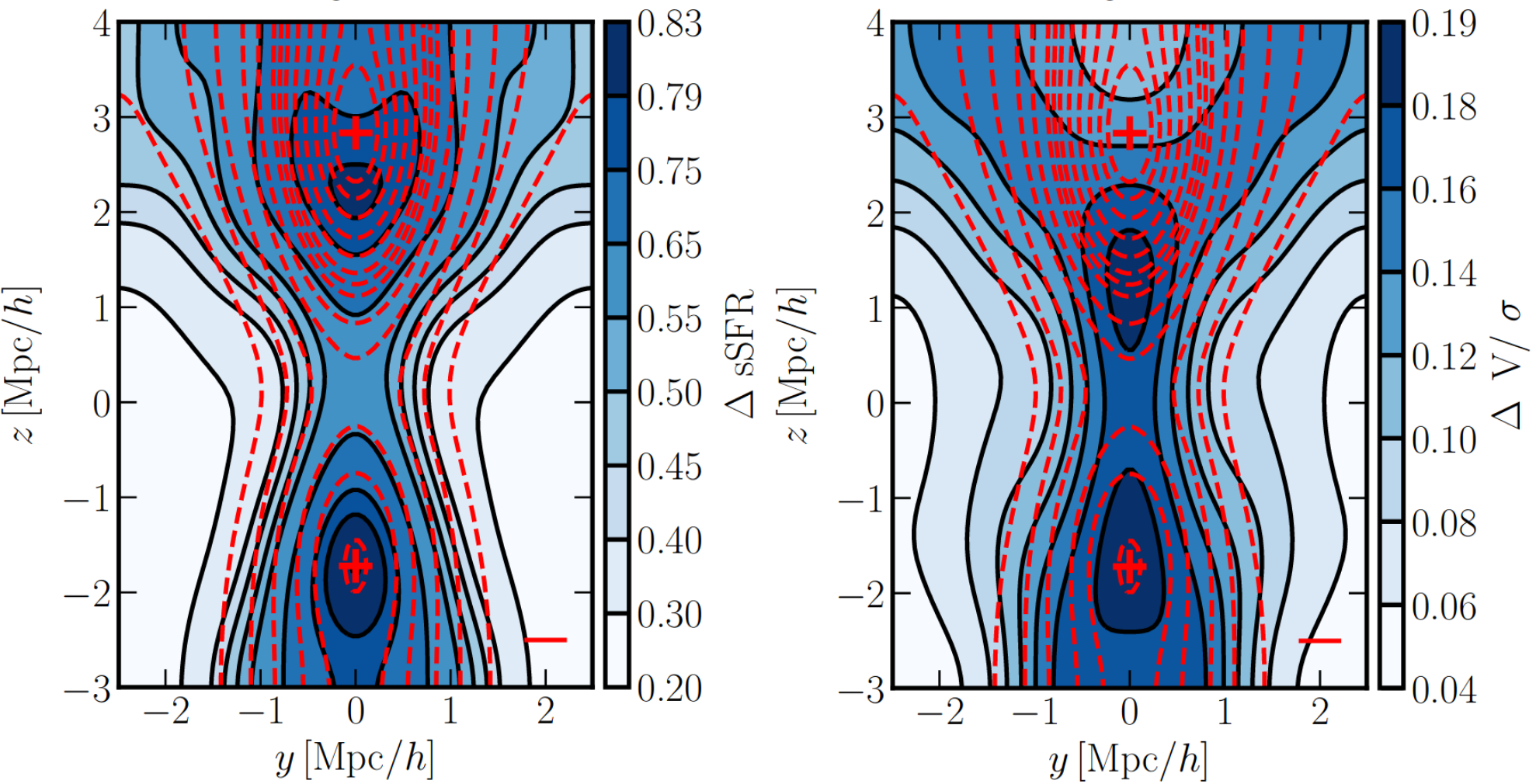
Triple effect:
- Halo assembly bias
- Feedback
- Accretion
Cosmic web: effects on halo vector properties
Small \(\perp\) alignment of halo spin/shape with filament axis

\(\perp\) filament
// filament

Interim takeaway 1/3 Cosmic web drives 1%-level effects?
Cosmic web: effects on halo vector properties
How can we study this?
Sample \(M\) at fixed cosmic web
or sample cosmic web at fixed \(M\)


\( \pm 20\% \)!
Interim takeaway 2/3 Local cosmic web drives 20%-level effects (DM halos)
More in Anatole Storck’s Thursday talk
Cosmic web: effects on galactic vector properties
Small \(\perp\) alignment of halo spin with filament

Environment perturbed on \(>\mathrm{Mpc}\) scales
Cosmic-web-scale information trickles to galactic scale
\(\Rightarrow\) what's the messenger?
Interim takeaway 3/3 Local cosmic web drives 20%-level effects (galaxies)

How strongly does the cosmic web affect galaxy formation?
\(\ll 1\%\) or \(\gg 20\%\)?
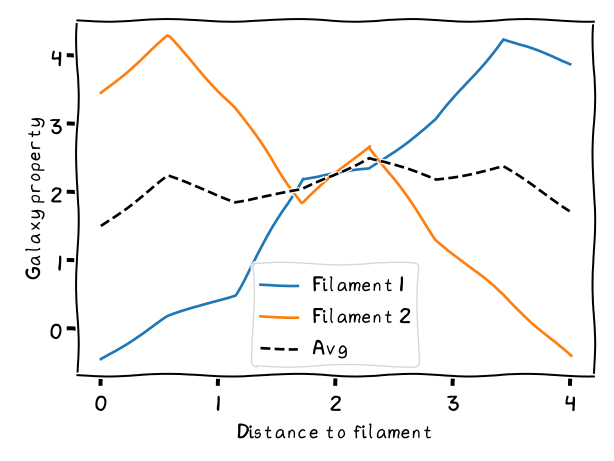
How strongly does the cosmic web affect galaxy formation?
\(\ll 1\%\) or \(\gg 20\%\)?
Sabri Errachdi
PhD work in progress
More in his Wednesday talk

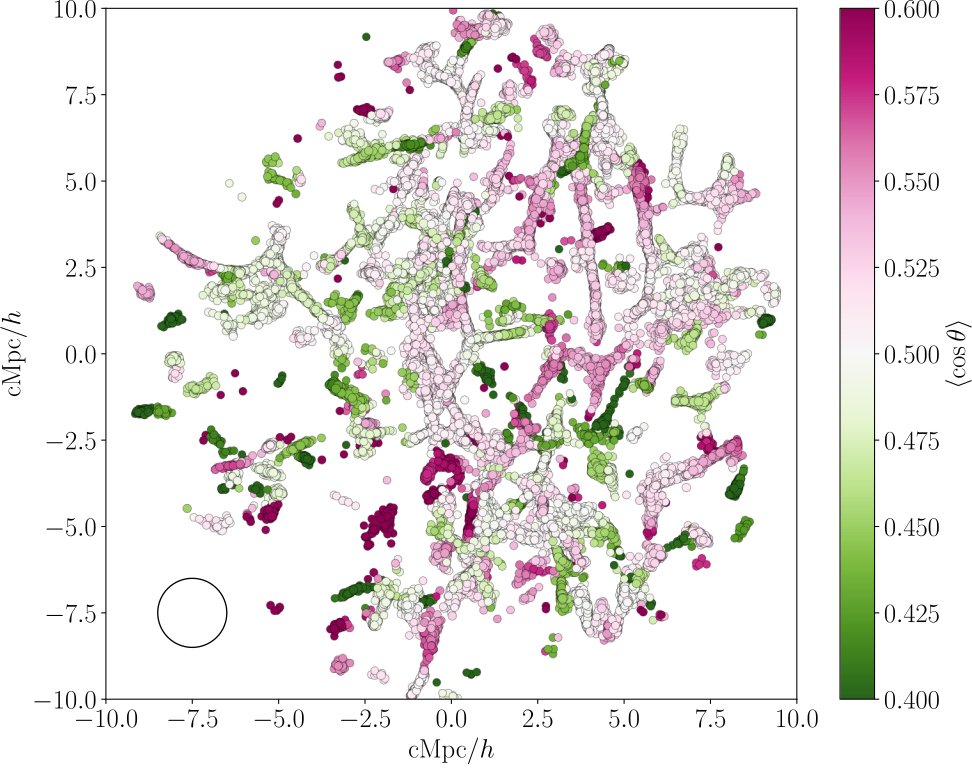
Related methods: Aragón-Calvo 16 · Storck, CC+25

The local cosmic web \(<1\,\mathrm{Mpc}\): theory
2-3 “Cold flows” embedded in local cosmic web pancakes, feeding the galaxy
\( z=2.5, M_\star=10^{12}\,M_\odot \) ; Danovich+12
The CGM cosmic web \(\lessapprox 100\,\mathrm{kpc}\): observations
Hints of detection of anisotropic extended cold emission
Excess of Ly\(\alpha\) in stacked images
\(3< z< 4\); Gallego+18


Ly\(\alpha\) radiation between quasar pairs; \( z\sim 3\); Herwig+24


Ly\(\alpha\), CIV and HeII emissions; Vayner+23
| Observable | Instrument / sample | Projected reach [physical kpc] | Selected references |
|---|---|---|---|
| Lyα — individual | MUSE: QSO pairs / overdensities | Rₜ ≈ 110; L ≈ 700–1000 | Tornotti+25a, 25b |
| Lyα — stacks | MUSE / HETDEX: LAEs | R ≈ 60–160 | Guo+24; Lujan Niemeyer+22 |
| C IV, He II, C III] | Quasar nebulae / stacks | R ≈ 45 (stack); ≈100 (individual) | Guo+20; Zhang+23 |
| [O II] | MUSE: quasar + filament | R ≈ 50; filament L ≈ 120 | Johnson+22 |
| [O III] | JWST: quasar / starburst | R ≈ 60; L ≈ 100 | Peng+25 |
| Balmer / optical lines | KCWI nearby; JWST z ≈ 6 QSOs | R ≈ 30; Hα R ≈ 4–11+ | Nielsen+24; Ďurovčíková+25 |
| Mg II | MUSE: galaxy group | L ≈ 70 | Leclercq+22 |
| [C I] / CO | ALMA (+ACA): radio galaxy / QSO | L ≈ 100 | Emonts+23; Li+21 |
| [C II] 158 μm | ALMA: z ≈ 5–7 galaxies | ∼10-kpc-scale haloes | Fujimoto+19; Posses+25 |
| O VI | HST: starburst | R ≈ 23 | Hayes+16 |
| Diffuse X-rays | eROSITA: massive-galaxy stacks | R ≈ R₅₀₀c | Zhang+25 |
| PAHs / warm dust | JWST: Makani wind | R ≈ 35 | Veilleux+25 |

Tornotti+25 · \(z\simeq3.2\)
\(L \approx 700\,\mathrm{kpc}\)
CGM–IGM transition: \(R \approx 100\,\mathrm{kpc}\)

Peng+25 · \(z=2.8\)
\(L \approx 100\,\mathrm{kpc}\)
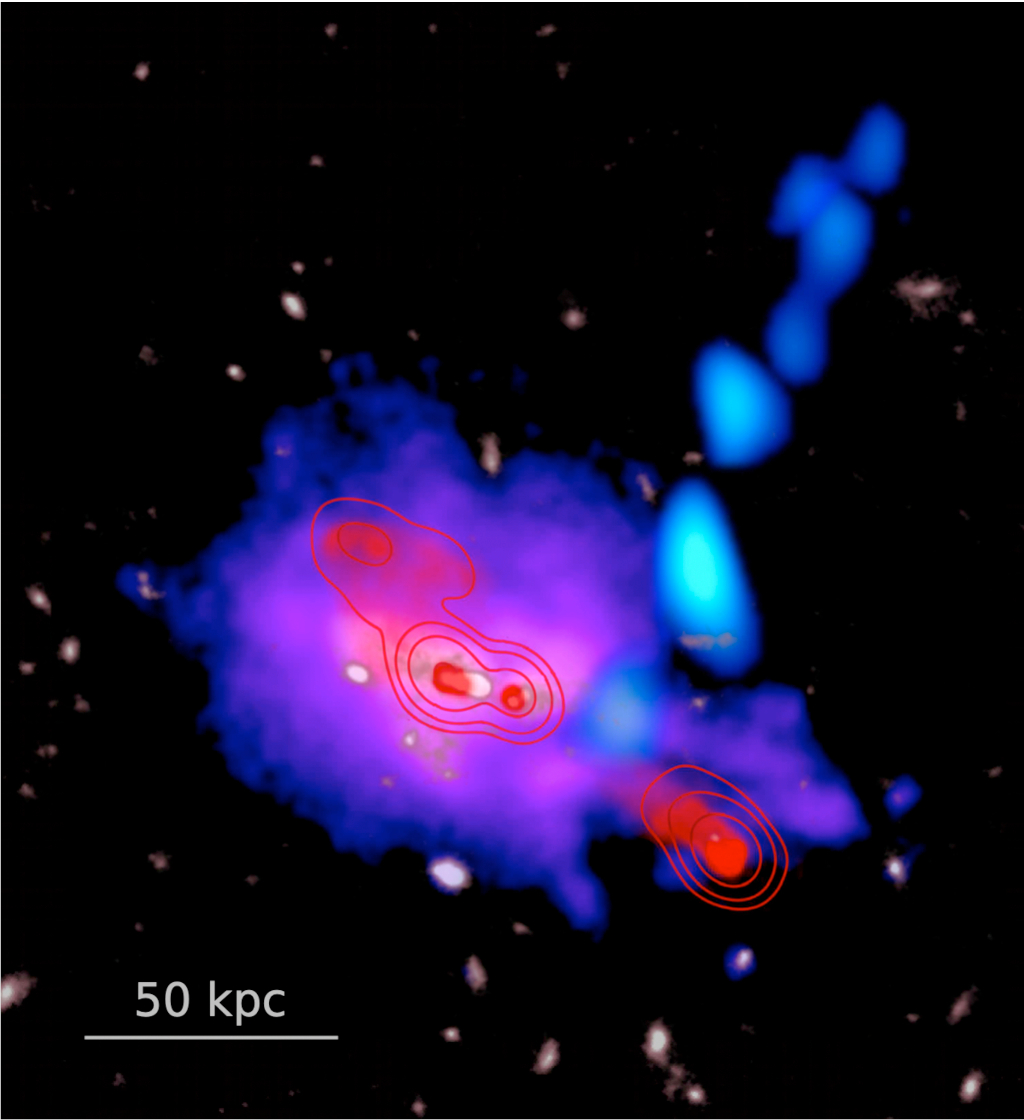
Emonts+23 · \(z=3.8\)
Stream \(L \approx 100\,\mathrm{kpc}\)
The CGM cosmic web \(\lessapprox 100\,\mathrm{kpc}\): theory
Ly\(\alpha\) is great, but hard to interpret
Other lines are great… but are we getting the right predictions?


Ly\(\alpha\)
H\(\alpha\) recomb. only
CIII] 1906Å
[CIV] 1548Å
HeII 1640Å
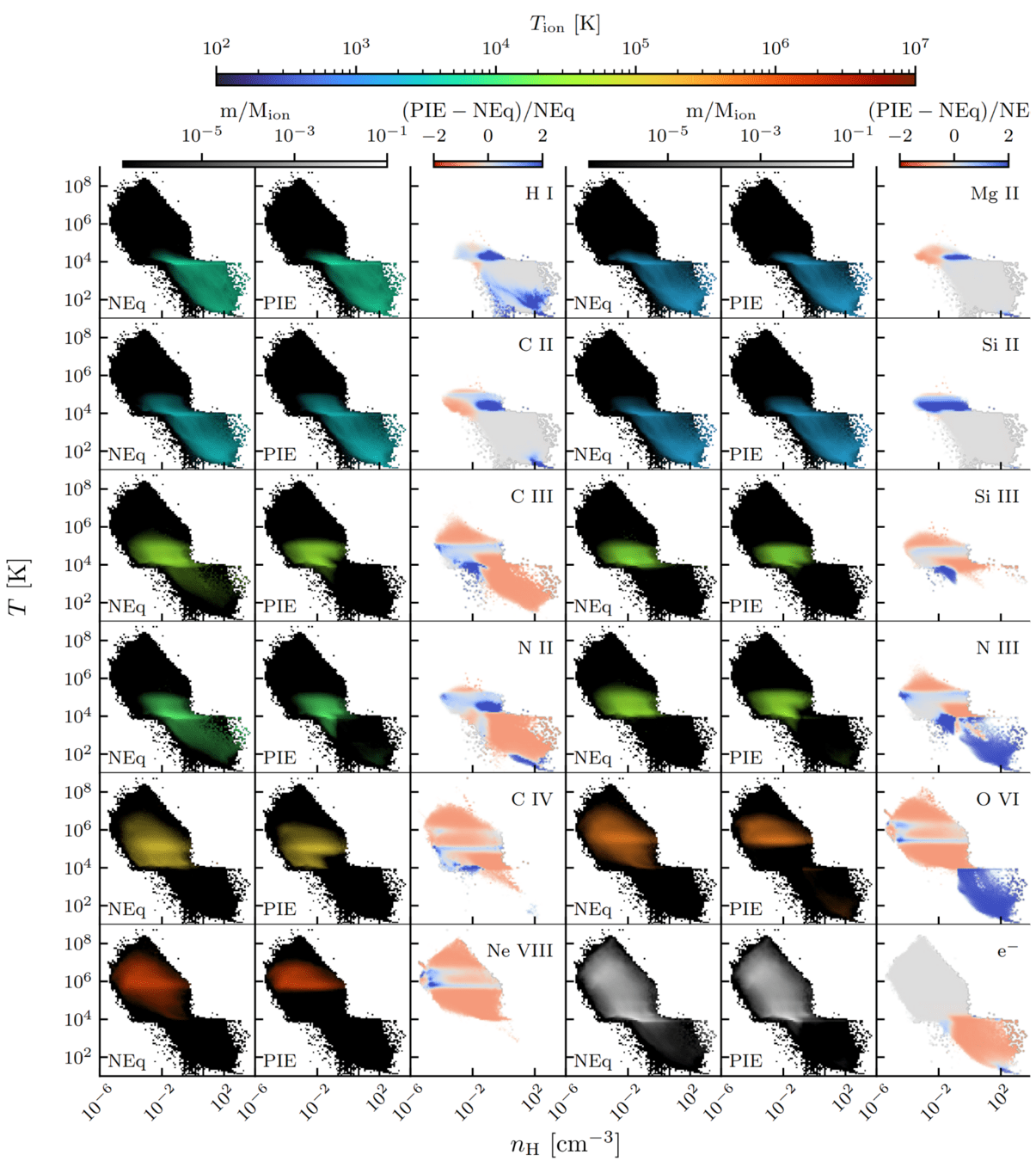
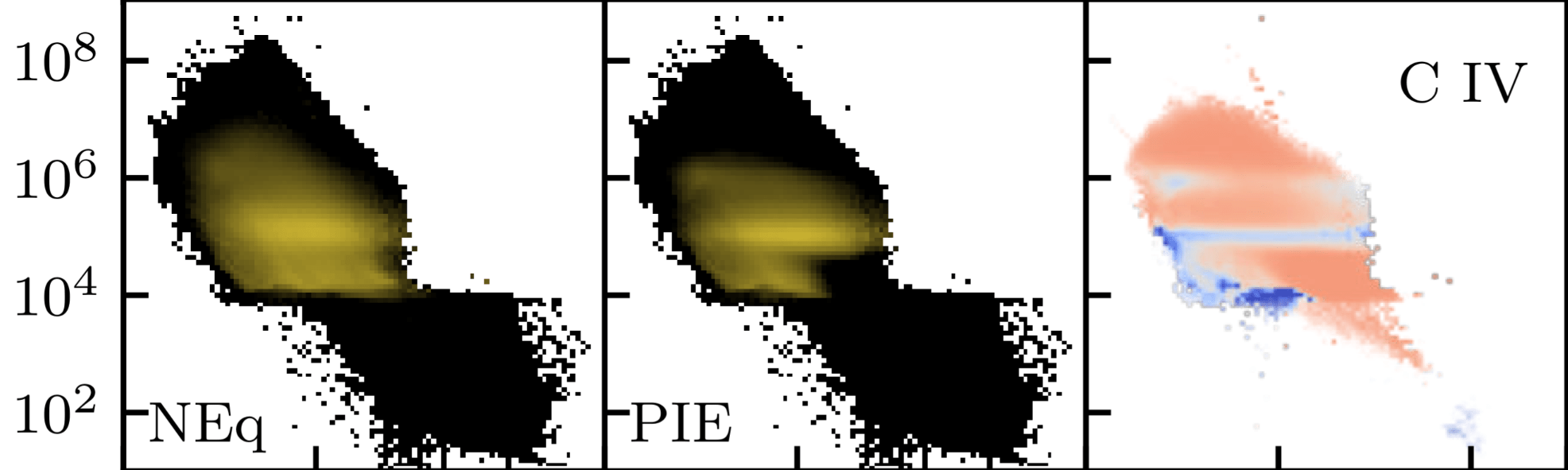
The CGM cosmic web \(\lessapprox 100\,\mathrm{kpc}\): theory
Ly\(\alpha\) is great, but hard to interpret
Other lines are great… but are we getting the right predictions?
H\(\alpha\)
HeII 1640Å
Ly\(\alpha\)
Interim takeaway Predictions and interpretation of CGM observations may not yet be mature.
[CIV] 1548Å
CIII] 1906Å
Connecting the cosmic web through the CGM
The effects of the cosmic web on galaxies at \(>\mathrm{Mpc}\) scales are well established,
but likely massively underestimated.
How these effects reach galaxies is less clear.
Uncertainties remain on small scales:
- Effects of feedback and AGN on the cosmic web
- Survival of cold flows
- Observational predictions
- Separating inflows from outflows
Observing the cosmic web–CGM interface
- VLT/BlueMUSE: \(z\sim 2-4\) (Ly\(\alpha\), CIV)
- ELT/Harmoni: \(z>3\) (Lyα, CIV, HeII, Hβ)
- ALMA: \(z\sim 2-4\) ([CII]158µm)
Corentin Cadiou · cadiou@iap.fr
Context: CC+22a · CC+26 · Faucher-Giguère & Oh 23