Multivariable Functions
Econ 50: Section 1
Today's Agenda
- Introductions
- Practice drawing indifference curves
- Partial derivatives and marginal utilities
- Parameterized curves and solution functions
Drawing Indifference Curves
- Evaluate the utility function at a point
- Set the function equal to that level, and solve for \(x_2\) as a function of \(x_1\)
- Plot!
Drawing Indifference Curves
- Evaluate the utility function at a point
- Set the function equal to that level, and solve for \(x_2\) as a function of \(x_1\)
- Plot!
Utility Function
Utility at (4,3)
u(x_1,x_2) = 4x_1^{1 \over 2}x_2
u(x_1,x_2) = 2x_1 + 4x_2
u(x_1,x_2) = x_1^2 + x_2^2
24
20
25
4 \times 4^{1 \over 2} \times 3 =
2 \times 4 + 4 \times 3 =
4^2 + 3^2 =
Drawing Indifference Curves
- Evaluate the utility function at a point
- Set the function equal to that level, and solve for \(x_2\) as a function of \(x_1\)
- Plot!
Utility Function
Util. at (4,3)
u(x_1,x_2) = 4x_1^{1 \over 2}x_2
u(x_1,x_2) = 2x_1 + 4x_2
u(x_1,x_2) = x_1^2 + x_2^2
Equation of Ind. Curve
24
20
25
4x_1^{1 \over 2}x_2 = 24
2x_1 + 4x_2 = 20
x_1^2 + x_2^2 = 25
✅
Drawing Indifference Curves
- Evaluate the utility function at a point
- Set the function equal to that level, and solve for \(x_2\) as a function of \(x_1\)
- Plot!
Utility Function
u(x_1,x_2) = 4x_1^{1 \over 2}x_2
Indifference Curve Passing through (4,3)
✅
x_2 = {6 \over \sqrt{x_1}}
✅
x_2
x_1
1
4
9
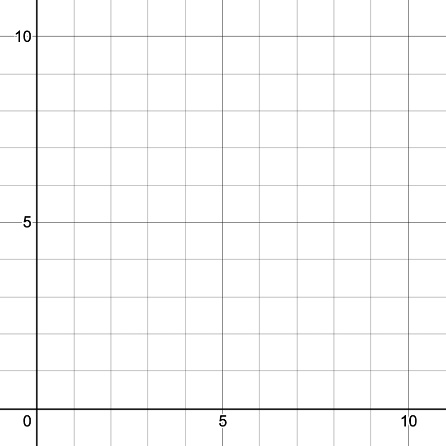
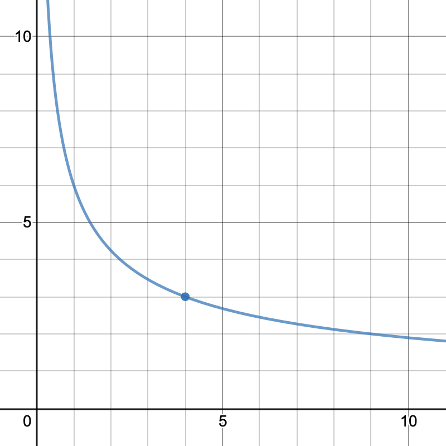
Drawing Indifference Curves
- Evaluate the utility function at a point
- Set the function equal to that level, and solve for \(x_2\) as a function of \(x_1\)
- Plot!
Utility Function
u(x_1,x_2) = 2x_1+4x_2
Indifference Curve Passing through (4,3)
✅
x_2 = 5 - {1 \over 2}x_1
✅
x_2
x_1
0
4
10
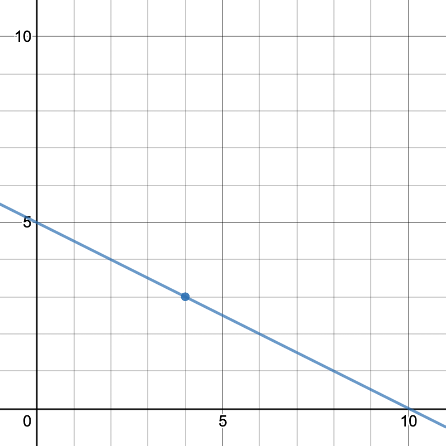
Drawing Indifference Curves
- Evaluate the utility function at a point
- Set the function equal to that level, and solve for \(x_2\) as a function of \(x_1\)
- Plot!
Utility Function
u(x_1,x_2) = x_1^2+x_2^2
Indifference Curve Passing through (4,3)
✅
x_2 = \sqrt{25 - x_1^2}
✅
x_2
x_1
0
4
5
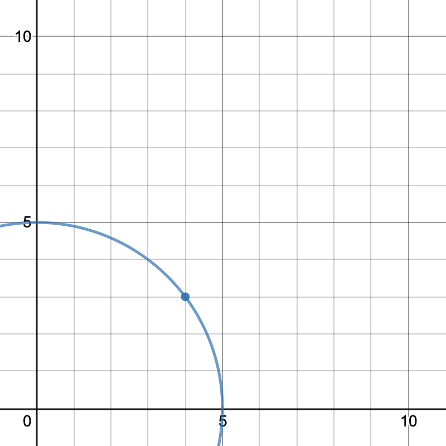
✅
Partial Derivatives
- Derivatives of a multivariable function with respect to one of the variables
- In economic terms, it's the marginal utility from another unit of one of the goods, holding the other good constant
- Mechanically: just treat everything as a constant except for the variable you're taking the partial derivative with respect to
Partial Derivatives and Marginal Utility
Utility Function
u(x_1,x_2) = 4x_1^{1 \over 2}x_2
u(x_1,x_2) = 2x_1 + 4x_2
u(x_1,x_2) = x_1^2 + x_2^2
MU_1 = {\partial u(x_1,x_2) \over \partial x_1}
MU_2 = {\partial u(x_1,x_2) \over \partial x_2}
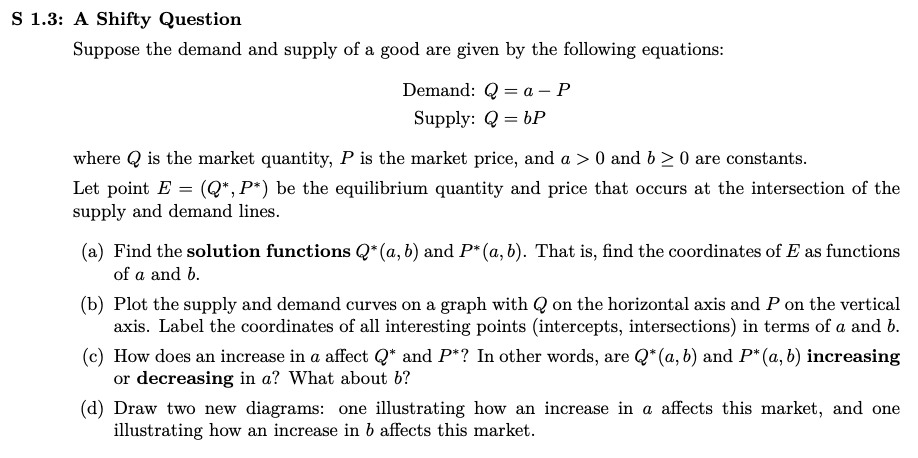
Solution Functions
- Often, curves in economics are parameterized: the constants in them are parameters, and when those parameters change, the curves shift.
- Example: shifts in supply and demand curves, like you saw in Econ 1 or high school
- The equilibrium point is a multivariable function of those underlying parameters
Econ 50 | Section 1
By Chris Makler
Econ 50 | Section 1
Multivariable calculus