Accretion / Dilution Analysis in M&A

Business Scenario
You are working as an M&A Analyst evaluating a hypothetical 100% stock-for-stock acquisition.
Hindustan Unilever Limited (HUL) is considering acquiring Emami Limited.
Your objective is to determine whether the proposed acquisition will be:
-
Accretive – increases HUL's EPS
-
Dilutive – decreases HUL's EPS

Pre-Lab Preparation
For this exercise, use recent NSE market prices and FY2025–26 financial data. The transaction is hypothetical and is intended only for learning purposes.
Baseline Data
| Financial Metric | HUL | Emami |
|---|---|---|
| NSE Share Price* | ₹1,962 | ₹369.05 |
| Shares Outstanding | 235 crore | 43.65 crore |
| FY2025–26 Net Income/PAT | ₹11,020 crore | ₹775.27 crore |
Market prices are based on 3 September 2026 market data. HUL's FY2026 standalone reported PAT was ₹11,020 crore. Emami's FY2026 consolidated profit attributable to equity holders was ₹775.27 crore.
Topic : M&A & Pitch Deck
1) Types of mergers and acquisitions
2) Deal process overview
3) Accretion and dilution basics
4) Role of investment banks in M&A
5) Investment banking pitch deck structure
6) Valuation and transaction slides
Task 1: Calculate EPS Impact Before and After Merger
Before analyzing the acquisition, first calculate the standalone EPS of HUL and Emami.
Standalone EPS means the earnings generated by the company before the acquisition takes place.
HUL – Hindustan Unilever Limited
Use the FY2025–26 EPS reported by HUL.
Before analyzing the acquisition, first calculate the standalone EPS of HUL and Emami.
Standalone EPS means the earnings generated by the company before the acquisition takes place.
HUL – Hindustan Unilever Limited
Use the FY2025–26 EPS reported by HUL.
https://www.hul.co.in/files/annual-report-2025-26.pdf
HUL Standalone EPS = ₹46.90 per share
Emami Limited
Use the FY2025–26 EPS reported by Emami.
Emami Standalone EPS = ₹17.76 per share
https://www.emamiltd.in/wp-content/uploads/2026/07/28235441/emami-ltd-annual-report-fy26.pdf
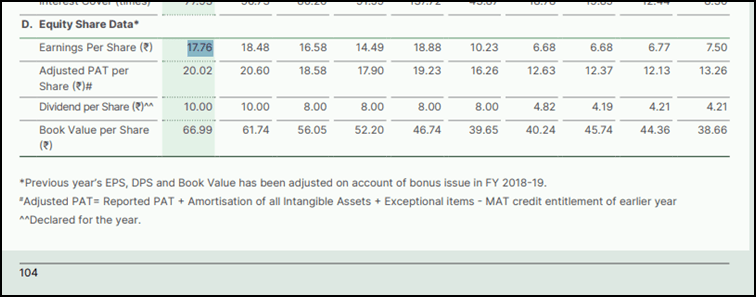
Question
Which company has the higher standalone EPS?
Answer : HUL has the higher standalone EPS.
| Company | FY2025–26 Standalone EPS |
|---|---|
| HUL | ₹46.90 |
| Emami | ₹17.76 |
HUL's standalone EPS of ₹46.90 is significantly higher than Emami's ₹17.76. This means that, on a standalone basis, HUL generated ₹46.90 of earnings attributable to each equity share, compared with ₹17.76 per share for Emami.
The difference is:
₹46.90 − ₹17.76 = ₹29.14 per share.
Interpretation for the M&A Analysis
This comparison provides the starting point for the accretion/dilution analysis. Since HUL is the acquiring company, its existing EPS of ₹46.90 will be compared with the pro-forma EPS after acquiring Emami.
-
If HUL's post-acquisition EPS > ₹46.90, the acquisition is accretive.
-
If HUL's post-acquisition EPS < ₹46.90, the acquisition is dilutive.
-
If HUL's post-acquisition EPS = ₹46.90, the transaction is EPS neutral.
However, the higher standalone EPS of HUL does not by itself mean that HUL is financially stronger or that the acquisition will be successful. EPS is influenced by both the company's earnings and the number of shares outstanding. Other factors such as revenue growth, profitability, valuation, debt, cash flows, purchase price, and the number of new HUL shares issued must also be considered.
Conclusion: HUL has the higher standalone EPS at ₹46.90, compared with Emami's ₹17.76. This establishes HUL's pre-acquisition EPS benchmark of ₹46.90, which will be used in the next step to determine whether the proposed stock acquisition of Emami is accretive or dilutive.
Task 2 : Analyze Accretion/Dilution using NSE Listed Company Data
Assume HUL proposes to acquire 100% of Emami through an all-stock transaction.
HUL offers Emami shareholders a 25% premium over Emami's NSE market price on 3 September 2026.
The transaction is hypothetical, but all financial inputs used in the calculation are based on actual reported FY2025–26 company figures and the market prices available on 3 September 2026.
Calculate Offer Price
1
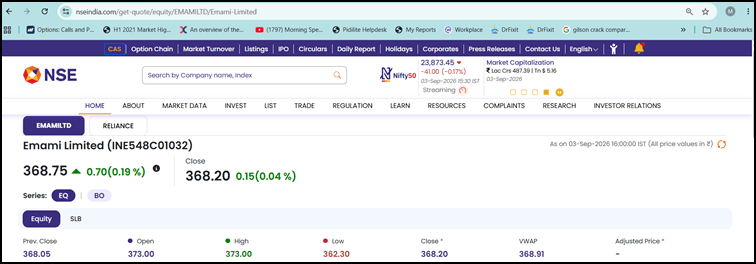
Emami's NSE market price on 3 September 2026 was ₹368.55 per share.
Check on Nse website : https://www.nseindia.com
Offer Price = Emami Market Price × (1 + Premium)
= ₹368.55 × 1.25
= ₹460.69 per Emami share
Therefore, HUL offers approximately ₹460.69 per Emami share
Calculate Purchase Equity Value
2
Emami had 43.65 crore equity shares outstanding at FY2025–26 year-end from annual report.
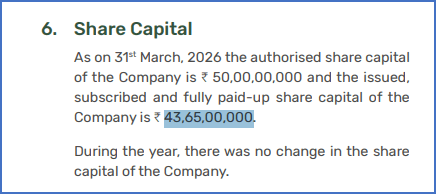
Purchase Equity Value = Offer Price × Emami Shares Outstanding
= ₹460.69 × 43.65 crore
≈ ₹20,109.01 crore
Therefore, the implied equity purchase price for 100% of Emami is approximately ₹20,109 crore.
Calculate New HUL Shares Issued
3
HUL's NSE market price on 3 September 2026 was ₹1,962 per share.
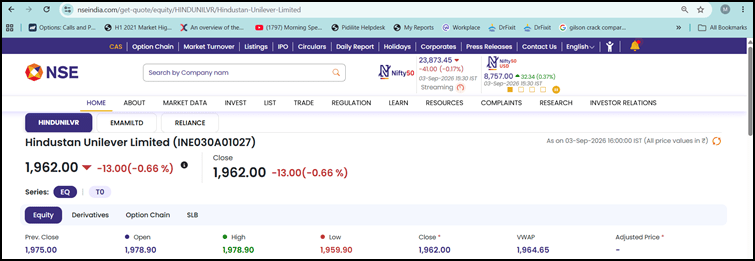
Because the acquisition is entirely stock-funded:
New HUL Shares Issued = Purchase Equity Value ÷ HUL Share Price
= ₹20,109.01 crore ÷ ₹1,962
≈ 10.25 crore shares
Therefore, HUL would issue approximately 10.25 crore new shares to Emami shareholders
Calculate Pro-Forma Net Income
4
For consistency, use the standalone FY2025–26 reported PAT of both companies.
- HUL FY2025–26 standalone PAT = ₹11,020 crore
- Emami FY2025–26 PAT attributable to equity holders = ₹775.27 crore
Assume:
- No synergies
- No restructuring costs
- No transaction fees
- No financing costs
- No tax adjustments arising from the transaction
Pro-Forma Net Income = HUL PAT + Emami PAT
= ₹11,020 crore + ₹775.27 crore
= ₹11,795.27 crore
Calculate Pro-Forma Shares
5
HUL's FY2025–26 standalone results imply approximately 235 crore shares outstanding, consistent with its reported EPS and PAT.
Pro-Forma Shares = Existing HUL Shares + New HUL Shares
= 235.00 crore + 10.25 crore
≈ 245.25 crore shares
Calculate Pro-Forma EPS
6
HUL's reported FY2025–26 standalone EPS was ₹46.90.
After the acquisition:
Pro-Forma EPS = Pro-Forma Net Income ÷ Pro-Forma Shares
= ₹11,795.27 crore ÷ 245.25 crore
≈ ₹48.10
Therefore, the estimated post-acquisition EPS is ₹48.10
Calculate EPS Accretion / Dilution
7
Compare the pro-forma EPS with HUL's actual standalone FY2025–26 EPS of ₹46.90.
EPS Accretion (%) = [(Pro-Forma EPS − Standalone EPS) ÷ Standalone EPS] × 100
= [(₹48.10 − ₹46.90) ÷ ₹46.90] × 100
≈ +2.55%
Therefore, the acquisition is approximately 2.55% EPS accretive.
Final Analyst Verdict
The acquisition is approximately 2.55% EPS accretive.
HUL's EPS increased from approximately ₹46.90 before the acquisition to ₹48.10 after the acquisition under the assumptions of this hypothetical all-stock transaction.
The transaction is accretive because the additional earnings contributed by Emami are greater than the earnings dilution resulting from the issuance of approximately 10.25 crore new HUL shares.
Why is the transaction accretive?
The key factor is the relative valuation of the two companies.
At the market prices used in this exercise:
-
HUL trades at a substantially higher earnings multiple.
-
Emami trades at a lower earnings multiple.
-
HUL therefore uses its relatively highly valued shares to acquire Emami.
-
Even after paying a 25% premium, the earnings generated by Emami are sufficient to produce a higher EPS for the combined company.
However, this is an EPS-based analysis only. A transaction can be EPS accretive and still destroy shareholder value if HUL overpays, if expected synergies fail to materialise, or if the acquisition creates strategic, operational, or integration problems.