Economic Peace Revisited
Dawid Walentek
University of Amsterdam
Introduction
- Democracies do not go to war with one another – democratic peace (Bueno de Mesquita et al., 1999)
- Democracies do not sanction one another – economic peace (Lektzian and Souva, 2003; Cox and Drury, 2006)
- Mixed empirical results on economic peace (Hafner-Burton and Montgomery, 2008; Wallace, 2013)
Literature
- Structural argument for economic peace (Lektzian and Souva, 2003)
- Normative argument for economic peace (Cox and Drury, 2006)
- Public choice argument for economic sanctions (Kaempfer and Lowenberg, 1998)
- Economic peace driven by the US (Hafner-Burton and Montgomery, 2008)
- Economic peace driven by issue salience (Wallace, 2013)
Literature
- Domestic audience benefit for democratic leaders regardless of the sanction outcome (Whang, 2011)
- Democracies are not more resilient targets of economic sanctions (Bapat and Kwon, 2015)
- Democratic leaders not less likely to impose sanctions on major trade partners (Bapat and Kwon, 2015)
- Updated TIES data set (Morgan, Bapat and Kobayashi, 2014)
Puzzle
- Building blocks of economic peace theory at odds with recent empirical research on economic sanctions.
- Inconsistent results on economic peace – subject to data and methodological choices.
- Is there an economic peace?
Hypotheses
-
H1: Democracies are less likely to sanction one another.
-
H2: Democracies are more likely to issue economic sanctions.
-
H3: Democracies are less likely to be a target of economic sanctions.
-
H4: The US is the only democracy less likely to sanction other democracies.
-
H5: Economic peace between democracies depends on issue salience.
Theory testing
- H1 – economic peace
- H1 and H3 – structural economic peace
- H1 and H2 – normative economic peace
-
H2 – public choice theory of economic sanctions
- H4 – economic peace driven by the US
- H5 – economic peace driven by salience
Data
- TIES (Morgan, Bapat and Kobayashi, 2014)
- Polity IV (Marshall, Gurr and Jaggers, 2018)
- Correlates of War (Barbieri, Omar and Omar, 2016)
Variables
- DV: imposition after a threat has been issued.
- IV: democracy score sender, democracy score target and dyad democracy score.
- AUTOC and DEMOC score in Polity IV data
- Democracy score as a continuous variable
- Unconditional main effect and interaction term
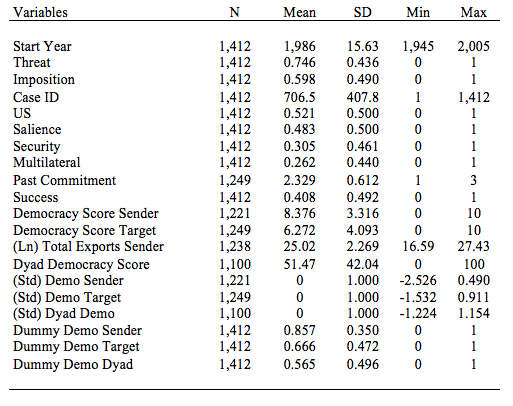
Table I
Summary statistics
Econometric model
- Problems with the rare-event logit
- Threats as counterfactual observations
- Consistency or accuracy
- Model:
Y(Imposition)=β_0+β_1 (std) democracy \,score \,target +β_2 (std) democracy \,score \,sender +β_3 (std) interaction \,term+β_4 Control \,variables+ϵ
Results
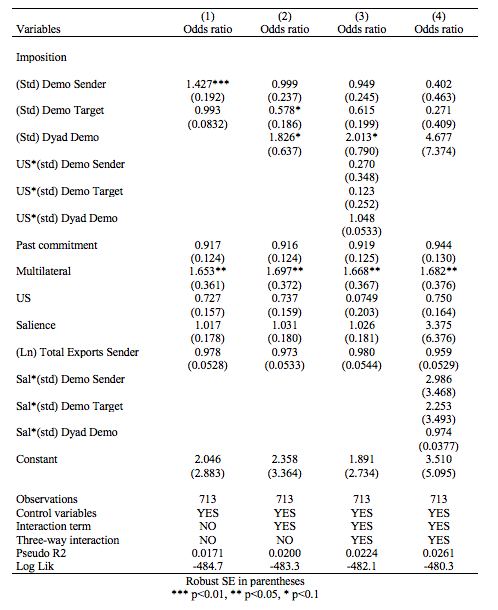
- Democracies more likely to sanction one another (weak)
- Democracies more likely to issue sanctions
- Results consistent with Public Choice approach (Kaempfer and Lowenberg, 1998)
- No economic peace
- No special role of US
- No special role of issue salience
Table II
Democracy and economic sanctions (continuous score, all years)
Robustness
- Replication of Wallace's (2013) study – years 1971 to 2000
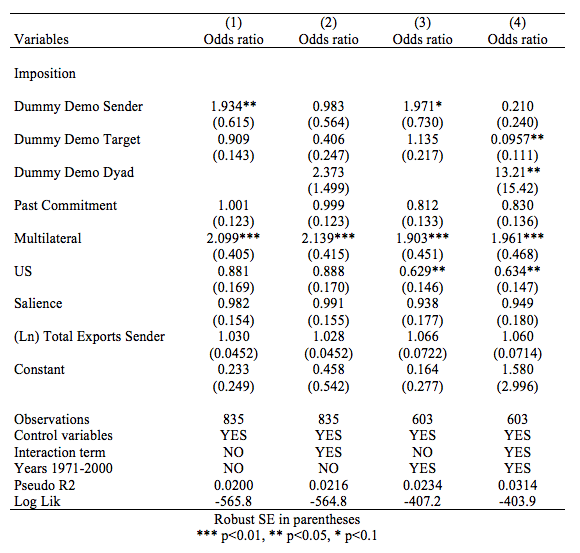
- Replication with dummy democracy score
- Absent threats treated as a failed threat
- All replications largely consistent with the main findings
- Using dummies increases S.E.
Table III
Democracy and economic sanctions (continuous score, years 1971-2000)
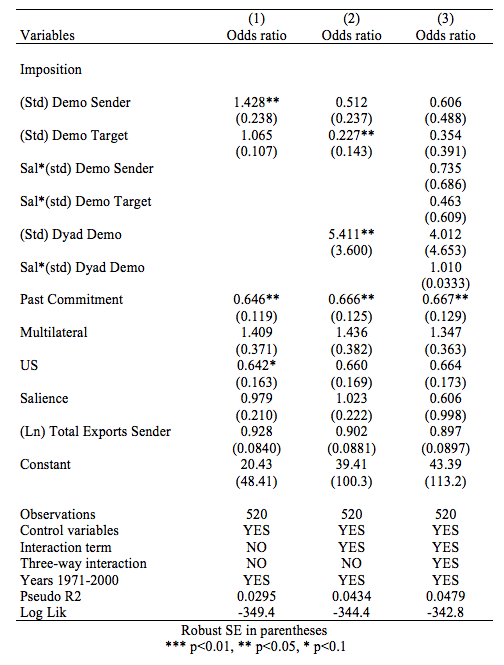
Table IV
Democracy and economic sanctions (dummy score, all years & 1971-2000)
Summary
- Main purpose: behaviour of democracies in respect to economic sanctions
- New TIES data
- New research design
- Support for Public Choice theory
- Absence of economic peace
Discussion
- Rise of economic sanctions popularity, due to rise in democratisation?
- Substitution of military conflict with economic coercion among democracies?
Thank you
Dawid Walentek
d.m.walentek@uva.nl