Ethan Yeh
INFOR 38th — 學術
INFOR38 葉倚誠
建資 37th 社員
概述與字串基礎
字典樹 Trie
KMP Algorithm
有限自動機 Finite Automaton
廣度優先搜尋 BFS
AC 自動機
題
假設我要在一個文本中 找到多個模式字串
若文本長度 N;模式字串個數 M;模式字串總長度 L
暴力匹配時時間複雜度會達到 O(NML)
AC 自動機本質上是建立在 Trie 上的有限自動機
透過 Trie + 失配連結,在多模式字串匹配時
可以做到近似線性的時間複雜度!
假設我們有字串 S,關於字串 S 有以下定義
子字串:S 的某一個部分,S[i...j]表示 S從i到j的這一段
前綴:從字串開始一直到某個字串的某個位置所形成到子字串
後綴:從字串的某個位置一直到字串結尾所形成的子字串
真前綴/真後綴:字串 S 的前/後綴,但不包含字串 S 本身
模式字串匹配:在字串S中檢查是否包含子字串T,T為模式字串
又稱前綴樹 (Prefix Tree)
如字典一樣儲存很多字串
節點儲存字元,並彼此串連
字串間可以共享前綴
支援插入 、尋找(前綴)、統計等操作
(root)
 ├── a
 │   ├── p
 │   │   ├── e (ape)
 │   │   ├── x (apex)
 │   │   └── p ── l ── e (apple)
 ├── b
 │   ├── a ── t
 │   │   ├── c ── h (batch)
 │   │   ├── h (bath)
 │   │   └── (bat)
 ├── c
 │   ├── a ── t
 │   │   ├── c ── h (catch)
 │   │   └── (cat)
 │   ├── o ── w
 │       ├── e ── r (cower)
 │       └── (cow)
By ChatGPT
class Trie {
private:
    struct Node {
        bool isEnd;  // 檢測是否為字串結尾
        unordered_map<char, Node*> children;
        Node() : isEnd(false) {} 初始化 isEnd 為 false

        ~Node() { // 釋放記憶體
            for (auto& child : children) {
                delete child.second;
            }
        }
    };

    Node* root; // 建立根節點

public:
    Trie() : root(new Node()) {} // 初始化根節點

    ~Trie() { // 釋放記憶體
        delete root;
    }
};
void insert(const string& word) {
    Node* cur = root;
    for (const char &c : word) {
        if (cur->children.find(c) == cur->children.end()) {
            cur->children[c] = new Node();
        }
        cur = cur->children[c];
    }
    cur->isEnd = true;
}bool search(const string& word) {
Node* cur = root;
for (const char& c : word) { // 遍歷 word 中的字元
// 不存在字典樹中,回傳 false
if (cur->children.find(c) == cur->children.end()) return false;
cur = cur->children[c];
}
return cur->isEnd; // 檢查是否為字串結尾
}
bool startsWith(const string& prefix) {
Node* cur = root;
for (const char& c : prefix) {
if (cur->children.find(c) == cur->children.end()) return false;
cur = cur->children[c];
}
return true; // 不論是否為字串結尾接回傳 true
}如果我想要在 S = "ababcababa" 中找到模式字串 P = "ababa"
暴力炸開?
| a | b | a | b | c | a | b | a | b | a |
| a | b | a | b | a |
時間複雜度 O(|S|*|P|) 💣
| a | b | a | b | a |
| a |
| a | b | a | b | a |
| a |
| a | b | a | b | a |
| a |
| a | b | a | b | a |
| a |
| a | b | a | b | a |
| a |
可以用配對失敗的資訊,避免不必要的配對
| a | b | a | b | c | a | b | a | b | a |
| a | b | a | b | a |
匹配階段的時間複雜度僅有 O(|S|)!
| a | b | a | b | a |
| a |
| a | b |
| a | b | a | b | a |
| a |
| a | b |
| a | b | a | b | a |
| a |
| a | b |
| a | b |
範例中的模式字串 P = "ababa" 配對之前
可以先對 P 做預處理 (時間複雜度 O(|P|))
取得字串 P[0...j] (1 <= j <= p ) 的最長相等真前綴與真後綴
定義為 前綴函數 ,以 π 表示
舉例來說,有模式字串 P = "ababa"
已經匹配了 "abab",但在 P[4] = 'a' 失配
文本:... a b a b x ...
模式:    a b a b a
                ^ 失配
文本:... a b a b x ...
模式: a b a b a
^ 從這裡繼續匹配 (跳過 π[3] 個位置)文本:... a b a b x ...
模式: a b a b a
又稱為 π 函數 / 失配函數 / Failure Function
代表模式字串最長的相等真前綴與真後綴長度
π[i] = max{j | 0 < j ≤ i, S[0...j-1] = S[i-j+1...i]},π[0] = 0
E.g. 對於字串 "abcabcdabc"
π[0] = 0 π[5] = 3
π[1] = 0 π[6] = 0
π[2] = 0 π[7] = 1
π[3] = 1 π[8] = 0
π[4] = 2 π[9] = 0
#include <bits/stdc++.h>
#define endl '\n'

using namespace std;

vector<int> prefix_function(const string &s) { // π 函數
    const int n = s.size(); // n = 字串長度
    vector<int> pi(n); // 儲存 π 函數
    for (int i = 1; i < n; ++i) {
        for (int j = i; j >= 0; --j) {
        	// 檢查 s[0:k] 與 s[i-j+1:i+1] 是否一致 (相等真前綴/後綴)
            if (s.substr(0, j) == s.substr(i - j + 1, i + 1)) {
                pi[i] = j;
                break; // 找到最長真前綴/後綴後跳出迴圈
            }
        }
    }

    return pi;
}
對於一個長度為 n 的字串
最長真前綴/後綴一定會小於等於 n - 1
所以我們有 π[i] <= i-1;π[i + 1] <= i
⇒ π[i + 1] - π[i] <= 1
也就是說,j 可以改成從 π[i - 1] 開始!
#include <bits/stdc++.h>
#define endl '\n'

using namespace std;

vector<int> prefix_function(const string &s) { // π 函數
    const int n = s.size(); // n = 字串長度
    vector<int> pi(n); // 儲存 π 函數
    for (int i = 1; i < n; ++i) {
        for (int j = pi[i - 1]; j >= 0; --j) { // 讓 j 從 π[i - 1] 開始
        	// 檢查 s[0:k] 與 s[i-j+1:i+1] 是否一致 (相等真前綴/後綴)
            if (s.substr(0, j) == s.substr(i - j + 1, i + 1)) {
                pi[i] = j;
                break; // 找到最長真前綴/後綴後跳出迴圈
            }
        }
    }

    return pi;
}
經過了第一次優化之後
時間複雜度降為 O(n²),但最終目標是 O(n)
考慮用類似動態規劃的想法來解
如果要求 π[i],可以利用已知的 π[i -1]
例如對於字串 S = "ababcab",有 π [3] = 2,要求π [4]
從 π[3] = 2 得知 S[0...3] 有相等真前綴/後綴 "ab"
比較前/後綴的下一個字母 (S[2] = 'a',S[4] = '4')
失配,指針回退至 π[1] = 0,比較 S[0] 及 S[4]
重複直到找到π 函數值或無法再回退 (此時 π 函數 = 0)
| a | b | a | c | a | b | a | b |
| 0 | 0 | 1 | 0 | 1 | 2 |
| a |
| b |
| b |
| a |
| a |
| a |
| b |
| c |
| 3 |
| a |
| b |
| a |
2
3
1
3
| a | b | a | c | a | b | a | b |
| 0 | 0 | 1 | 0 | 1 | 2 |
| a |
| a |
| b |
| b |
| 3 |
| 2 |
#include <bits/stdc++.h>
#define endl '\n'

using namespace std;

vector<int> prefixFunction(const string &s) {
    const int n = s.size();  // 字串的長度
    vector<int> pi(n);       // 儲存前綴函數的陣列,大小為字串長度

    for (int i = 1; i < n; ++i) {
        int j = pi[i - 1];  // 取得前一個位置的前綴函數值
        // 若匹配失敗,則沿著前綴函數回溯到更短的前綴
        while (j > 0 && s[i] != s[j]) {
            j = pi[j - 1];
        }
        // 若匹配成功,將前綴函數值加 1
        if (s[i] == s[j]) {
            ++j;
        }

        pi[i] = j;
    }

    return pi;
}
vector<int> kmp(const string &s, const string &p) {
    const int n = s.size(), m = p.size();
    vector<int> pi = prefixFunction(p); // 計算前綴函數
    vector<int> res;

    for (int i = 0, j = 0; i < n; ++i) {
        // 若匹配失敗,則沿著前綴函數回溯到更短的前綴
        while (j > 0 && s[i] != p[j]) {
            j = pi[j - 1];
        }

        // 若匹配成功,匹配長度加 1
        if (s[i] == p[j]) {
            ++j;
        }

        // 如果匹配長度等於模式字串長度,表示匹配成功
        if (j == m) {
            res.push_back(i - m + 1); // 儲存匹配的位置
            j = pi[j - 1];
        }
    }

    return res;
}int main() {
string s, p;
cin >> s >> p;
vector<int> res = kmp(s, p);
for (const auto &i : res) {
cout << i << "";
}
cout << endl;
return 0;
}ababaababc5代表一個字串集合 (F) 的抽象數學模型
用於判斷輸入字串是否屬於該集合
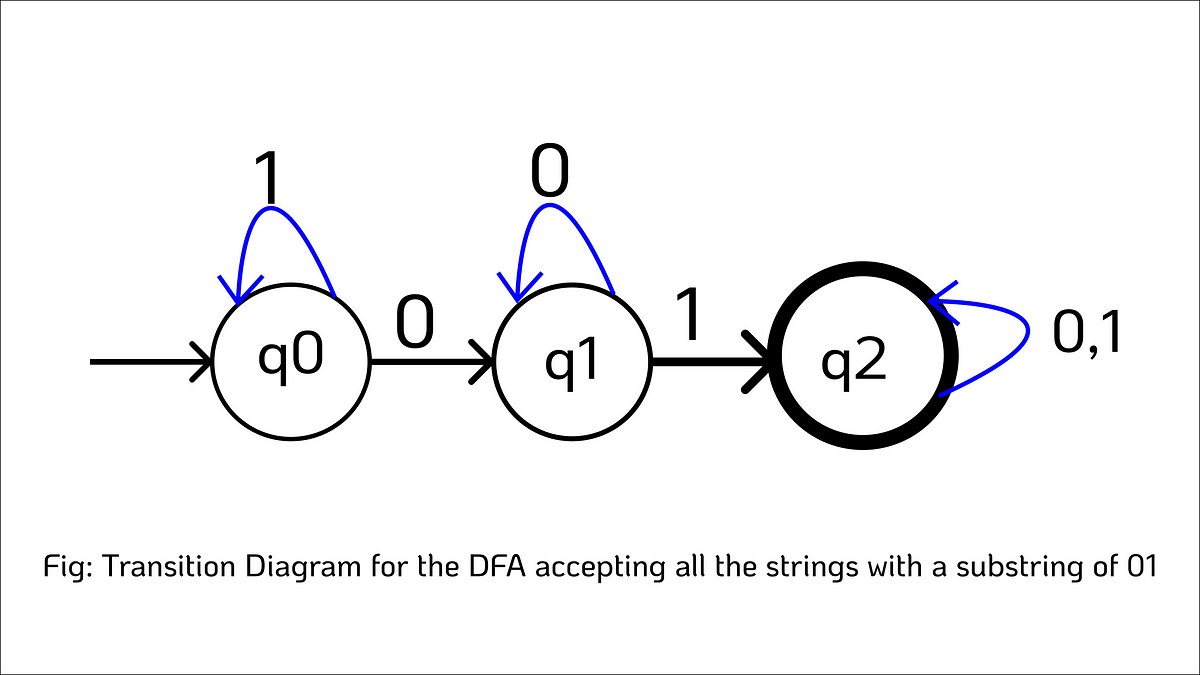
分為 DFA、NFA (確定 / 非確定)
由以下元素組成:
Q = {q0, q1, q2}
∑ = {0, 1}
F = {q2}
僅接受 "01" 的自動機 (DFA)
Trie 也是一種自動機!
(root)
 ├── a
 │   ├── p
 │   │   ├── e (ape)
 │   │   ├── x (apex)
 │   │   └── p ── l ── e (apple)
 ├── b
 │   ├── a ── t
 │   │   ├── c ── h (batch)
 │   │   ├── h (bath)
 │   │   └── (bat)
 ├── c
 │   ├── a ── t
 │   │   ├── c ── h (catch)
 │   │   └── (cat)
 │   ├── o ── w
 │       ├── e ── r (cower)
 │       └── (cow)
| DFA | NFA |
|---|---|
| 確定有限自動機 | 非確定有限自動機 |
| 輸入對轉換為一一對應 | 輸入對轉換可以一對多 |
| 不允許 ε 轉換 | 允許 ε 轉換 |
| n(Q) 通常大於等價 NFA | n(Q) 通常小於等價 DFA |
| O(|S|) | O(|S| * n(Q)) |
| 任何 NFA 皆可轉換為等價 DFA |
| 皆能使用正規表達式 |
Trie + 失配連結 (運用 KMP 邏輯) 所構成的有限自動機 = AC 自動機
將所有模式字串加入 Trie 中
使用 BFS 從 root 開始遍歷,建立失配連結
*建立輸出連結
進行字串匹配
時間複雜度:建立 Trie / 失配連結 + 字串匹配 = O(L + M + N)
M:模式字串總長度;N:文本長度;Z:成功匹配總數
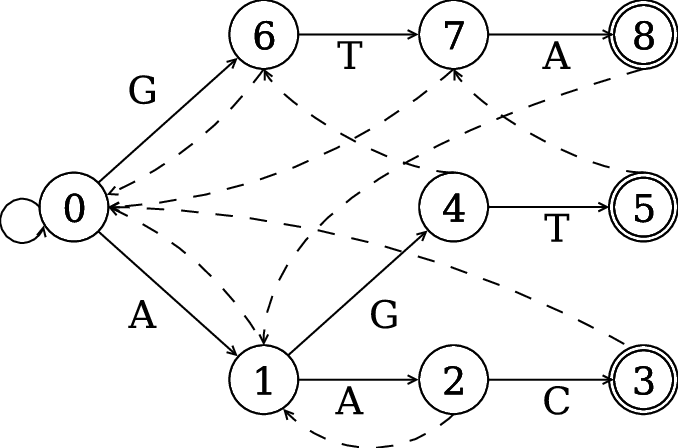
E.g. 若在節點 4 -> 5 失配,因為已經匹配 'G',所以透過失配連結轉移到節點 6 繼續匹配
目標:找尋當前路徑的最長後綴與 Trie 中某個模式字串前綴的匹配位置
使用 BFS:計算節點的失配連結時,需利用其父節點的失配連結
根節點失配連結指向自己
根節點的直接子節點的失配連結指向根節點 (第一個就失配只能回到原點)
void buildFailLinks() {
    queue<Node*> q;

    // 將根節點的子節點的失配連結為根節點
    for (const auto &child : root->children) {
        child.second->fail = root;
        q.push(child.second);
    }

    // 使用 BFS 遍歷所有節點
    while (!q.empty()) {
        Node *cur = q.front();
        q.pop();
        // 為當前節點的每個子節點建立失配連結
        for (const auto &child : cur->children) {
            Node *fail = cur->fail;  // 從當前節點的失配連結開始

            // 找到失配指針指向的節點,若匹配失敗則沿著失配連結走,直到匹配成功或回到根節點
            while (fail != root && fail->children.find(child.first) == fail->children.end()) {
                fail = fail->fail;
            }

            // 若找到匹配的子節點,建立失配連結
            if (fail->children.find(child.first) != fail->children.end()) {
                child.second->fail = fail->children[child.first];
            } else {
                child.second->fail = root;
            }

            q.push(child.second);  // 將子節點加入佇列中
        }
    }
}用一個指針遍歷文本,指針從不回退
將每個遍歷到的字符沿著 Trie 匹配
若遍歷到字串結尾,將對應的模式字串索引值及其出現的位置存入
匹配成功後沿著當前節點的失配連結走,找出所有匹配避免遺漏 (E.g. 若有模式字串 "abc"、"bc",匹配 "abc" 等同於匹配 "bc")
若失配則沿著失配連結繼續嘗試匹配
遍歷文本後匹配結束,達成近似線性時間複雜度
vector<pair<int, int>> search(const string &text) {    vector<pair<int, int>> res;
    Node *cur = root;

    const int SIZE = text.size();
    for (int i = 0; i < SIZE; ++i) {
        const char c = text[i];

        // 若匹配失派,則沿著失配連結走
        while (cur != root && cur->children.find(c) == cur->children.end()) {
            cur = cur->fail;
        }
        if (cur->children.find(c) != cur->children.end()) {
            cur = cur->children[c];  // 若匹配成功,則移動到該子節點
        }

        // 檢查當前節點及其失配連結上的節點是否為接受狀態 (模式字串結尾)
        Node *tmp = cur;
        while (tmp != root) {
            if (tmp->isEnd) {
                res.push_back({i - patterns[tmp->index].size() + 1, tmp->index});
            }
            tmp = tmp->fail;  // 沿著失配連結檢查
        }
    }

    return res;
}當前的字串匹配函數中,每找到一個接受狀態 (模式字串結尾)
我們都需要沿著失配連結走一次,檢查有沒有遺漏的字串
這會讓時間複雜度增加不少
可以考慮加上一個輸出連結,如果找到接受狀態
藉由輸出連結可以直接找到所有匹配到的模式字串
這樣做就能真正達到近似線性的時間複雜度!
#include <bits/stdc++.h>
#define endl '\n'

using namespace std;

class AhoCorasick {
private:
    struct Node {
        unordered_map<char, Node*> children;
        Node* fail;
        bool isEnd;
        int index;
        vector<int> outputs;  // 建立輸出連結

        Node() : fail(nullptr), isEnd(false), index(-1) {}
    };

    Node* root;
    vector<string> patterns;

public:
    AhoCorasick() {
        root = new Node();
    }

    ~AhoCorasick() {
        queue<Node*> q;
        q.push(root);
        while (!q.empty()) {
            Node* cur = q.front();
            q.pop();
            for (const auto& child : cur->children) {
                q.push(child.second);
            }
            delete cur;
        }
    }

    void insert(const string& p) {
        Node* cur = root;
        for (char c : p) {
            if (cur->children.find(c) == cur->children.end()) {
                cur->children[c] = new Node();
            }
            cur = cur->children[c];
        }
        cur->isEnd = true;
        cur->index = patterns.size();
        patterns.push_back(p);
    }

    void buildFailLinks() {
        queue<Node*> q;
        for (const auto& child : root->children) {
            child.second->fail = root;
            q.push(child.second);
        }

        while (!q.empty()) {
            Node* cur = q.front();
            q.pop();
            for (const auto& child : cur->children) {
                Node* fail = cur->fail;
                while (fail != root && fail->children.find(child.first) == fail->children.end()) {
                    fail = fail->fail;
                }
                if (fail->children.find(child.first) != fail->children.end()) {
                    fail = fail->children[child.first];
                }
                child.second->fail = fail;
                q.push(child.second);
            }

            if (cur->isEnd) {  // 如果當前節點為接受狀態,則加入輸出連結
                cur->outputs.push_back(cur->index);
            }

            // 將失配連結的所有輸出都加到自己的輸出連結
            for (int idx : cur->fail->outputs) {
                cur->outputs.push_back(idx);
            }
        }
    }

    vector<pair<int, int>> search(const string& text) {
        vector<pair<int, int>> res;
        Node* cur = root;
        const int SIZE = text.size();

        for (int i = 0; i < SIZE; ++i) {
            const char c = text[i];

            while (cur != root && cur->children.find(c) == cur->children.end()) {
                cur = cur->fail;
            }

            if (cur->children.find(c) != cur->children.end()) {
                cur = cur->children[c];
            }

            // 使用輸出連結直接獲取所有可能的匹配
            for (int index : cur->outputs) {
                res.push_back({i - patterns[index].size() + 1, index});
            }
        }

        return res;
    }
};
可以使用建立完成的 AC 自動機
完成一個簡易的敏感字詞過濾器
輸入文本及敏感字詞
輸出時將敏感字詞轉換為星號
#include <bits/stdc++.h>
#define endl '\n'

using namespace std;

class AhoCorasick {
private:
    struct Node {
        unordered_map<char, Node*> children;
        Node* fail;
        bool isEnd;
        int index;
        vector<int> outputs;

        Node() : fail(nullptr), isEnd(false), index(-1) {}
    };

    Node* root;

public:
    vector<string> patterns;

    AhoCorasick() {
        root = new Node();
    }

    ~AhoCorasick() {
        queue<Node*> q;
        q.push(root);
        while (!q.empty()) {
            Node* cur = q.front();
            q.pop();
            for (const auto& child : cur->children) {
                q.push(child.second);
            }
            delete cur;
        }
    }

    void insert(const string& p) {
        Node* cur = root;
        for (char c : p) {
            if (cur->children.find(c) == cur->children.end()) {
                cur->children[c] = new Node();
            }
            cur = cur->children[c];
        }
        cur->isEnd = true;
        cur->index = patterns.size();
        patterns.push_back(p);
    }

    void buildFailLinks() {
        queue<Node*> q;
        for (const auto& child : root->children) {
            child.second->fail = root;
            q.push(child.second);
        }

        while (!q.empty()) {
            Node* cur = q.front();
            q.pop();
            for (const auto& child : cur->children) {
                Node* fail = cur->fail;
                while (fail != root && fail->children.find(child.first) == fail->children.end()) {
                    fail = fail->fail;
                }
                if (fail->children.find(child.first) != fail->children.end()) {
                    fail = fail->children[child.first];
                }
                child.second->fail = fail;
                q.push(child.second);
            }

            if (cur->isEnd) {
                cur->outputs.push_back(cur->index);
            }

            for (int idx : cur->fail->outputs) {
                cur->outputs.push_back(idx);
            }
        }
    }

    vector<pair<int, int>> search(const string& text) {
        vector<pair<int, int>> res;
        Node* cur = root;
        const int SIZE = text.size();

        for (int i = 0; i < SIZE; ++i) {
            const char c = text[i];

            while (cur != root && cur->children.find(c) == cur->children.end()) {
                cur = cur->fail;
            }

            if (cur->children.find(c) != cur->children.end()) {
                cur = cur->children[c];
            }

            for (int index : cur->outputs) {
                res.push_back({i - patterns[index].size() + 1, index});
            }
        }

        return res;
    }
};

int main() {
    AhoCorasick ac;

    int n;
    cin >> n;
    while (n--) {
        string word;
        cin >> word;
        ac.insert(word);
    }
    ac.buildFailLinks();

    string input;
    cin >> input;
    vector<pair<int, int>> matches = ac.search(input);

    if (matches.empty()) {
        cout << input << endl;
    } else {
        sort(matches.begin(), matches.end(), [](const auto& a, const auto& b) {
            return a.first > b.first;
        });

        for (const auto& match : matches) {
            int start = match.first;
            int index = match.second;
            string patt = ac.patterns[index];
            input.replace(start, patt.size(), string(patt.size(), '*'));
        }
    }
    cout << endl;

    return 0;
}
By Ethan Yeh