\text{Chapter 13}
\text{Chapter 13}
\text{Chapter 13}
\text{Chapter 13}
\text{Dr. Adel Abbout}
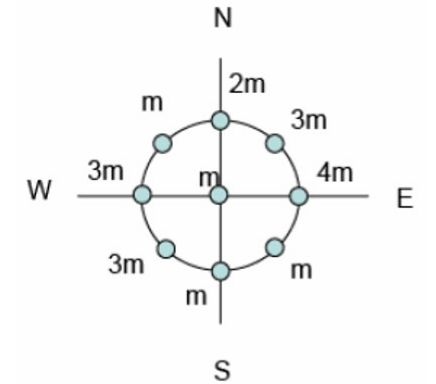
\text{Eight balls of different masses are placed along a circle as shown in Fig. 8 The net force on }
\text{a ninth ball of mass $m$ in the center of the circle is in the direction of:}
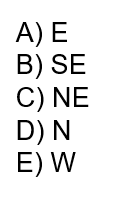
\text{Eight balls of different masses are placed along a circle as shown in Fig. 8 The net force on }
\text{a ninth ball of mass $m$ in the center of the circle is in the direction of:}
\text{Answer C}
\text{Fig. 12 shows five configurations of three particles, two of which have mass $m$ and the}
\text{other one has mass $M$. The configuration with the least (minimum) gravitational force }
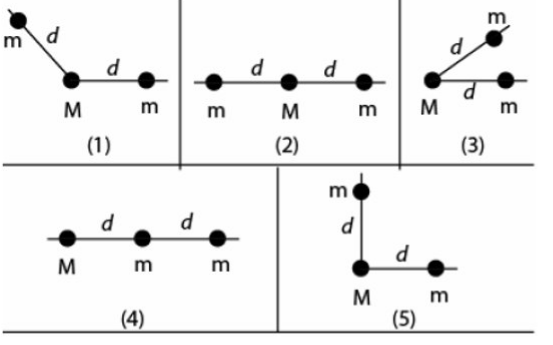
\text{on $\mathrm{M}$, due to the other two particles is:}
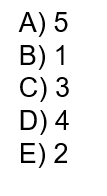
\text{Fig. 12 shows five configurations of three particles, two of which have mass $m$ and the}
\text{other one has mass $M$. The configuration with the least (minimum) gravitational force }
\text{on $\mathrm{M}$, due to the other two particles is:}
\text{Answer E}
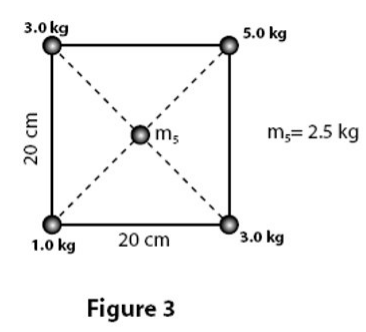
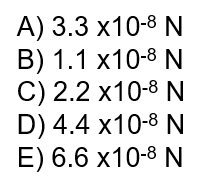
\text{Four point masses are at the corners of a square whose side is $20 \mathrm{~cm}$ long (see Fig 3).}
\text{What is the magnitude of the net gravitational force on a point mass $\mathrm{m}_5=2.5 \mathrm{~kg}$ located}
\text{at the center of the square?}
\text{Answer A}
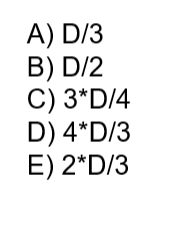
\text{Two particles with masses $M$ and $4^* \mathrm{M}$ are separated by a distance $D$. What is the distance }
\text{from the mass $M$ for which the net gravitational force on a mass $m$ is zero?}
\text{Answer A}
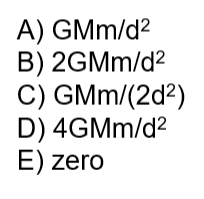
\text{Two uniform concentric spherical shells each of mass $M$ are shown in Fig. 11. The magnitude }
\text{of the gravitational force exerted by the shells on a point particle of mass $m$ located a }
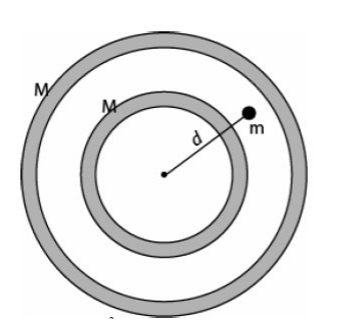
\text{distance $d$ from the center, outside the inner shell and inside the outer shell, is: }
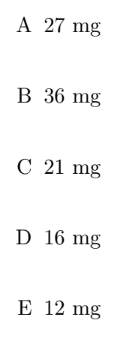
\text{A spherical planet has a uniformly distributed mass $M$ and radius $R$. The gravitational}
\text{force of the planet on a mass $\mathrm{m}$ located at an altitude $2 \mathrm{R}$ above the surface of the planet, }
\text{is $\mathrm{F}=4 \mathrm{mg}$, where $g$ is the Earth's free fall acceleration. What will be the force on the mass $\mathrm{m}$ }
\text{if it is located at a distance $\mathrm{R} / 4$ below the surface of the planet?}
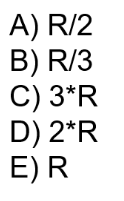
\text{An object is fired vertically upward from the surface of the Earth (Radius $=\mathrm{R})$ with an }
\text{initial speed of (Vesc)/2, where (Vesc = escape speed). Neglecting air resistance, how far }
\text{above the surface of Earth will it reach?}
\text{An object is fired vertically upward from the surface of the Earth (Radius $=\mathrm{R})$ with an }
\text{initial speed of (Vesc)/2, where (Vesc = escape speed). Neglecting air resistance, how far }
\text{above the surface of Earth will it reach?}
\text{Conservation of total energy}
K_i+U_i=K_f+U_f
\displaystyle \frac{1}{2}m v^2-G\frac{Mm}{R}=0-G\frac{Mm}{r}
v=\frac{v_\text{esc}}{2}
\frac{1}{2}m v^2_\text{esc}=G\frac{Mm}{R}
(lecture)
\cdots \textcircled{1}
\textcircled{1} \Rightarrow
\displaystyle \frac{3}{4}G\frac{Mm}{R}=G\frac{Mm}{r}
\Rightarrow
r=\frac{4}{3}R
h=r-R=\frac{R}{3}
\text{Answer B}
\text{Conservation of total energy}
K_i+U_i=K_f+U_f
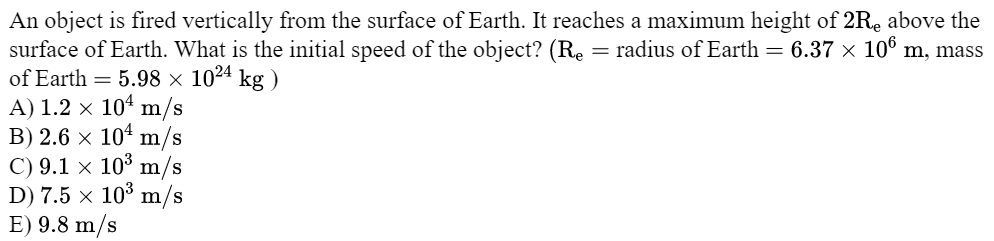
\displaystyle \frac{1}{2}m v^2-G\frac{Mm}{R_e}=0-G\frac{Mm}{\textcolor{red}{3}R_e}
\displaystyle \frac{1}{2}m v^2=2G\frac{Mm}{3R_e}
\displaystyle v=\sqrt{4G\frac{M}{3R_e}}=\sqrt{\frac{4\times6.67\times10^{-11} \times 5.98 \times 10^{24}}{3\times6.37\times10^6}}
\displaystyle v=9.1\times 10^{3} \text{ m/s}
\text{height } h=2R_e\Rightarrow r=3R_e
\text{A planet has two moons of masses $m_1=m$ and $m_2=2 m$ and orbit radii $r_1=$ $r$ and $r_2=2 r$,}
\text{respectively. The ratio of their periods $T_1 / T_2$ is:}
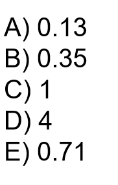
\text{A planet has two moons of masses $m_1=m$ and $m_2=2 m$ and orbit radii $r_1=$ $r$ and $r_2=2 r$,}
\text{respectively. The ratio of their periods $T_1 / T_2$ is:}
\text{We have from Kepler laws:}
\displaystyle \frac{r_1^3}{T_1^2}=\frac{r_2^3}{T_2^2}
\Rightarrow
\displaystyle \frac{T_1}{T_2}=\Big(\frac{r_1^3}{r_2^2}\Big)^{3/2}=2^{-2/3}\approx 0.35
\text{Answer B}