Corentin Cadiou
Framing the Big Picture of Galaxy Star Formation Quenching with JWST & Euclid 2024
Postdoc @ Lund University
Soon “Chargé de recherche” CNRS @ IAP, Paris


Mini-quenching of high-\(z\) \(\gtrsim 10^7\,\mathrm{M}_\odot\) halos & ISM
Side-B: peeking into emission lines
Insights from the MEGATRON* simulation — with H. Katz & M. Rey


*MEGATRON: TransforMing Galaxy Formation by REsolvinG the Non-Equilibrium Chemistry And TheRmOdyNamics of the ISM and CGM
Detailed modelling of the ISM and emission lines to constrain (the interplay between) feedback and star formation

Spectra contain a huge amount of information
SFR
SFH
Katz+23
Spectrum of a \(z=8.5\) galaxy
U
Z
Katz+23
*geometry, equilibrium, ISM properties near stars, element abundances

3. Mock spectra &
images

2. Post-processing*

1. Simulation

From intrinsic…
… to observed


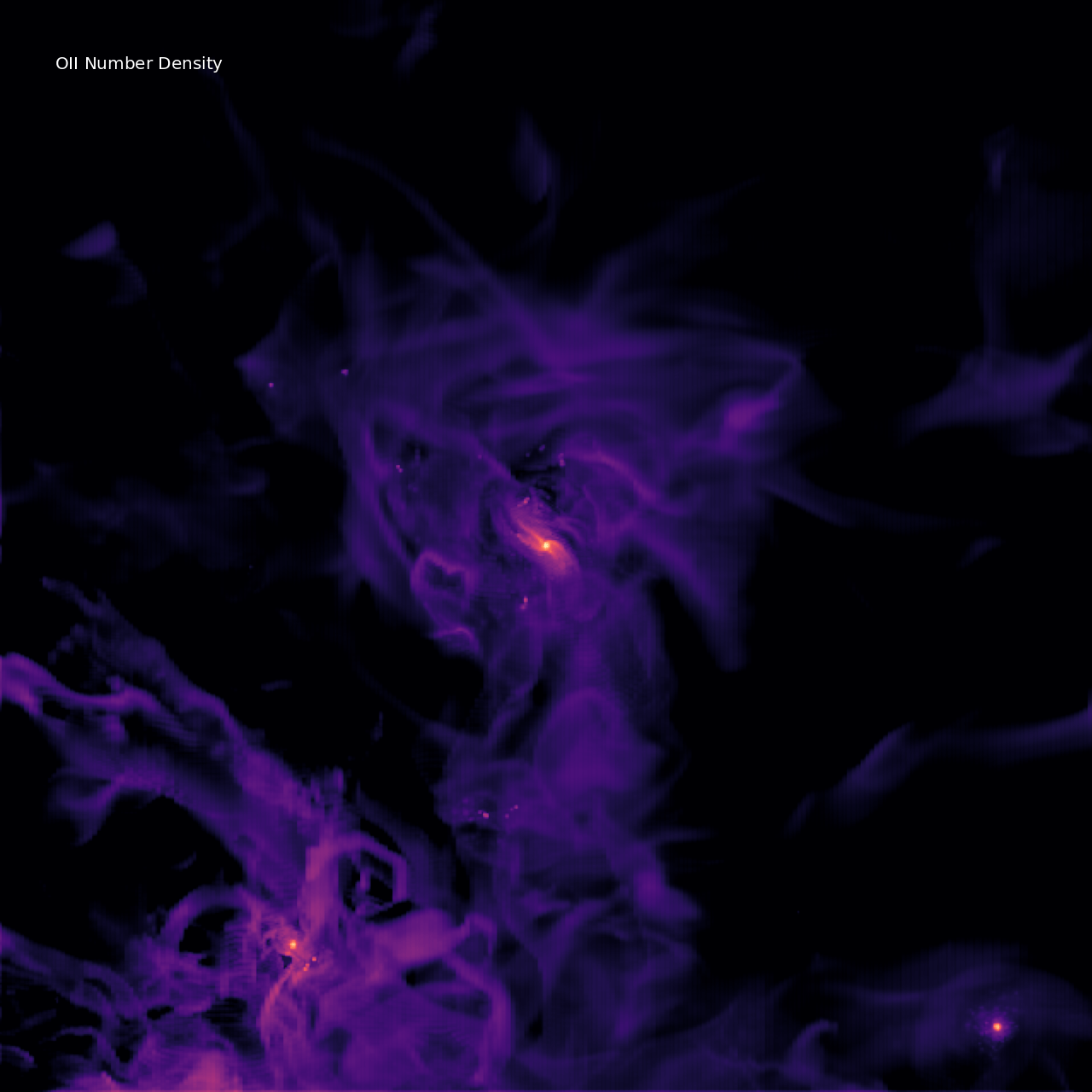


\(\text{O\small{II}}\)
\(\text{O\small{I}}\)
\(\text{N\small{I}}\)
\(\text{Mg\small{II}}\)
\(\text{Ne\small{II}}\)
\(\text{CO}\)
\(\rho\)
\(v_r\)
\(\text{O\small{III}}\)
Megatron model [i]
- Based on RAMSES-RT (Rosdahl+13)
- Out-of-equilibrium chemistry (Katz 23)
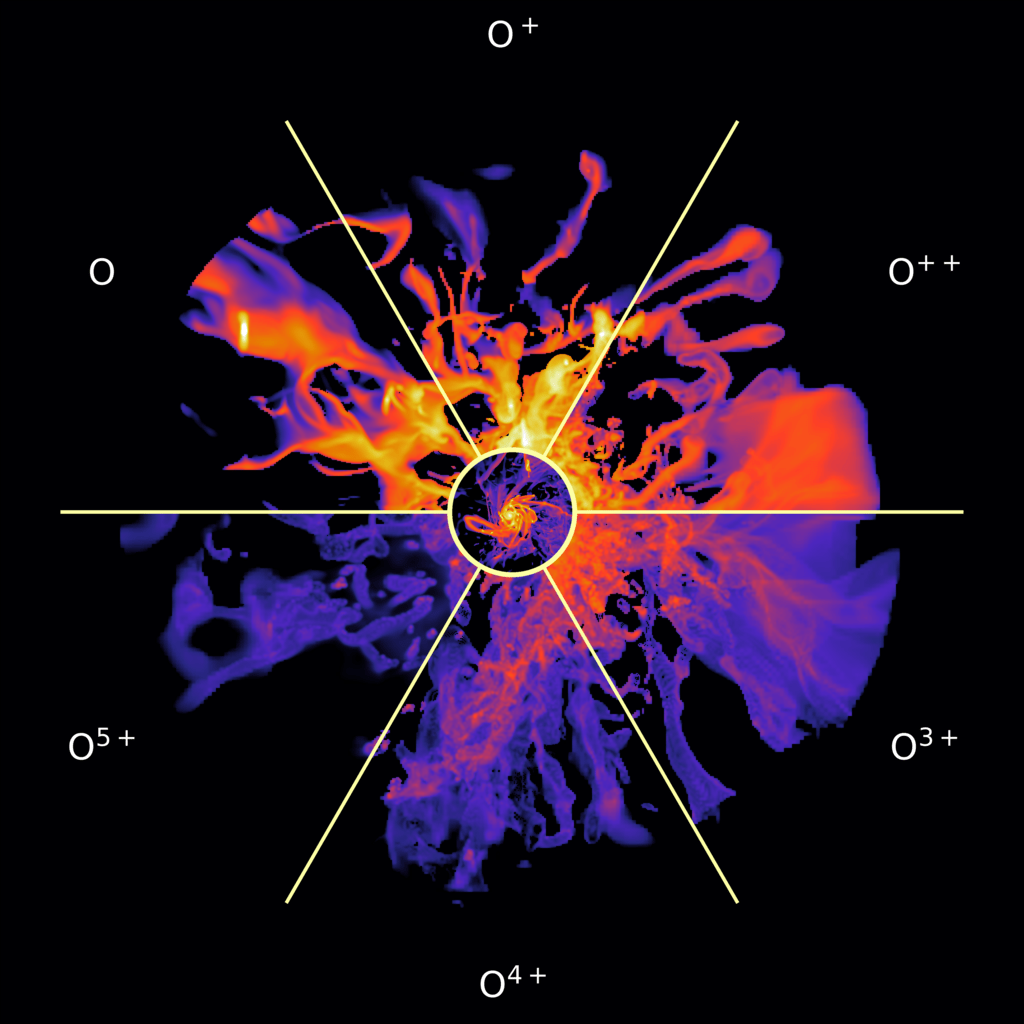
Primordial species: \(\text{H~{\small I}-{\small II}}\), \(\text{He~{\small I}-{\small III}}\), \(e^{-}\)
Metal ions: \(\text{C~{\small I}-{\small VI}}\), \(\text{N~{\small I}-{\small VII}}\), \(\text{O~{\small I}-{\small VIII}}\), \(\text{Ne~{\small I}-{\small X}}\), \(\text{Mg~{\small I}-{\small X}}\), \(\text{Si~{\small I}-{\small XI}}\), \(\text{S~{\small I}-{\small XI}}\) & \(\text{Fe~{\small I}-{\small XI}} \)
Molecules: \(\text{H}_2\) & \(\text{CO}\)
- Dust model (Rémy-Ruyer+14)
Assuming dust-to-gass ratio
- Heating & Cooling out of equilibrium
photoheating, photoelectric heating, excitation/dissociation heating, primordial, dust recombination, dust-gas collisions, metal lines- \(\text{C~{\small I}}\), \(\text{C~{\small II}}\), \(\text{N~{\small II}}\), \(\text{O~{\small I}}\), \(\text{O~{\small III}}\), \(\text{Ne~{\small II}}\), \(\text{Si~{\small I}}\), \(\text{Si~{\small II}}\), \(\text{S~{\small I}}\), \(\text{Fe~{\small I}}\), \(\text{Fe~{\small II}}\) @ \(T<10^4\,\mathrm{K}\)
- CLOUDY tables @ \(T>10^4\,\mathrm{K}\)
Megatron model [ii]
- Turbulence-based star formation (Padoan & Nordlund 11, Agertz+21)
\(\dot{\rho_\star} = \varepsilon_\star\rho/t_\mathrm{ff}\)- if \(Z<10^{-6}Z_\odot\) ⇒ Pop. III
- if \(Z\geq10^{-6}Z_\odot\) ⇒ Pop. I & II, Kroupa
- \(M_\star = 500\,\mathrm{M}_\odot\)
\(M_{\star,\rm III} \sim 100\,\mathrm{M}_\odot\)
- Feedback (Agertz+21; Rey+23)
core-collapse SN, type Ia, winds + HN (Nomoto+06).
- Yields (Limongi & Chieffi 18)
AGB winds (Ritter+18)
Simulated objects
- MW analogue @ \(z=0\)
- Genetically engineered to form earlier
ICs generated withgenetIC
- 2 main runs
- constant physical \(\Delta x_\mathrm{min} \approx 20-40\,\mathrm{pc}\)
-
constant comoving \(\Delta x_\mathrm{min}(z=2) = 20\,\mathrm{pc}\)
\(\Delta x_\mathrm{min}(z=5)=10\,\mathrm{pc}\)
\(\Delta x_\mathrm{min}(z=14)=4\,\mathrm{pc}\)

fiducial:
few JWST targets


early-forming:
many targets
\(z>8\)
Side quest:
if you have an unusual formation history to test, we can simulate it!

(side quest): causal origin of (morphological) quenching
\(M_\star = 10^{11}\,\mathrm{M_\odot}\) @ \(z=2\) galaxy
different ang. mom history (ask me for details!)
Low tides
High tides
\(\mathcal{B}\searrow\)
\(R_\mathrm{eff} \nearrow \)
\(v/\sigma\nearrow\)
See Cadiou+21a, and Cadiou+21b; Storck, CC+24


1. Single-halo setup: massive dwarf
\(M_\mathrm{DM} \approx 10^{8}\,\mathrm{M_\odot}\)
to \(z=6\)


Merger
1. Single-halo setup: massive dwarf
\(M_\mathrm{DM} \approx 10^{9}\,\mathrm{M_\odot}\) at \(z=6\)


Strong feedback
⇒ removes cold gas
⇒ \(\sim100\,\mathrm{Myr}\) mini-quenching
Increasing feedback strength

\(T<500\,\mathrm{K}\)
\(2\times 10^{51}\,\mathrm{erg/SN}\)
\(4\times 10^{51}\,\mathrm{erg/SN}\)
\(5\times 10^{51}\,\mathrm{erg/SN}\)
1. Single-halo setup: varying \(E_\mathrm{SN}\)


With hypernovae
With Ly\(\alpha\) rad. pressure
1. Single-halo setup: varying feedback channels
⇒ Stronger feedback heats up/expells cold gas \(T<500\,\mathrm{K}\)

1. Single-halo setup: signature of FB?
High \(T_\mathrm{e^-}\)
Lower \(T_\mathrm{e^-}\)
⇒ Exciting opportunities to relate
ISM to feedback with NIRSPEC!
1. Single-halo setup: signature of FB?
⇒ Exciting opportunities to relate
ISM to feedback with NIRSPEC!

Varying feedback
Varying star formation recipe
See Nicolas' talk yesterday
2. Quenching of more massive halos?
Focus : halos \(M_\mathrm{DM} = 10^8-10^{10}\,\mathrm{M_\odot}\)
at \(z=10\)


⇒ Mini-quenching
\(M_\star \lesssim 10^8\,\mathrm{M_\odot}\) for \(\sim 50-100\,\mathrm{Myr}\)
iff feedback is strong enough
Increasing mass
Mini-quenching? Napping?
3. Even more massive?
Focus : halos \(M_\mathrm{DM} = 10^{10}-10^{11}\,\mathrm{M_\odot}\) at \(z=6\)


⇒ No SNe quenching in this mass range?


SNe quenching - SPICE simulation (Bhagwat+24)
\(M_\mathrm{DM}=3\times 10^{11}\,\mathrm{M}_\odot\) at \(z=5\)
\(M_\star= 10^{8.5}\,\mathrm{M}_\odot\) at \(z=5\)
Plenty others in bursty/HN channels
3. Massive end : peeking into other sims


AGN quenching - FLARES simulation (Lovell+20)
AGN quenching - THESAN simulation (Kannan+22) (no ISM)
Conclusions
- Low-mass quenching within our uncertainties
Strong SNe (Hypernovæ, top-heavy IMF, Ly\(\alpha\)) ⇒ mini-quenching
- Maybe high-mass quenching w/out AGN is possible
- Different feedback (quenching?) channels ⇒ different line ratios
ISM thermodynamics matter, direct obs.
Open questions
- Observational constraints on FB processes to understand quenching?
- “Easy” to generate mocks → how to make the simulations most useful? How to pin down quenching?
- Can we learn anything from combined IFU data?
Conclusions
- Low-mass quenching within our uncertainties
Strong SNe (Hypernovæ, top-heavy IMF, Ly\(\alpha\)) ⇒ mini-quenching
- Maybe high-mass quenching w/out AGN is possible
- Different feedback (quenching?) channels ⇒ different line ratios
ISM thermodynamics matter, direct obs.
Open questions
- Observational constraints on FB processes to understand quenching?
- “Easy” to generate mocks → how to make the simulations most useful? How to pin down quenching?
- Can we learn anything from combined IFU data?


Katz 22
Detailed modelling of the ISM and emission lines
By Corentin Cadiou
Detailed modelling of the ISM and emission lines
Framing the Big Picture of Galaxy Star Formation Quenching with JWST & Euclid